Beats Are Not Enough: What Four Banks Must Deliver When Earnings Land Tomorrow
Four of Wall Street's largest banks report Tuesday. All beat estimates last quarter, yet two stocks fell. Here is what to watch and what options markets imply.

Key Highlights
- JPMorgan, Goldman Sachs, Wells Fargo and Citigroup report Tuesday, with a combined market value near $1.62 trillion.
- All four beat second-quarter EPS estimates, yet Citigroup and Wells Fargo shares fell the next day.
- Financials rank among the weakest S&P 500 sectors this year, even as the index trades near record highs.
- Options markets imply moves of about 2.5% to 3.5% per stock, or roughly $45 billion in combined market value.
- Net interest income, trading revenue, investment banking fees and credit quality will shape the reaction.
Why Tuesday's Bank Earnings Matter for the Stock Market
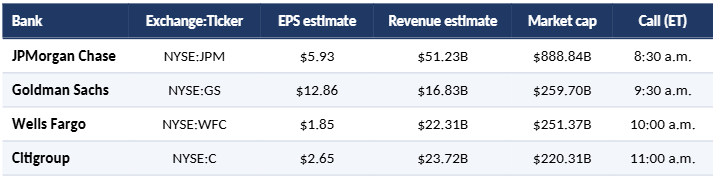
Bank earnings season opens with a concentrated test. Seven of the largest US lenders are due to report this week, and four of them, JPMorgan Chase, Goldman Sachs, Wells Fargo and Citigroup, report on Tuesday before the market opens. Together they carry a market value of about $1.62 trillion.
The backdrop is awkward. The S&P 500 sits near all-time highs, yet financials are the third-weakest sector of 2026 and roughly flat on the year. With investors weighing higher rates against a stretched consumer, the options market is pricing sizeable moves.
The Setup at a Glance
Last Quarter's Report Card: Big Beats, Divergent Reactions
All four banks beat second-quarter EPS estimates in July, some by wide margins. The share-price reaction did not follow the size of the beat.
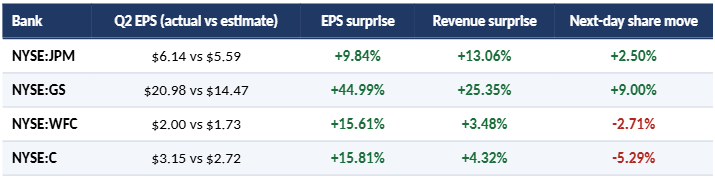
Goldman's 45% beat earned a 9% gain, while the 15.8% beat at Citigroup and the 15.6% beat at Wells Fargo were followed by declines of 5.3% and 2.7%. Guidance, earnings quality and positioning appear to matter more than the headline surprise. A strong quarter for trading, with equities revenue up 86% year on year at both JPMorgan and Goldman Sachs, has also raised the bar for the third.
JPMorgan Chase (NYSE:JPM): A Cleaner Quarter After a Distorted One
Consensus calls for EPS of $5.93 on revenue of $51.23B. Against year-ago figures of $5.07 and $47.1B, that implies growth of about 17% and 9%. The comparison with the second quarter is distorted: revenue of roughly $57B to $58B, depending on the provider, included a $7.9B gain on Visa shares, and reported EPS of $7.70 compares with $6.14 excluding significant items. Expected revenue sits about 11% to 12% below the second quarter, largely because that gain will not recur. Markets revenue, which reached $12.1B, is the line to watch. Management said in September that investment banking fees and Markets revenue should rise in the mid-to-high teens year on year. Guidance for 2026 includes net interest income excluding Markets of about $96.5B, adjusted expenses of about $107.5B and a card net charge-off rate near 3.2%, which management linked to better-than-expected consumer credit. The common equity Tier 1 (CET1) ratio was 14.1%.
Options imply a 2.5% move, slightly above the 2.22% average of the past eight quarters, according to Cboe LiveVol. July's 2.5% gain was the first positive earnings reaction since a 4% jump in April 2025. Shares have fallen 4.7% over the past month, against an average decline of 7.4% for peers.
Goldman Sachs (NYSE:GS): A Record Quarter Sets the Bar
Analysts expect EPS of $12.86 on revenue of $16.83B. The second quarter was a record, with EPS of $20.98, revenue of $20.3B, equities revenue of $7.4B and a deal backlog at its highest in five years. Consensus now implies sequential declines of about 39% in earnings and 17% in revenue, and the expected $4.96B of equities revenue sits a third below that record. Estimates were revised lower over the past 30 days. Goldman has beaten estimates in each of the last seven quarters in the data reviewed.
Trading will dominate. CEO David Solomon said fixed income, currencies and commodities (FICC) activity softened in the third quarter after a strong first half, while equities stayed firm. Analysts expect FICC revenue near $3.72B and investment banking fees near $2.76B, up 3.8%. Management guided non-compensation expenses to rise by more than $500M sequentially. Capital return is also in focus after a 25% dividend increase to $5 per share, a $4B quarterly buyback and a CET1 ratio of 12.9%.
Options imply a 2.84% move, against an eight-quarter average near 2%. Only three of those eight reactions were negative, the latest a 1.87% decline in April despite a 7.4% EPS beat. The 9% rally in July was the largest post-earnings gain since January 2019, which sets a demanding reference point for sentiment.
Wells Fargo (NYSE:WFC): A Name With Something to Prove
Consensus EPS is about $1.85 on revenue near $22.31B, while other estimates put revenue near $22.15B, or about 3.3% growth. The second quarter looked strong on paper: EPS of $1.96 to $2.00, depending on the adjustment basis, against $1.73 expected, and revenue of $22.6B against about $21.9B. Yet the shares fell 2.71% the next day. The stock has reacted poorly to each of its last three reports, including a 5% decline in April that followed a 1.27% EPS miss, and it is down about 10% this year.
Net interest income is expected near $12.63B, up about 5.7%. Management guided 2026 net interest income to about $50B and noninterest expense to about $55.7B, both unchanged in July, and pointed to a third-quarter margin flat to down 1 basis point sequentially. Consensus for net charge-offs is about $986M, and investment banking fees are forecast near $904M, with management expecting investment banking and markets fees to rise by a mid-single-digit percentage.
Options imply a 3.5% move, well below the 5.6% average of the past eight quarters. History suggests the market may be underpricing the potential for a larger reaction, though implied moves do not indicate direction.
Citigroup (NYSE:C): The Year's Best Performer Faces a Test
Citigroup enters the report up 11% this year, the strongest showing among this week's reporting banks. Consensus EPS is about $2.65 to $2.66 on revenue near $23.7B, up about 7%. The second quarter was strong: EPS of $3.15 against $2.72 expected, revenue of $24.8B, a 13% return on tangible equity, markets revenue up 17% and investment banking revenue up 44%. The shares still fell 5.29%. Adjusted EPS beat by 9.7% to 17.3% in each of the last four quarters, although one summary counts the fourth quarter of 2025 as a $0.46 miss, probably a reported-basis figure.
Management guided third-quarter investment banking revenue up low single digits and markets revenue up mid-single digits, a sharp slowdown from the second quarter's pace. Net interest income is forecast near $16.6B, up 11.1%. Investors will focus on net credit losses, delinquencies, reserve building and whether loan growth holds near 6%. The chief financial officer described consumer credit as stable in September and the full-year return on tangible common equity outlook as slightly above 11%. CET1 stood at 12.8%, about 120 basis points above the requirement, and a 12% dividend increase is planned from the third quarter. Citigroup also expects to deconsolidate Banamex in early 2027, which carries a currency translation charge of roughly $9B.
Options imply a 3% move, below the 3.8% eight-quarter average. Caution is warranted, because last quarter's 5.3% decline compared with an implied 3.5%.
FB Financial (NYSE:FBK): A Regional Read on the Calendar
Tennessee-based FB Financial also reports Tuesday. Consensus EPS is $1.21 on revenue of $181.57M, and its market value of $2.65B is about 0.3% of JPMorgan's. Scale differs sharply, but regional lenders can reflect local deposit competition and loan demand more directly. Only calendar estimates were reviewed for this name.
What Options Markets Imply Across the Group
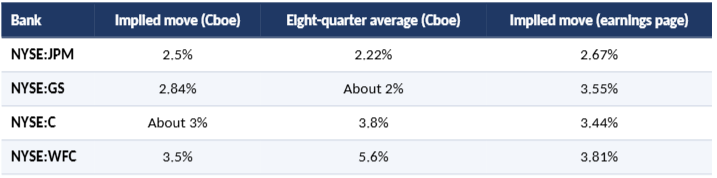
Applying the Cboe implied moves to the calendar market values gives roughly $45 billion of combined swing in absolute terms, or about $50 billion using the earnings-page figures. This is an illustrative calculation, not a forecast, and it says nothing about direction.
Pricing sits above recent history for JPMorgan and Goldman Sachs, and below it for Citigroup and Wells Fargo. That may indicate unusual uncertainty around the two largest capital markets franchises, and less than history would suggest at the two banks with larger recent share-price reactions.
Risks and Counterpoints
The upside case rests on stronger dealmaking, firm equities trading, supportive net interest income and ample capital. The downside case rests on softer FICC revenue, higher reserves, expense growth such as Goldman Sachs' guided increase, flat or narrowing margins and any deterioration in consumer credit, which links directly to the stretched-consumer concern. JPMorgan's guided mid-to-high teens growth in investment banking and Markets revenue compares with low or mid-single digits at Citigroup and Wells Fargo, which leaves it with the highest bar. Consensus can also move before the reports, and last quarter showed that a headline beat does not guarantee a favourable reaction.
The Bottom Line
Tuesday's reports will help show whether bank earnings can narrow the gap between a lagging sector and an index near record highs. Options pricing suggests a meaningful chance of larger-than-usual moves at JPMorgan and Goldman Sachs, and a smaller but real chance of surprises at Citigroup and Wells Fargo. Guidance on margins, capital markets activity and credit will probably matter more than the headline figures.
The Wall Street Wrap: October 12, 2026
Related post