IonQ Elisity Deal in Five Numbers as Shares Trade 9% Down Today
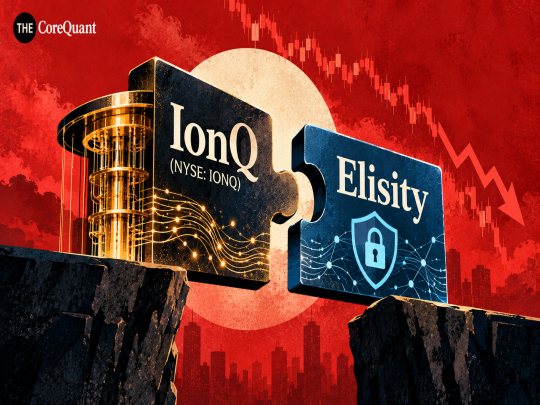
IonQ to acquire Elisity in an all-stock deal worth up to $1.3 billion, with shares down 9% in today’s session. Five key numbers explain the terms, share dilution and risks.

Key Highlights
- IonQ has agreed to acquire Elisity in an all-stock deal valued at up to $1.3 billion.
- Shares are trading at $36.21, down $3.69 or 9.24% from the previous close of $39.89, with the session still under way.
- The price includes up to $150 million that depends on Elisity's performance.
- The collar around IonQ's share price will set how many new shares are issued at closing.
- Completion is expected in the fourth quarter of 2026, subject to regulatory approval.
IonQ, Inc. (NYSE: IONQ) has announced a definitive agreement to acquire Elisity, Inc., a Zero Trust security company. The terms are easiest to understand through five figures, each of which points to a different question about value, dilution and execution. Prices cited here reflect trading while the market remains open and may change before the close.
$1.3 Billion: The Ceiling, Not the Fixed Price
The headline value is "up to" $1.3 billion, paid entirely in IonQ stock. Removing the earnout leaves a base of roughly $1.15 billion. Because payment is in shares rather than cash, the true cost to existing holders depends on IonQ's own stock price when the deal closes, a point that becomes important further down.
$150 Million: The Performance Link
Up to $150 million of the total is an earnout, payable only if Elisity meets performance conditions. Earnouts are a common way to bridge a gap between what a seller expects and what a buyer is willing to pay up front. The specific targets were not disclosed in the announcement, so the likelihood of full payment cannot be judged yet.
23 Million to 35 Million: The Share Count
IonQ will set the number of shares using its 20-day volume weighted average price before closing, limited to a floor of $33.07 and a ceiling of $49.61. Applying the base value to those limits suggests about 23 million to 35 million new shares, roughly 6% to 9% of the shares currently outstanding. These are arithmetic estimates rather than company guidance.
The current price of $36.21 sits near the lower end of the collar. If the averaging price slips toward the floor, more shares would be issued; if it rises, fewer would be. The collar also acts as a boundary: because the price used cannot fall below $33.07, issuance should not rise above roughly 35 million shares, and because it cannot exceed $49.61, issuance should not fall below roughly 23 million.
40%: The Growth Claim Behind the Strategy
IonQ reports 40% year-over-year growth in multiproduct revenue for the second quarter of 2026, which it cites as evidence that customers want several of its products together. Elisity, for its part, says it has doubled revenue and customers each year, with more than 100 deployments and no churn. Both sets of figures come from the companies. The thesis is that Elisity's enterprise relationships could open a new route for IonQ's post-quantum cryptography and quantum key distribution products.
Backing for that view comes from policy. Two executive orders signed on 22 June 2026 call for a research-grade quantum computer by 2028 and stronger protection of government systems, which IonQ says shows the urgency of preparing for quantum-era threats.
9.24%: The Market's First Answer
IonQ shares are trading at $36.21, with a session range of $35.89 to $39.20 after an open of $38.79. Rigetti Computing and D-Wave Quantum are also lower, suggesting some of the move reflects sector sentiment. Analyst commentary has called the strategy a sensible way to reach customers while noting that cybersecurity is among the quantum applications furthest from commercial use.
The stock is also coming off a period of heavy deal activity. IonQ completed the $1.8 billion purchase of SkyWater Technology in July, and it has acquired several quantum firms over the past eighteen months, including Oxford Ionics.
The Counterweights
Every acquisition carries uncertainty, and this one is no exception. Integrating enterprise security software with a quantum hardware business involves different sales cycles and engineering priorities. IonQ has flagged the retention of customers, partners and employees as a risk. Revenue tied to quantum threats depends on when organisations commit budgets to cryptographic migration, and the deal may not close on schedule, or at all, if approvals are delayed.
On the other hand, a recurring software revenue stream and a larger enterprise channel could diversify the company's income if integration goes to plan. The announcement does not provide enough information to estimate the probability of either outcome.
What to Watch
Investors may follow the regulatory approval process, the pricing period that fixes the share count, any detail on Elisity's earnout targets, and IonQ's next quarterly update on multiproduct revenue.
abc
Related post