The Wall Street Wrap: October 12, 2026
US stocks ended little changed on Monday as a chip-led slide in technology offset gains in energy, consumer staples, and communication services, with Meta jumping on a new AI model. Oil climbed after a deadly attack on Riyadh's airport, and big bank earnings begin Tuesday.

Stocks end little changed as chipmakers slide and Meta rallies, oil climbs on a deadly Gulf attack, and big bank earnings loom
Welcome to Wall Street Wrap, your quick end-of-day rundown of what moved US markets today, plus what's shaping global sentiment overnight.
MARKETS TODAY
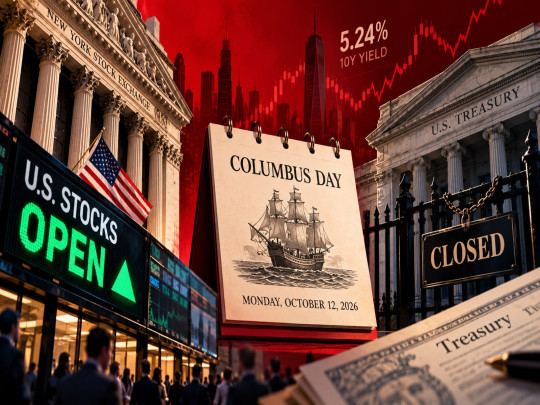
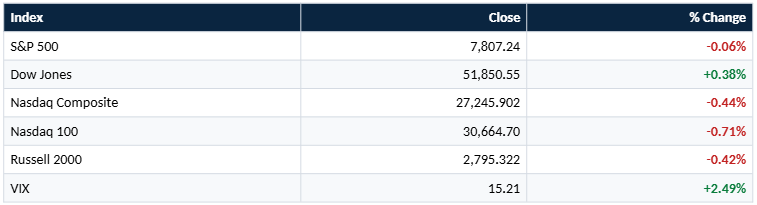
US stocks closed little changed on Monday as a chip-led slide in technology offset gains in energy, consumer staples, and communication services, leaving the major averages mixed. The S&P 500 slipped 0.06% to 7,807.24 and the Nasdaq Composite fell 0.44% to 27,245.902, while the Dow Jones Industrial Average rose 0.38% to 51,850.55, helped by a 2.09% gain in Salesforce after a double upgrade at a major bank. The Nasdaq 100 dropped 0.71% to 30,664.70, the Russell 2000 lost 0.42% to 2,795.322, and the VIX rose 2.49% to 15.21. Micron fell 3.9% as investors weighed rising competition from China's CXMT, while Meta jumped 3.38% after launching a new AI model. West Texas Intermediate crude settled at $93.74 and Brent at $106.65, both higher after a deadly Houthi attack on Riyadh's airport and doubts over a Russia-Ukraine energy ceasefire, and the bond market was closed for Columbus Day. Energy, consumer staples, and communication services led the sectors, while information technology and consumer discretionary fell the most.
ANALYTICAL VIEW
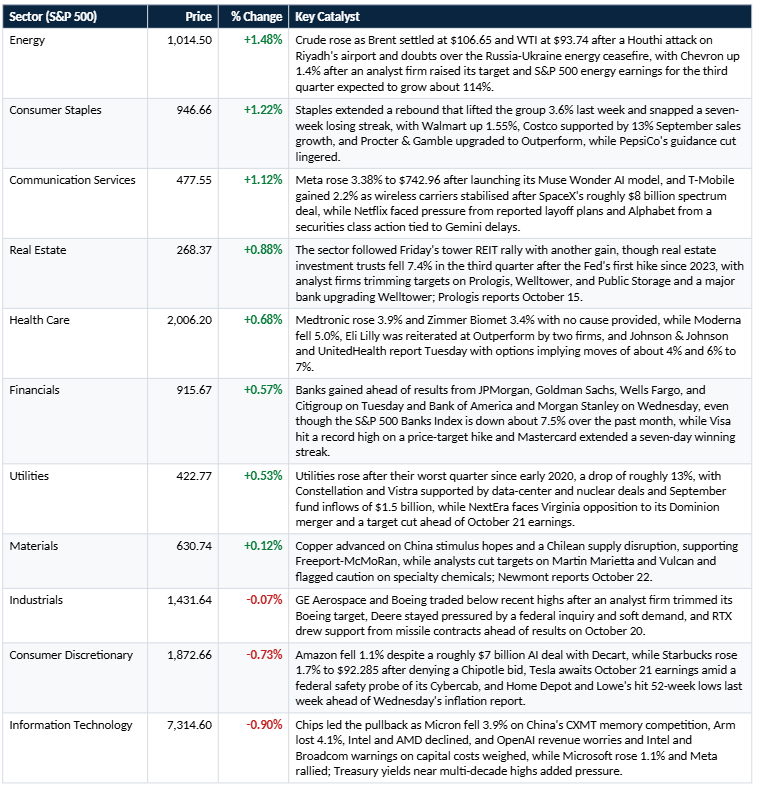
The calm headline numbers hid a clear rotation. Eight of the 11 S&P 500 sectors rose, but information technology fell 0.90% as chipmakers and hardware names sold off, with Micron down 3.9%, Arm 4.1%, CrowdStrike 4.4%, SanDisk 6.0%, and Nvidia 1.3%, while optical and networking names such as Ciena, Lumentum, and Coherent dropped between 7.9% and 10.0%. Microsoft rose 1.1%, Apple 1.3%, and Meta 3.4%, which cushioned the sector's losses, but the Nasdaq 100 still finished as the weakest major index. Money moved toward energy, up 1.48% on higher crude, consumer staples, up 1.22%, and communication services, up 1.12%, as investors leaned on defensive and commodity-linked areas.
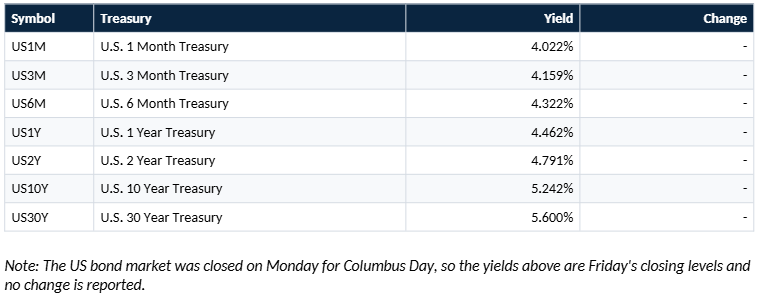
Rates and earnings set the tone beneath the surface. The bond market was closed, so the 10-year Treasury yield stayed at Friday's 5.242%, near multi-decade highs, and after a voting Fed official said a restrictive policy stance is appropriate, CME FedWatch showed more than a 78% chance the Fed holds this month and nearly an 88% chance of a hike in December. Consumer and producer price data are due Wednesday and Thursday, and third-quarter S&P 500 earnings are expected to grow 29.6%, the fourth straight quarter above 25%, as the S&P 500 marks four years since its October 2022 low, from which it has more than doubled. One chief investment officer said the market will trade mostly on earnings and that even a hot inflation print is unlikely to derail the Fed.
What could change the picture: Whether the Gulf escalation and a shaky Russia-Ukraine energy ceasefire keep Brent above $106, and whether Tuesday's bank earnings and Wednesday's inflation report confirm a Fed that is leaning toward another rate hike.
SECTOR PERFORMANCE
WINNERS & LOSERS
Top 5 Gainers (across S&P, Nasdaq, Dow):
- Fair Isaac Corporation (NYSE:FICO): +10.848%
- Shopify Inc. (NASDAQ:SHOP): +4.899%
- Medtronic plc (NYSE:MDT): +3.899%
- Vylor Inc. (NYSE:VYLR): +3.746%
- Zimmer Biomet Holdings, Inc. (NYSE:ZBH): +3.399%
Top 5 Decliners:
- Ciena Corporation (NYSE:CIEN): -9.952%
- Lumentum Holdings Inc. (NASDAQ:LITE): -9.783%
- Coherent Corp. (NYSE:COHR): -7.869%
- Carvana Co. (NYSE:CVNA): -6.622%
- Bloom Energy Corporation (NYSE:BE): -6.496%
AFTER-HOURS MOVERS
Gainers:
- FormFactor, Inc. (NASDAQ:FORM), +4.01% after hours: Shares rose to $135.50 after Teradyne announced a collaboration and a $300 million strategic equity investment in the chip-testing equipment maker. FormFactor had closed 6.72% lower at $130.28, and Teradyne closed 4.68% lower.
- Nurix Therapeutics, Inc. (NASDAQ:NRIX), +1.53% after hours: Shares rose to $22.50 after fiscal third-quarter net income of $4.73 per diluted share, against a loss of $1.03 a year earlier and a loss of $0.60 expected by analysts, driven by $653.2 million of license revenue from its Roche collaboration. Cash and securities stood at $1.1 billion after Roche's $700 million upfront payment, which the company said funds operations into the second half of 2029, and the first patient has been dosed in its Phase 3 trial in chronic lymphocytic leukemia. The stock had closed 0.85% lower at $22.16.
Decliners:
- Syndax Pharmaceuticals, Inc. (NASDAQ:SNDX), -15.41% after hours: Shares fell to $14.00 after the Phase 2 MAXPIRe trial of axatilimab in idiopathic pulmonary fibrosis missed its primary endpoint, the annualized rate of decline in forced vital capacity. The company will not pursue the indication, said the safety profile matched earlier studies, and said its chronic graft-versus-host disease trials are unaffected. The stock had closed 2.59% lower at $16.55.
COMMODITIES & RATES
US TREASURY YIELDS
TOP STORIES: US
Chipmakers lead a tech pullback as Micron slides on Chinese memory competition, and the Intel and Broadcom chiefs warn that capital could be AI's biggest constraint. Micron fell 3.9% as investors assessed China's CXMT, which reported progress on a new chip structure, and the selloff spread across semiconductors, with Arm down 4.1%, SanDisk 6.0%, and Nvidia 1.3%, and the Nasdaq 100 dropped 0.71%. At a conference in Singapore, Broadcom CEO Hock Tan said "the biggest constraint is capital," ranking it above shortages of chips, memory, or electricity, while Intel CEO Lip-Bu Tan also pointed to the rising cost of capital and the need for companies to show returns on their AI spending. Both still described demand for computing infrastructure as outrunning supply, and Hock Tan said wafer shortages could ease by 2028 or 2029.
IonQ to buy cybersecurity firm Elisity for up to $1.3 billion, and its shares fall. IonQ agreed to acquire Elisity in an all-stock deal worth up to $1.3 billion, including up to $150 million in performance-based earnouts, with closing expected in the fourth quarter subject to regulatory approval. The company said the purchase is meant to defend against attackers targeting generative AI models and AI agents and to protect against emerging quantum threats, and Elisity will keep its current leadership. IonQ shares fell about 9% in afternoon trading, and fellow quantum names Rigetti Computing and D-Wave Quantum also traded lower. The deal follows IonQ’s $1.8 billion purchase of SkyWater Technology in July and a string of earlier quantum acquisitions, and its chief executive said of the quantum threat to encryption that “Frankly, people are not ready.”
Big banks report this week, and options markets are pricing moves of 2.5% to 3.5%. JPMorgan, Goldman Sachs, Citigroup, and Wells Fargo report Tuesday, followed by Bank of America, Morgan Stanley, and BlackRock on Wednesday, with implied moves of 2.5% for JPMorgan, 2.84% for Goldman Sachs, 3% for Citigroup, 3.5% for Wells Fargo, 2.9% for Bank of America, 3% for Morgan Stanley, and 3.3% for BlackRock. Financials are the third-worst performing S&P 500 sector in 2026 and are flat on the year, with Citigroup up 11%, the best of this week's reporters, and Wells Fargo down 10%. The reports arrive as third-quarter S&P 500 earnings are expected to rise 29.6%, and one bank strategist said investors worry that actual results may underwhelm even though earnings should support the market.
Meta launches its Muse Wonder AI model as it tests whether users will pay. Meta said Muse Wonder is the most advanced option for powering digital assistants, and access through the Muse app requires a monthly subscription of $20 or $100, while a more powerful Muse Wonder Full variant is limited to developers on a $50 or $200 monthly plan for the Muse Code agent. Meta's AI chief said the model was trained to try other approaches after setbacks instead of stalling on tasks, and that developer access through its API will cost more than standard subscriptions but remain "meaningfully below" leading models from OpenAI and Anthropic. The launch underscores Meta's push for AI revenue beyond advertising, and the shares rose 3.38% to $742.96 even as some users have complained that the Muse agent accessed personal messages without authorization, which the company disputes.
Microsoft says it will rely mainly on its own Maia chips, reducing its dependence on Nvidia. Starting with the third-generation Maia 300, which enters production in 2027, Microsoft said it will mainly use its own silicon to handle incoming AI requests and is targeting multi-gigawatt deployments. The company expects to pack 96 chips into each data center rack, double the Maia 200, and says the chip can run up to seven times more AI tokens per rack and 40% more tokens per megawatt than GPUs. A research firm estimates Maia will account for about 10% of Microsoft's AI chip spending by the first quarter of 2027, though Nvidia remains central to model training and one industry analyst noted that "Nobody has tested them outside of Microsoft yet." Microsoft shares rose 1.14% to $541.15, while Nvidia fell 1.29%.
Starbucks says it is not buying Chipotle after takeover speculation. A Starbucks spokesperson said "Starbucks is not buying Chipotle," following a Financial Times report on Thursday that Starbucks had worked with advisers on a takeover proposal in recent months, and Semafor's earlier report that Chipotle had hired advisers to defend against activist investors or an unwanted bid. Chipotle fell nearly 4% in morning trading after the denial, while Starbucks rose 1.69% to $92.285, as some Starbucks shareholders had worried about an expensive distraction during its own turnaround. Chipotle shares are down about 20% over the past year.
Also today: Salesforce rose 2.09% to lead the Dow after a double upgrade at a major bank; about 1.2 million barrels per day of Gulf of Mexico oil output remained shut in as of Sunday because of Hurricane Isaias, according to the federal offshore safety regulator; and the Nobel memorial prize in economics went to Robert E. Hall and Michael Woodford for work on the microeconomic foundations of macroeconomic stability that underpins models used by central banks and governments.
TOP STORIES: GLOBAL
Trump defends his Russian diesel waiver as the Ukraine energy ceasefire comes under strain. Trump used Truth Social to defend the six-month easing of restrictions on Russian diesel, which he said would bring more than 4 million tons to the US and global markets, after seven senators, including four Republicans, said Washington should not give Putin a financial lifeline. Hours after Trump announced an energy ceasefire on Sunday, Ukrainian President Volodymyr Zelenskyy said Russia had attacked six Ukrainian energy facilities, including a Naftogaz gas production site in Kharkiv, while the Kremlin said contacts on the ceasefire are ongoing. The European Union, meanwhile, is adopting nearly 1,600 new sanctions listings, its largest single expansion since the war began, and its top diplomat said this is not the time to ease pressure on Russia.
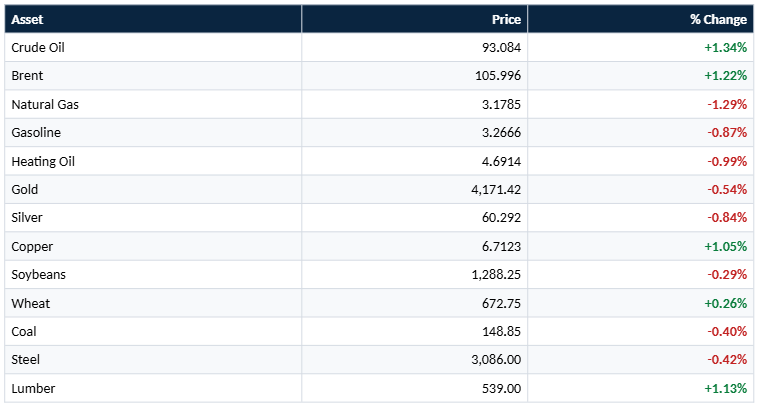
The Gulf escalates as Houthi attacks close Riyadh's airport and Trump weighs joining Saudi Arabia. A Houthi strike on a passenger terminal at King Khalid International Airport on Saturday killed 12 people and wounded more than 300, and the airport remained closed Monday after more than 2,000 flight cancellations since Thursday. Delta delayed the launch of its Atlanta to Riyadh service, planned for October 23, until March, and the Federal Aviation Administration warned US airlines to exercise caution around Saudi Arabia until December 10. Brent settled at $106.65, up 1.84%, and West Texas Intermediate at $93.74, up 2.06%, as Trump told reporters he was considering joining Saudi Arabia in its fight against the Houthis.
China's weakness hits LVMH and Volkswagen. LVMH said third-quarter organic sales rose 1% to 18.5 billion euros, short of the 1.3% growth expected, with fashion and leather goods down 5% against an expected 1.8% decline, Asia down 5%, and the US up 5%, while growth in watches and jewellery slowed to 6% from 9% and its US-listed shares fell more than 3%. Its finance chief blamed a sharp deterioration in Chinese consumer sentiment, which also weighed on Volkswagen, whose global deliveries fell 14.3% to 1.89 million vehicles in the quarter, the steepest drop in more than four years, with deliveries in China down 38.5%.
Asia-Pacific markets close mostly lower as South Korea tumbles. South Korea's Kospi fell 3.65% to 6,384.24 and the Kosdaq dropped 4.83% to 849.19, with no cause provided, while mainland China's CSI 300 lost 0.68% to 4,287.98 and Hong Kong's Hang Seng was marginally higher in its last hour of trade. Australia's S&P/ASX 200 gained 0.76% to 8,783.20, and Japan's markets were closed for a holiday.
MANAGEMENT & FED SPEAK
Beth Hammack, President, Federal Reserve Bank of Cleveland, on monetary policy:
Hammack, a voting member of the Fed's policymaking committee, told an economists' conference that "a restrictive monetary policy stance is appropriate" to ensure a timely return to 2% inflation, and said smaller adjustments made quickly are preferable to waiting and risking a larger correction. She warned that persistently elevated inflation raises the risk of "an inflationary mindset becoming entrenched in the economy" and said it will take "some time" to bring annual price growth back to target.
Hock Tan, Chief Executive, Broadcom, on AI demand and supply:
Tan said "There is more demand for compute infrastructure than we can supply," adding that the imbalance could persist through 2029 and potentially into 2030, and that "Memory shortage today might not be that way a year from now."
Lip-Bu Tan, Chief Executive, Intel, on the financing of AI:
Tan said the main challenge in the near term is "capital and the cost of capital," and that over the longer run "people want to see the ROI," while adding that he does not expect a significant slowdown in AI demand over the next two to three years.
Donald Trump, President, United States, on the Russian diesel deal and the energy ceasefire:
Trump wrote on Truth Social that "I made the right choice for the American People" in easing restrictions on Russian diesel, a day after announcing that "Effective immediately, there is an ENERGY CEASEFIRE in the War between Russia and Ukraine."
CORPORATE ACTIONS & EARNINGS CALENDAR
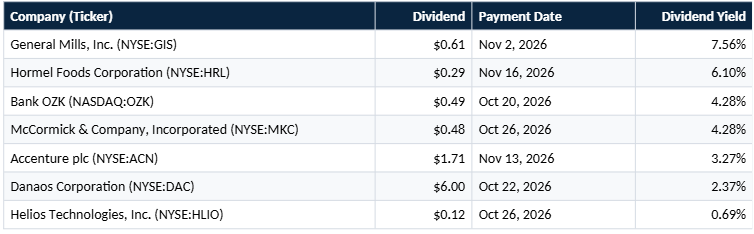
Top Ex-Dividend Companies for Tuesday, October 13:
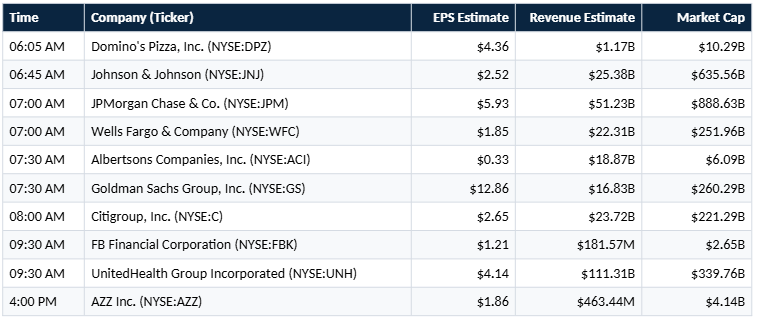
Upcoming Earnings (Tuesday, October 13):
Economic Calendar (Tuesday, October 13):
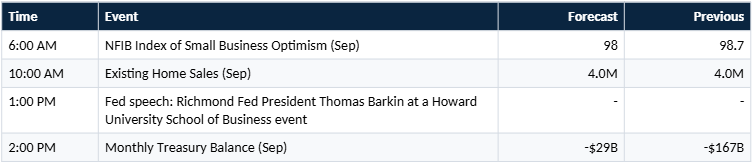
That's the wrap for today! Attention turns to Tuesday's bank earnings from JPMorgan, Goldman Sachs, Citigroup, and Wells Fargo, results from Johnson & Johnson and UnitedHealth, the IMF's updated global outlook, and Wednesday's consumer price report, as investors test whether stocks can hold near record highs with Brent above $106 and the 10-year Treasury yield above 5.2%.
Related post