Wall Street Wrap: Pre-Market, October 22, 2026
U.S. stock futures slide on Thursday as Tesla and Meta disappoint, Lam Research and IBM sink, and AI-spending worries hit chip and neocloud stocks, while oil tops $111 on reports of fresh Iran strike plans and French yields top U.S. yields.


Tech sell-off deepens as Tesla and Meta leave investors wanting more and Lam Research sinks, while oil tops $111 on reports of fresh Iran strike plans
Wall Street looks set for a sharply lower open on Thursday as mixed results from two mega-cap tech names and renewed AI-spending worries hit chip and neocloud stocks, while oil jumps on reports that the U.S. and Israel are planning fresh strikes on Iran.
Futures Snapshot
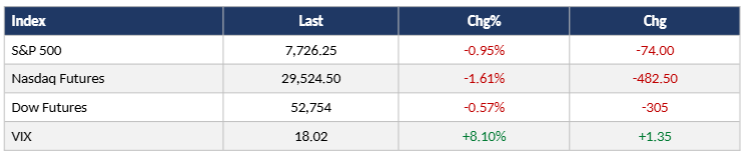
Futures were sharply lower early Thursday, with the Nasdaq leading the declines as chip and AI-linked names came under heavy selling pressure and the VIX jumped.
What's Driving the Open
Wall Street is coming off a strong Wednesday. The Dow Jones Industrial Average rose 0.69% to 52,861.30, the S&P 500 gained 0.58% to 7,757.17 for a third straight winning day, the Nasdaq-100 added 1.13% to 29,822.52, and the Russell 2000 slipped 0.17% to 2,768.5. That bullish tone reversed overnight, JPMorgan traders said, as investors judged the mixed earnings from two mega-cap names disappointing and worries about AI financing resurfaced. Chip stocks led the retreat, with Advanced Micro Devices (NASDAQ:AMD) down more than 4%, Micron Technology (NASDAQ:MU) down 3%, and Intel (NASDAQ:INTC) and Qualcomm (NASDAQ:QCOM) also lower. The chief executive of the chip giant that dominates AI hardware said demand for neocloud firms is "off the charts" but that scarce capital is holding back their growth, a message that did little to steady the group.
Oil and bonds are the other drivers. Brent crude futures rose about 3% to above $111 a barrel after a newspaper report, citing unnamed U.S. officials, that the U.S. and Israeli militaries have drawn up plans for renewed strikes on Iran after next month's midterm elections. Investors sought safety in Treasurys, with the 10-year yield falling 0.104 percentage points to 5.042%. In Europe, France's 10-year yield rose to 5.0813%, a 24-year high, as political turmoil compounds worries about its finances.
What could change the picture: Further signs that the U.S. is moving toward new strikes on Iran would push oil higher and deepen the sell-off, a stabilization in chip stocks would ease pressure on the Nasdaq, and a further jump in French bond yields would pressure global equity valuations.
Overnight Markets
In Asia, tech shares led a broad sell-off, with the MSCI All Country Asia Pacific ex-Japan index down more than 2% to its lowest level in nearly three months, putting it on course for a fourth straight weekly decline. South Korea's Kospi fell 3.52% to 5,533.77 and the small-cap Kosdaq fell 3.6% to 764.1. Japan's Nikkei 225 reversed earlier gains to drop 2.6% to 62,907.84 and the Topix lost 1.1% to 3,997.5. China's CSI 300 fell 1.8% to 4,036.30, slipping into a bear market, while Hong Kong's Hang Seng declined 3% in its last hour of trade. In Europe, the Stoxx 600 was down 1% in morning deals and France's CAC 40 fell about 1.3%, with Hermes down 6.3% after missing third-quarter revenue estimates. SAP (NYSE:SAP) fell despite raising its sales outlook, and Barclays (NYSE:BCS) slipped after a profit miss.
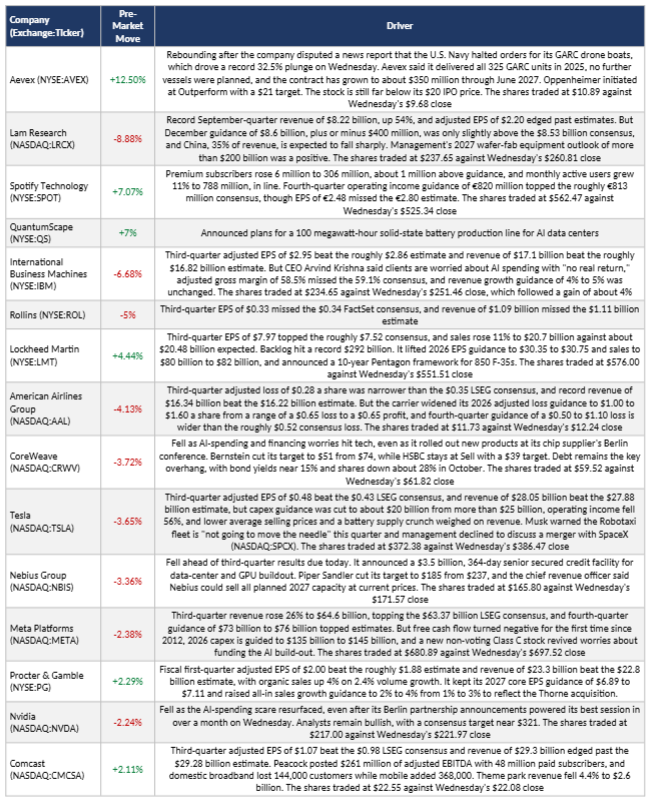
Pre-Market Movers
Rates, FX & Crypto
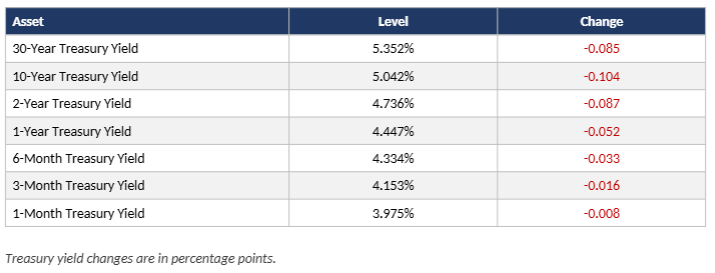
Treasury yields fell across the curve as investors sought safety, with the 10-year dropping the most, by more than 10 basis points, and the 2-year down almost 9 basis points. In Europe, France's 10-year yield rose 8.75 basis points to 5.0813%, topping the 10-year Treasury yield for the first time since 2013, as protests and a fiscal crisis weigh on investor confidence. Data were supportive, with weekly jobless claims falling to 194,000 against 200,000 expected.
Commodities
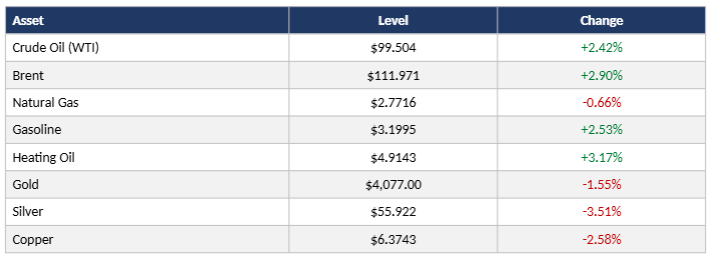
Oil jumped as Brent topped $111 a barrel, a level not seen since May, on the report that U.S. and Israeli planners are preparing a "short but intensive" strike on Iran after the Nov. 3 midterms. President Donald Trump has yet to approve the plan and has repeatedly vetoed a return to major combat, but he told reporters Washington is not negotiating with Tehran and that something will happen "fairly soon." The U.S. also ordered non-emergency government employees and their families to leave Saudi Arabia as Houthi attacks escalate. Even so, ship tracker Kpler says Middle East oil flows through the Strait of Hormuz have recovered to near pre-war levels, and it expects rising Chinese refinery throughput and falling inventories to support crude demand. Metals fell sharply, with silver down 3.51%, copper down 2.58% and gold down 1.55% to $4,077.
Key Levels & Catalysts Today
Economic data
- Weekly initial jobless claims for the week ended Oct. 17 came in at 194,000, below the 200,000 forecast and the 199,000 prior reading.
- The leading indicators index for September is due at 10:00 a.m. ET, with a forecast of -0.1% against -0.1% previously.
- The Kansas City Fed survey for October is due at 11:00 a.m. ET, with a previous reading of 20.
Corporate
- Nebius Group reports third-quarter results today.
- Investors will watch whether chip and neocloud stocks stabilize after the pre-market sell-off.
Top Stories
France's borrowing costs overtake the U.S. for the first time since 2013. The 10-year French government bond yield rose to 5.0813%, topping the 10-year Treasury yield as investors doubt that a government without a parliamentary majority can pass a budget to shrink the deficit. Ministers may resort to special powers, which would stoke more political volatility. President Emmanuel Macron called comments by foreign leaders on the country's unrest "unacceptable" and "stupid," while a student union and the Yellow Vests movement have called for more rallies this weekend and some military forces are being deployed to help maintain order. Morningstar estimates insured losses from the riots at up to 1.2 billion euros ($1.34 billion), and the government has cut its 2026 growth forecast to 0.5% from 1%.
U.S. orders diplomats out of Saudi Arabia as Iran strike plans reportedly advance. The State Department said the departure order for non-emergency staff and their families applies only to Saudi Arabia, citing rising Houthi attacks on civilian targets. A strike on an airport in Dammam killed at least one person and injured eight, and two people died in a drone attack on the Shaybah oil field. According to the newspaper report, the renewed U.S. and Israeli strikes would likely target Iranian energy infrastructure, nuclear facilities and missile and drone arsenals, and Defense Secretary Pete Hegseth met Israeli Prime Minister Benjamin Netanyahu this week to discuss them. Iranian officials have vowed to widen attacks to data centers and undersea internet cables, while U.S. and Iranian negotiators continue talks on Tehran's nuclear program and the Strait of Hormuz.
Norway's wealth fund posts a $30 billion quarterly loss. Norges Bank Investment Management, which manages about $2.3 trillion, reported a third-quarter loss of 278 billion kroner ($29.7 billion) as rising interest rates dented its bond holdings, which returned negative 3.5%. Equities, 72% of the portfolio, returned 0.5%, with energy stocks rising the most and utilities and real estate falling. The fund's top holding is a $65.4 billion stake in Nvidia, and its deputy CEO said the overall return was close to flat.
Critical PHP flaws prompt global security alarms. Two vulnerabilities, collectively known as "PHP2Shell," could let hackers remotely execute malicious code on servers running the widely used open-source language, and governments worldwide have issued urgent warnings, with some taking websites offline. The U.S. National Security Agency urged organizations to prepare updates and to take affected systems offline if they cannot patch immediately. Google parent Alphabet (NASDAQ:GOOGL) said its Wiz unit used AI models to help find the flaws, OpenAI said it spent two months leading a coalition to coordinate fixes, Amazon (NASDAQ:AMZN) detected attempted exploits before public disclosure, and Cloudflare (NYSE:NET) has deployed protections through its web application firewall.
China's CSI 300 enters a bear market. The benchmark, which tracks 300 of the largest stocks listed in Shanghai and Shenzhen, fell 1.8% to 4,036.30, marking a 20% drop from its June peak. It has declined for ten consecutive weeks, and the broader sell-off in Asian technology shares is pushing the regional index toward a fourth straight weekly decline.
Eyes on whether chip and neocloud stocks stabilize, on Nebius results, on oil as Iran strike reports unsettle the market, and on French bond yields.