When No One Agrees Who's in Charge: Inside Prediction Markets' Regulatory Chaos
Prediction markets are better at catching their own bad actors than regulators are at agreeing who's in charge. Four unresolved legal fights show why that's both reassuring and a warning sign

Key Highlights
- CFTC withdrew its 2024 proposal, then began rewriting the rules while suing nine states over jurisdiction.
- Kalshi lost to Nevada in a Ninth Circuit ruling that could reach the Supreme Court, and Washington ordered it geofenced out entirely.
- A White House aide forfeited over $170,000 for trading on advance access to the president's speeches, caught by Kalshi's own surveillance.
- A soldier charged with trading on classified intelligence argues the law itself doesn't apply to prediction-market bets.
- A flight-data provider sued Kalshi over unauthorized data use, then dropped the case a day later.
An Industry Policing Itself Faster Than Anyone Can Regulate It
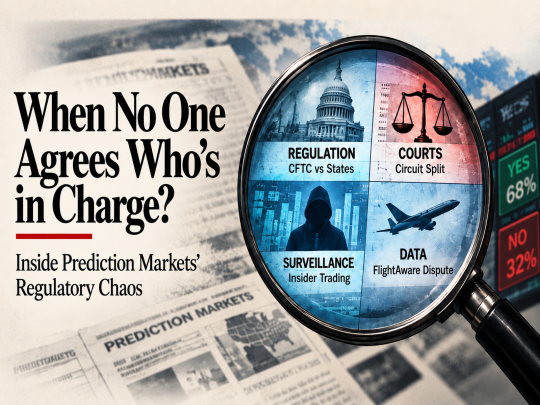
Kalshi and Polymarket both let people trade yes-or-no contracts on real-world outcomes, and both have grown large enough, fast enough, that the rules meant to govern them are being written after the fact rather than before. That gap shows up in four places at once: a federal regulator still deciding what it wants to allow while suing to defend its own turf, a patchwork of states reaching opposite conclusions on the identical legal question, real enforcement cases moving through the courts, and a brand-new category of dispute nobody anticipated at all.
One fact cuts through all four, and it points in two directions simultaneously. The industry's own surveillance is catching genuine bad actors, including a sitting White House aide, faster and more reliably than any regulator has managed to. That's a real argument for trusting these platforms to police themselves. But the same federal agency spending the year fighting for the industry in court, against nine state governments at once, is still writing the basic rules of what's allowed, and at least one federal circuit has now sided with a state instead. An industry can't simultaneously be this good at catching its own problems and this unsettled about who's allowed to write its laws. Both are true right now, and the tension between them is the actual story.
A Regulator Fighting a War on Two Fronts
Start with the federal posture, because it's shifted enough in two years to be a source of uncertainty on its own. The CFTC proposed in 2024 to ban political and certain sports-related event contracts, worried about their effect on market and election integrity. That proposal never became final, and the agency withdrew it entirely on February 4, 2026, calling the earlier approach overreach. An advance rulemaking notice followed in March, then a narrower proposed rule in June, an attempt to build a coherent framework for this category largely from scratch.
Writing new rules turned out to be the easy part. Defending its authority to write them at all has become a running legal campaign. When Wisconsin, Illinois, Arizona, Connecticut, Minnesota, New Mexico, Rhode Island, Kentucky, and New York each moved against Kalshi or Polymarket under their own gambling laws, the CFTC didn't just respond, it sued all nine of them, arguing Congress gave it exclusive jurisdiction over event contracts and that no state gets to override that by calling the product gambling instead of a derivative. In Michigan, where the state tried to force Kalshi to cancel trades outright, the CFTC ordered Kalshi to honor them anyway. And when New York's attorney general sued Kalshi directly at the end of July seeking $36 billion in damages and a nationwide shutdown, the agency escalated further still, invoking emergency authority on August 11 to order Kalshi to keep operating in the state regardless of how that lawsuit turns out. Congress, meanwhile, has bills on the subject sitting untouched in both chambers.
Winning and Losing the Same Argument, State by State
That federal campaign rests on a claim the states themselves haven't accepted: that a federally regulated exchange can operate anywhere in the country regardless of local gambling law. Nine lawsuits in, the results are genuinely split, and the biggest one just broke against Kalshi.
Nevada is the recent case that matters most. On August 28, the Ninth Circuit ruled that Kalshi's sports contracts function as sports bets, not federally protected swaps, clearing the way for Nevada's gaming regulators to enforce state law against the platform. The ruling applies across the entire Ninth Circuit, meaning California, Arizona, Oregon, and Washington are all now covered by the same logic, and it directly contradicts an April ruling from the Third Circuit that went the other way for Kalshi in New Jersey. That split between circuits is now heading toward the Supreme Court, with a formal petition expected within days. Given that sports contracts make up the large majority of Kalshi's business, this is the single most consequential ruling to hit the industry so far.
Washington shows the same losing pattern from a different angle. A King County judge ordered Kalshi to stop offering wagers there on sports, elections, politics, entertainment, and "mentions," the contract type Perez was caught exploiting, with a geofencing deadline of September 2. Washington's attorney general, Nick Brown, put it bluntly: "Kalshi has gotten rich promoting wagers on sports, elections, natural disasters... and more. Under this order, Kalshi is banned from offering wagers on most of those topics in Washington."
Kalshi has won the identical argument elsewhere. Federal courts have sided with the company's exclusive-jurisdiction claim against several of the states the CFTC sued, and the emergency order in New York keeps the platform running there for now regardless of how the underlying suit resolves.
There's no coherent doctrine yet, just the same argument winning in one courtroom and losing in the next, now serious enough to reach the country's highest court. For a trader, the platform looks and behaves identically no matter what state the app opens in. The legal ground underneath it does not.
The Industry's Best Argument Is Also a Warning Sign
Set against that legal chaos, Kalshi's own enforcement record looks unusually clean, and one case in particular shows why that record matters more than it might first appear.
Gabriel Perez, President Trump's teleprompter operator of nearly a decade, settled CFTC charges in August that he'd used advance access to the president's unreleased remarks to trade Kalshi's "mention markets," contracts tied to specific words Trump might say in a speech. He made more than $107,500 doing it. He agreed to give the money back, paid a further $65,000 penalty, and accepted a three-year trading ban, and Kalshi's own systems caught the pattern and referred it to regulators before any of it became public, cooperation the CFTC credited directly in the settlement. It wasn't an isolated catch: weeks earlier, former Congressman George Santos paid roughly $35,000 to settle nearly identical charges, for manipulating a Kalshi market on his own attendance at the State of the Union, an outcome he personally controlled, and Kalshi's systems flagged that one too.
Two clean catches in two months is a genuinely strong record, and it's exactly the record Kalshi is using to argue it needs a lighter regulatory touch, not a heavier one. In August, the exchange struck a multi-year deal to run Nasdaq's market surveillance system, technology already used across more than 50 exchanges and 20 international regulators. The pitch is straightforward: an exchange that catches its own bad actors before any state attorney general does shouldn't need nine of them suing over jurisdiction at once.
But a third case shows where that argument runs out. A US Army soldier is charged with using classified knowledge of the raid that captured former Venezuelan president Nicolás Maduro to turn a roughly $33,000 Polymarket stake into more than $409,000, facing up to 20 years on the most serious charge. He's pleaded not guilty, and his defense isn't contesting the facts so much as the premise, arguing federal fraud and commodities law were never written with prediction-market bets in mind and don't clearly apply. No amount of internal surveillance catches a case like this, because the question isn't whether the platform noticed, it's whether the law itself has any grip on what happened at all. If the argument succeeds, it could make it meaningfully harder to prosecute anyone who does something similar again.
The Risk Nobody Wrote a Rule For
Every fight so far has been about who gets to regulate these platforms. The last one is about something no regulator has touched at all: what happens when a contract's settlement depends on data or a brand that belongs to somebody else entirely.
In early July, Kalshi launched contracts letting traders bet on flight cancellation rates at specific airports, citing FlightAware as the data source, despite FlightAware saying it never agreed to that and had already sent cease-and-desist letters before the contracts even launched. FlightAware sued in August over unauthorized use of its data and branding, and withdrew the case the very next day after Kalshi swapped the FlightAware references for the generic term "Primary Source Agency."
It resolved in 48 hours, but the underlying question didn't go anywhere. As platforms keep listing contracts tied to flight status, weather, or anything else measured by a third party, they're taking on legal exposure that has nothing to do with the CFTC or any state's gambling code. Whoever owns the data being used to settle a bet has a claim of their own, and nobody has written a rule for that yet.
Self-Policing Isn't the Same as Legal Authority
Put the four fights together and one fact stands out above the rest: this industry is currently better at catching its own bad actors than any government is at deciding who's allowed to regulate it. That's real, and Kalshi is right to lean on it, a federal agency willing to sue nine states on your behalf is not a small asset. But "trust us to self-police" was never going to be the whole answer. It didn't stop the Ninth Circuit from siding with Nevada, it has no mechanism at all for a dispute like FlightAware's, which had nothing to do with gambling law in the first place, and it won't decide the constitutional question now headed for the Supreme Court.
None of this is settled, and with a circuit split in play, it may take the country's highest court to settle it. A trader opening the same app in two different states right now is operating under two different sets of rules, whether or not the interface tells them so.