Why Are Chipmakers Ordering ASML (NASDAQ: ASML) Tools for 2030?
Factories usually book their machines a year or two ahead. Some of the world's chipmakers are now asking for 2029 and 2030, and the bottleneck is shifting from chips to the tools that make them.

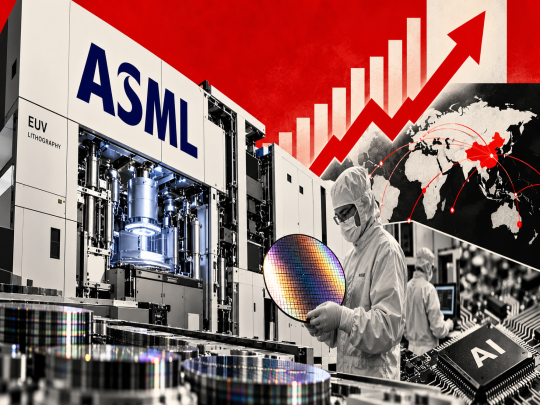
ASML Holding N.V. (NASDAQ: ASML) said on Wednesday, October 14, 2026, that some of its customers are interested in placing orders for 2029 and even 2030. Chief executive Christophe Fouquet tied the demand to the size and duration of artificial intelligence investment. The company also said that its planned supply for 2027 and 2028 will not fully meet customer demand. For retail investors asking why ASML stock is in focus, this is the unusual feature of the third-quarter report: the quarter was a record, yet the longer story is a growing queue.
What ASML actually said about demand
Third-quarter net sales reached a record €11.7 billion, near the high end of guidance. Sales of upgrades and services, which the company calls Installed Base Management, came in at €3.3 billion, above guidance, on strong demand for productivity upgrades. Gross margin of 57.5% also beat the outlook.
More striking was the language on the order book. Customers keep raising their short and medium-term equipment forecasts, and order momentum has increased every quarter this year. ASML is now investigating ways to expand capacity for 2028 beyond the 30% increase it had already announced. For the fourth quarter it guides to net sales of €14.2 billion to €15.2 billion, and for 2026 to €44 billion to €45 billion.
One caution is worth stating early. Interest in placing orders for 2029 and 2030 is not the same as signed orders. It signals confidence, not a contract.
Why a shortage of tools matters to investors
When customers want more machines than a supplier can build, the supplier gains pricing power and a long runway of visible revenue. Think of a popular restaurant booked months in advance: the owner can plan staffing, buy ingredients and set prices with far more certainty. Reuters reported in September that ASML's existing EUV machines, which cost around $200 million each, are all but sold out through 2027.
ASML has another lever. Rather than waiting for new tools, customers can buy productivity upgrades that squeeze more output from machines already installed. That explains the strength in service sales and the margin beat.
High NA EUV moves from doubt to dates
For years the market debated whether chipmakers would pay about $400 million for each High NA machine. The debate is now narrowing. According to Reuters, Samsung plans to use High NA in memory production from 2028, SK Hynix has set a similar date, and TSMC has committed to the technology from around 2030. Intel, the early adopter, said it has processed more than a million wafers on High NA tools.
The logic is simple. High NA machines need less light per exposure, which shortens the time to print each layer and raises wafer output. ASML and TSMC have also launched an initiative to move to larger 12-inch photomasks, which the companies say can lift productivity by more than 40% for dual mask exposure, with a pilot line targeted by 2031.
The quieter driver: faster machines
ASML also plans to ship its NXE:3800F EUV system in 2027, with volume following in 2028. Company commentary rates it at 260 wafers per hour, compared with 230 for an upgraded NXE:3800E. A faster tool is a form of new capacity. Customers get more chips from the same floor space, and ASML earns for the upgrade.
The moat, and the risks that come with it
This visibility is a product of the moat. ASML is generally regarded as the only commercial supplier of EUV machines, and it relies on an exclusive optics supplier, Carl Zeiss SMT. Customers cannot easily go elsewhere.
That same structure carries risk. Four customers made up 61.2% of 2025 sales, so a pause by one would matter. China accounted for 23% of third-quarter system sales, which exposes ASML to export rules. The company's own filings list order cancellations and delays as risks, and the semiconductor industry has always moved in cycles. Third-quarter cash flow was also flattered by customer prepayments, so it should not be annualized.
What to watch next
Investors should track fourth-quarter sales against guidance, any decision to lift 2028 capacity further, whether Samsung's 2028 High NA date holds, and the update to long-term targets at the Capital Markets Day on June 10, 2027.
The central question is whether today's queue turns into signed orders. If it does, ASML's visibility will stretch further than almost any industrial company in the world.
This article is for information only and is not investment advice. Figures come from ASML's third-quarter 2026 filings and Reuters reporting. Please verify against official sources.