5 Numbers From Nike's Earnings That Explain the Stock Drop
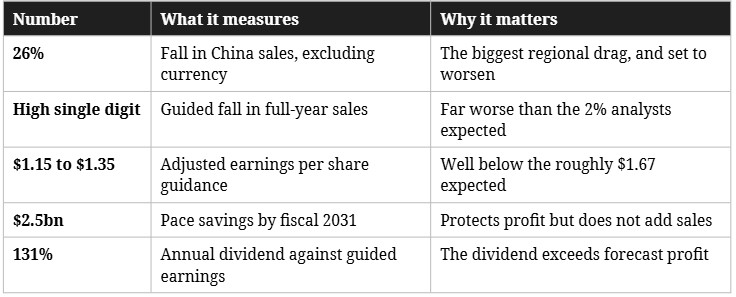
Nike beat profit estimates but cut its sales outlook, sending the shares sharply lower. Five numbers explain the sell-off: China, the sales forecast, earnings guidance, Pace savings and the dividend.


Key Highlights
- Nike beat profit estimates, yet sales fell 4% to $11.2bn and the shares fell sharply on Friday.
- Five numbers explain the reaction: China, the sales outlook, the profit forecast, Pace savings and the dividend.
- Nike expects full-year sales to fall by a high single-digit percentage, against about 2% expected by analysts.
- Adjusted earnings guidance sits roughly 19% to 31% below the roughly $1.67 per share analysts expected.
- Shares traded near $33 in early session, close to a 52-week low, valuing Nike at about $49bn.
A Beat That Nobody Believed
Earnings season rewards a simple test: did the company beat? Nike (NYSE:NKE) passed it. Earnings per share of $0.48 came in about 12% above the $0.43 analysts expected, and the gross margin widened to 42.8%. Yet the shares closed Thursday at $35.15, opened Friday at $32.20, and traded near $33.08 in early session, down about 5.9%. Before the open they had been down 10%.
The market was not pricing the quarter. It was pricing the next two years. Five numbers explain why.
How Nike Got Here
Nike's stock market value peaked at roughly $280bn in November 2021, and yearly sales passed $50bn in fiscal 2023. Then the company made a costly choice. It pushed hard to sell directly through its own stores and apps, and cut ties with many retail partners. Rivals took the empty shelf space. Nike also sold too many of its popular Dunk and Jordan retro shoes. Discounts followed and the brand lost some shine.
A new chief executive returned in 2024 to refocus on sport, rebuild retail partnerships and bring back fresh products. The repair work is real but uneven, and this quarter showed both sides.
The Quarter in Brief
Sales were $11.2bn, down 4% (5% excluding currency) and just short of the $11.3bn analysts expected. Operating profit, measured as EBIT, was $907m, almost unchanged. The EBIT margin, which is operating profit as a share of sales, rose to 8.1% from 7.7%. Selling and administrative costs (SG&A) fell 3% to $3.9bn, as 6% lower overheads outweighed 5% higher marketing spend around the football World Cup. The gross margin gain came mainly from lower warehouse and shipping costs, partly offset by more discounting.
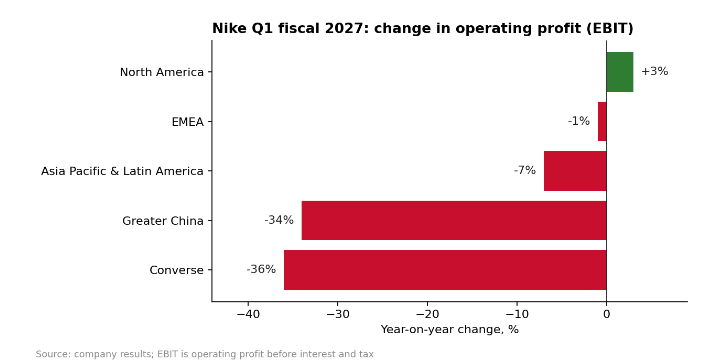
By region, North America grew 2%, Europe, the Middle East and Africa fell 5%, Asia Pacific and Latin America were flat, and Converse fell 28%.
Number 1: A 26% Fall in China Sales
Sales in Greater China fell 26% excluding currency effects, or 22% as reported. It was the ninth drop in a row. Operating profit in the region fell 34%, and China was about 10.5% of Nike's sales this quarter, down from 12.9% a year ago.
Nike is cleaning up its online sales there. From January it will stop some large partners from selling Nike online and focus on its own official stores on the big Chinese shopping platforms. The aim is to end heavy discounting. The cost is lost sales, and the chief financial officer said the full-year forecast assumes China "gets worse" for the rest of the year.
Not everyone agrees this is the right fix. One bank analyst argued that Nike has "a product problem" in China, not a channel problem. There are signs both ways. Running has grown for six straight quarters there and Nike's Shanghai flagship has grown for ten months, but local brands are gaining ground and Nike's first collection made for China does not launch until October.
Number 2: A High Single-Digit Fall in Sales
Nike expects full-year sales to fall by a high single-digit percentage. Analysts had expected only about 2%. The second quarter faces a further drag of about 4 percentage points from tough comparisons, and management says the pressure will run into fiscal 2028.
The reason is that Nike is now two businesses. The performance side, covering running, football, basketball, tennis and golf, makes about $16bn a year and grew at a high single-digit rate. The lifestyle side is shrinking. Sportswear, nearly half of all sales, fell by a low double-digit rate. Cutting Dunk sales by half on purpose cost roughly $200m. Jordan, 13% of sales, fell by a mid-teens rate as Nike releases fewer retro shoes to make them feel special again.
The chief executive said the performance business "is not yet large enough to offset the pressure" in sportswear, Jordan and China. One encouraging detail: North American sales to retail partners rose 9% while Nike's own stores and apps fell 6%. The return to partner shops seems to be working.
Number 3: A $1.15 to $1.35 Profit Forecast
Nike guided adjusted earnings per share to between $1.15 and $1.35, before about $0.15 of Pace costs. Analysts had expected about $1.67, so the range sits roughly 19% to 31% below that. This is the figure that moved the shares.
Because the first quarter earned $0.48, the remaining three quarters must earn between $0.67 and $0.87 in total, or about $0.22 to $0.29 each. That is 40% to 55% below this quarter's level, assuming no major one-off items in the first quarter.
At about $33.08, Nike is worth about $49bn, less than a fifth of its 2021 peak. Applied to the forecast range, that price is about 25 to 29 times earnings, or around 26 times at the midpoint. That is simple arithmetic, not a view on whether the shares are cheap or expensive. A leading brokerage said there is "no justification" for Nike to earn a higher valuation than faster-growing rivals. Markets often look past a temporary dip, but Nike says this one will last well into next year.
Number 4: A $2.5bn Cost-Cutting Plan
Pace is Nike's plan to run a leaner company. It includes supply chain changes, a new campus in Bengaluru, India, a move from four regions to three, and a smaller workforce. Nike has already cut jobs twice this year: 775 in warehouses in January and 1,400, mostly in technology, in April.
The target is about $2.5bn in savings through fiscal 2031, against about $1bn of one-off costs, plus roughly $0.3bn of severance booked last year. Most savings arrive in fiscal 2029 and 2030.
Two points give context. The $2.5bn is a total over five years, roughly half a billion dollars a year, set against quarterly SG&A of $3.9bn. And cost cuts protect profit but do not make customers want more shoes. As one leading brokerage put it, "Nike is turning into a cost-cutting story."
Number 5: A 131% Dividend Comparison
Nike pays $0.41 a share each quarter, or $1.64 a year, a yield of close to 5% at the current price. Set against the $1.25 midpoint of its adjusted earnings forecast, that is about 131%. This is a comparison with guidance, not a standard payout ratio, but it shows the dividend exceeds the profit Nike now expects to earn.
Dividends cost about $610m this quarter, close to the $712m of net income. The balance sheet can cope for now, with $8.4bn in cash against about $7.9bn of debt. Management said it supports "maintaining and ultimately growing" the dividend, but investors will watch whether profits recover first.
The Competition
The sports footwear market is still growing, but much of the growth is going to others. Hoka, owned by Deckers (NYSE:DECK), grew sales by nearly 16% to about $2.6bn in its latest fiscal year. That is small next to Nike's $16bn performance business, but it is growing about twice as fast. On (NYSE:ONON) has built a strong running brand, and one of football's biggest stars, Kylian Mbappe, left Nike for On last month. Adidas has revived its lifestyle shoes, and in China local brands are winning with products made for local tastes.
Nike keeps real strengths. It leads in football and basketball, and a new signature shoe for a leading women's basketball star launched in 5,000 stores, twice the usual number.
What Could Go Right, and What Could Go Wrong
What could go right: running keeps its momentum, new launches sell well, the November investor day offers a convincing long-term plan, and easier comparisons arrive in fiscal 2028.
What could go wrong: shoppers stay bored with lifestyle styles, China weakens more than forecast, Nike has to discount more to clear old stock, input costs rise, the restructuring disrupts the business, or profits fail to cover the dividend.
The big question is whether Nike is a great brand in a temporary slump or a slower-growing company that deserves a lower valuation. This quarter does not answer it. It shows a performance business that works, a lifestyle business shrinking by design, and a company now focused on cost, not growth.
Related post