The Garden Hose That Became a Global Brand: The Story of "On Holding AG" (NYSE:ONON)
A Swiss running-shoe brand, listed in New York as On Holding AG (NYSE: ONON), has signed the world's most marketable footballer and promised investors it can grow at a high-teens rate until 2029. Can a premium sportswear stock really take on Nike and Adidas in football boots?

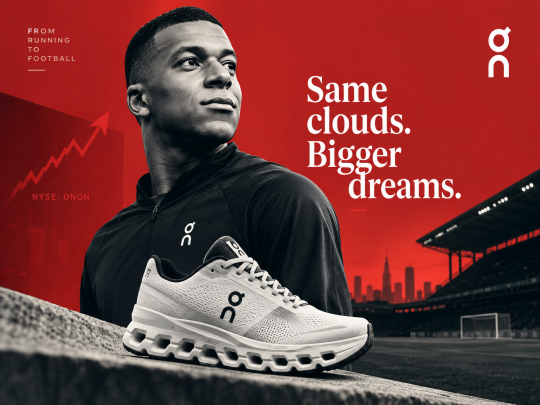
Every great sportswear company eventually has to decide what it is. Nike (NYSE: NKE) chose to be everything. Adidas (XETRA: ADS) chose to be football first and fashion later. On, the Zurich-based maker of premium running shoes, has spent sixteen years refusing to choose, which is another way of saying it has been waiting for the right moment. This autumn it decided the moment had come.
On September 18th the firm announced a partnership with Kylian Mbappé, the French forward who plays for Real Madrid, ending his nearly two-decade association with Nike and giving him both cash and an equity stake in the Swiss company. French press reports, relayed by other outlets, put the term at ten years. Financial details were not published. Four days later, at an investor day at its Zurich laboratories, the company unveiled a 2029 ambition of high-teens annual sales growth, a gross margin of at least 65% and an adjusted EBITDA margin of at least 22%, together with its first-ever share buyback of up to $1bn. Within hours the shares were up by more than 11%, their best day in over ten months.
The sequence was not an accident. On wants to be judged not as a clever running brand that got lucky, but as a global sportswear company with a repeatable method for entering new categories. Football, the world's largest sport, is the test.
From garden hose to Wall Street
The story is by now part of corporate folklore. Olivier Bernhard, a Swiss duathlon champion, stuck pieces of garden hose to the soles of a running shoe in search of cushioning that was soft on landing and firm on take-off. He teamed up with two friends, David Allemann and Caspar Coppetti, and in 2010 they founded On, named for the idea of being switched on and on the move. The hollow "CloudTec" pods that grew out of the hose experiment gave the shoes a look no rival could mistake.
The founders sold first to specialist running shops, whose staff are the most sceptical shoe-buyers in the business, and held prices high. On listed on the New York Stock Exchange in September 2021 at $24 a share. Since then it has grown from a niche running-shoe company into a lifestyle label worn by people who have never run a marathon. The firm now guides for full-year 2026 net sales of CHF 3.47bn-3.56bn, and it says its average selling price has risen from $145 to $270 since its previous investor day in 2023. That is a bold claim in an industry where discounting is a reflex. It is also the heart of the investment case.
The Federer playbook
Football is not On's first adjacent leap. In 2019 Roger Federer, then still a Nike athlete, became an investor and product collaborator after, as the tale goes, his wife Mirka took to the shoes. Reports put his stake at about 3%, bought for roughly $50m. The investment has turned into one of sport's better side-bets, and the template it created matters more than the profit: the athlete owns a slice, helps design the product and has reason to say honestly when something is wrong.
The Mbappé arrangement copies the formula. He will, according to the company's announcement, help to design, develop and test football footwear and apparel. He is also said to be building his own sub-brand of boots, in the manner of Nike's Jordan Brand. Thierry Henry, the former Arsenal and France striker, has been named On's director of football; he has been fulfilling the role unofficially since the end of 2025. The first boots and apparel are expected to reach the market next year, built around "LightSpray", the robotic spray-on upper technology On unveiled in 2024.
The logic is sound. Running and tennis are premium but modest in scale. Football is a global mass market, with fans from Lagos to Lahore to Lyon, and boots are a high-visibility product that shapes how a whole generation sees a brand. A credible foothold would also help On with Latin America, Africa and Asia, where its brand recognition is thinnest.
Why the market is nervous
Yet the shares, at about $30, are down roughly 35% so far this year, while the S&P 500 is up by some 13%. The reasons are worth understanding, because they reveal what investors are actually worried about.
The first is a slowing growth rate in the firm's biggest market. Management guides for constant-currency sales growth in the low 20% range this year, which would be the envy of most consumer firms. But On has trained investors to expect more, and the most recent quarterly earnings fell short of forecasts, with earnings per share of $0.35 against the $0.42 expected, even as revenue rose by 13.5%. A growth stock priced for acceleration has little patience for deceleration.
The second is competition. Hoka, owned by Deckers (NYSE: DECK), has proved that a cushioned-running upstart can scale quickly, and then discovered that scaling brings its own problems. Asics (TYO: 7936) is enjoying a revival. Adidas has returned to form with its retro "terrace" trainers. Nike, under fresh management, is attempting to rediscover its running roots. Each is a worthy rival.
The third is valuation. On's market capitalisation is near $10bn on revenue of $3.63bn last FY, close to six times sales. That is not a price that leaves room for stumbles. Analysts are divided: Jefferies reiterated an "underperform" rating on September 18th, while BMO Capital called the Mbappé deal a convincing first step but kept its "market perform" rating and a $28 price target.
The arithmetic of 2029
Management's targets are ambitious but not fanciful. On wants net sales of at least CHF 5.6bn by 2029, which implies close to a doubling from this year's level. If it reaches a 22% adjusted EBITDA margin on that revenue, adjusted EBITDA would be in the region of CHF 1.2bn. The first of those numbers depends on three engines: running, sneakers and apparel, with football and golf as supplements rather than saviours.
Here the investor must be careful. Football boots will not move the needle by themselves in 2027. The category is dominated by Nike, Adidas and Puma (XETRA: PUM), whose ties to clubs, federations and kit contracts run for decades. A boot is a technical product that elite players will wear only if it feels right on the first touch, and a poor launch would be very visible. The sensible expectation is that football is a brand-building exercise for the first few years and a profit driver only if the product proves itself.
The buyback matters for a different reason. On ended the second quarter with net cash of just over CHF 1.2bn, and its premium pricing generates plenty of cash. A programme worth about a twentieth of the company's market value signals that the founders think the shares are cheap, and gives them a way to prove it. As sceptics point out, an authorisation is an intention rather than a purchase.
Control and the founders' bet
Investors in On accept something that governance purists dislike. The founders hold high-vote Class B shares, which give them strong control while public shareholders own the lower-vote Class A stock. The structure is common among founder-led consumer firms and has real merits: it shields long-term decisions, such as refusing to discount, from the pressures of quarterly earnings. Its risk is obvious. If the founders get a big call wrong, outsiders have little recourse. The return of Mr Allemann and Mr Coppetti as co-chief executives, after a period in which professional managers ran the business day to day, sharpens that bet. The brand will rise or fall on their taste.
Closing Thoughts
The Mbappé deal is best read as a statement of intent rather than an immediate earnings event. It tells investors that On does not want to be a one-trick running brand, that it will use equity rather than cash to attract the world's best athletes, and that it believes its pricing power can survive a leap into a more crowded and more commoditised category.
Whether that belief is vindicated will be decided by far humbler things than a famous signature: the quality of the first boot, the sell-through of the next running shoe (the Cloudsurfer 3 begins rolling out this month), the discipline of the wholesale channel in America and the willingness of management to keep saying no to discounts. For a stock with a beta of more than two, the ride will not be smooth.
Still, there is a certain symmetry. A man who glued a garden hose to a shoe built a company that has now lured a footballer away from the world's biggest sportswear firm. Whether On can turn a clever product into a lasting global sportswear franchise is the question every investor in the premium footwear sector, from Zurich to Wall Street, is now trying to answer.
Related post