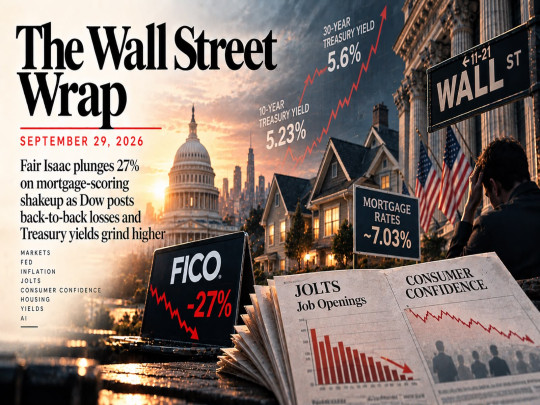
The Wall Street Wrap: October 1, 2026
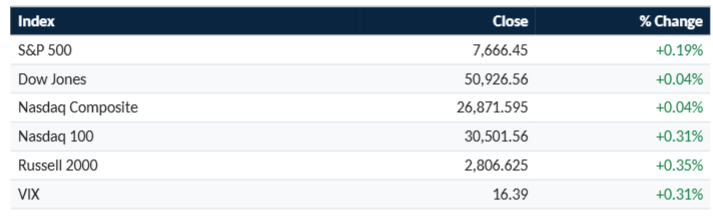
US stocks edged higher on the first trading day of October as Treasury yields retreated from their highest levels since 2002, with the S&P 500 gaining 0.19% and the Dow 0.04%. Accenture surged nearly 16% on strong results, oil jumped on a US military buildup in the Middle East, and a global bond selloff took borrowing costs in the US, France, and Britain to multi-decade highs, while Nike sank after hours on a steep sales warning and a new restructuring.


Global bond rout pushes the 10-year to its highest since 2002 before stocks claw back, Accenture surges 16%, and Nike sinks after the bell on a steep sales warning
Welcome to Wall Street Wrap, your quick end-of-day rundown of what moved US markets today, plus what's shaping global sentiment overnight.
MARKETS TODAY
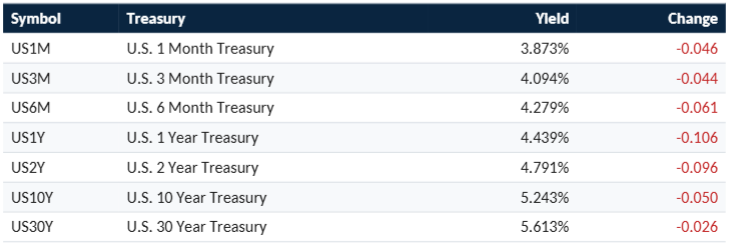
US stocks posted modest gains on the first trading day of October, clawing back early declines as Treasury yields retreated from their highest levels in more than 20 years. The S&P 500 added 0.19% to 7,666.45, the Nasdaq Composite eked out a 0.04% gain to 26,871.595, and the Dow Jones Industrial Average rose 20.51 points, or 0.04%, to 50,926.56, while the Nasdaq 100 gained 0.31% to 30,501.56. The 10-year Treasury yield hit an intraday high of 5.344% before turning lower to close at 5.243%. Energy, industrials, and information technology led the sectors as Accenture surged and chip names climbed, while health care and communication services lagged and oil jumped more than 2.5% on reports of a US military buildup in the Middle East.
ANALYTICAL VIEW
October opened with the bond market blinking. The 10-year Treasury yield touched 5.344%, its highest since 2002, before turning lower by late morning, while the 2-year yield tumbled nearly 10 basis points to 4.791% as investors priced out the odds of a Fed hike this month after Wednesday's softer PCE data and a few dovish remarks from central bankers. One strategist noted that the 10-year has risen about 50 basis points in 18 trading days since Fed Chairman Kevin Warsh signaled at Jackson Hole that a hike was coming, while another said a weaker jobs number on Friday could all but cement a hold in October. Stocks have lately moved opposite to yields, rising on days when yields fall, though a further jump in oil kept the enthusiasm in check.
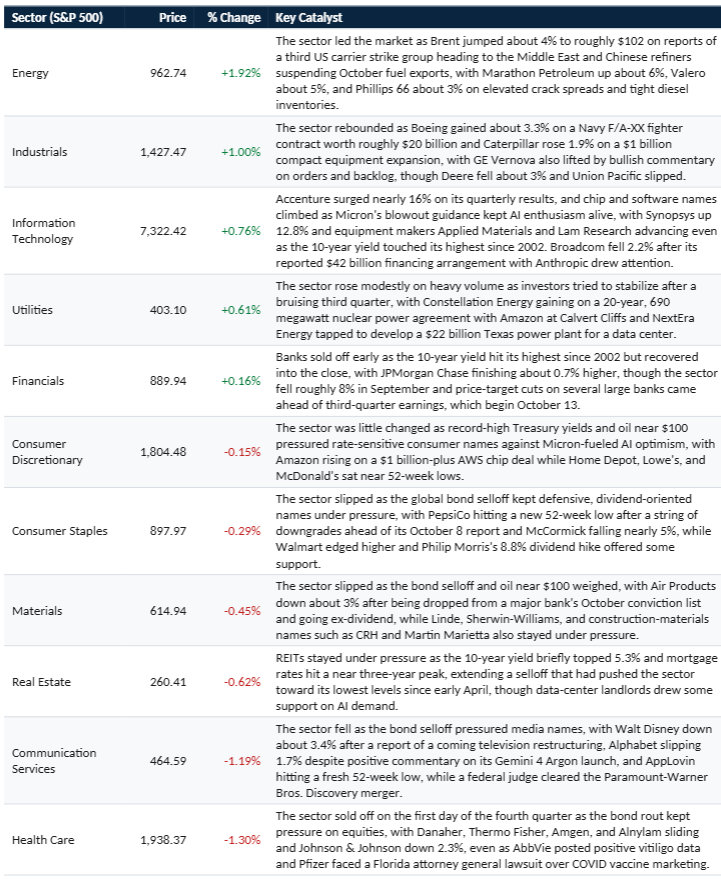
The tape rewarded AI-linked hardware and software while punishing health care and media. Synopsys jumped 12.8%, Coherent 10.9%, and Lumentum 7.7%, Micron added about 3% a day after its blockbuster results, and industrials and energy joined technology at the top of the sector table as Boeing, Caterpillar, and the refiners rallied. Health care fell 1.30%, with Danaher, Thermo Fisher, Amgen, and Alnylam all sliding, while communication services dropped 1.19% as Disney and Alphabet declined. The transportation index gained 1.15%, showing that appetite for cyclicals survived the bond rout even with Brent back above $102.
What could change the picture: Whether Friday's September jobs report, expected to show 84,000 jobs added, is soft enough to cement a Fed hold in October and keep yields off their highs, and whether Washington's reported military buildup in the Middle East pushes oil, and with it inflation expectations, back toward the levels that have driven the bond selloff.
SECTOR PERFORMANCE
WINNERS & LOSERS
Top 5 Gainers (across S&P, Nasdaq, Dow):
- Accenture plc (NYSE:ACN): +15.777%
- Synopsys, Inc. (NASDAQ:SNPS): +12.783%
- Fair Isaac Corporation (NYSE:FICO): +11.693%
- Coherent Corp. (NYSE:COHR): +10.903%
- Corteva, Inc. (NYSE:CTVA): +7.897%
Top 5 Decliners:
- Paramount Skydance Corp (NASDAQ:PSKY): -9.584%
- Alnylam Pharmaceuticals, Inc. (NASDAQ:ALNY): -6.306%
- McCormick & Company, Incorporated (NYSE:MKC): -4.871%
- Danaher Corporation (NYSE:DHR): -4.419%
- Incyte Corporation (NASDAQ:INCY): -3.469%
Note: Accenture's post-earnings surge led a rally in software and AI-linked names, with Fair Isaac's rebound among the day's biggest gains, while Paramount Skydance and a cluster of health care names dominated the decliners.
AFTER-HOURS MOVERS
Gainers:
- ON Semiconductor Corporation (NASDAQ:ON), +6.42% after hours: Shares extended a 4.18% regular-session gain after the company amended its June merger agreement to acquire Synaptics, switching to an all-cash price of $123 per share, an aggregate value of about $5.7 billion versus roughly $7 billion under the prior deal. The revision followed an unsolicited competing proposal for Synaptics, and onsemi said the transaction is expected to be immediately accretive to non-GAAP earnings per share, with financing from cash on hand and committed debt.
- Venture Global, Inc. (NYSE:VG), +2.90% after hours: Shares rose after the company and ConocoPhillips signed a 20-year LNG supply agreement under which ConocoPhillips will buy 1 million tonnes a year starting in 2030, adding to recent contract momentum. Venture Global also filed with FERC for approval to place its Plaquemines LNG export facility into service, and the stock had closed 1.03% higher at $12.77.
Decliners:
- Fair Isaac Corporation (NYSE:FICO), -6.49% after hours: Shares gave back part of an 11.69% regular-session rebound after Bloomberg reported that the Federal Housing Finance Agency plans to direct Fannie Mae and Freddie Mac to require lenders to pull credit data from two credit bureaus instead of three, a move that could be announced as soon as October 12. TransUnion fell about 6% on the same report, and the rebound had followed a nearly 49% plunge in September that included a 27% drop on September 29.
- Slide Insurance Holdings, Inc. (NASDAQ:SLDE), -5.67% after hours: Shares slid in extended trading after closing 5.92% higher at $23.63, on a day when the Tampa-based property insurer announced it will report third-quarter results on October 27 after the close, with a conference call on October 28.
- Nike, Inc. (NYSE:NKE), -5.63% after hours: Shares fell after the sportswear giant reported fiscal first-quarter EPS of $0.48 versus $0.43 expected, but revenue of $11.21 billion, down 4%, missed the $11.32 billion consensus as sales in China tumbled 26%. Nike guided fiscal 2027 revenue to decline by a high-single-digit percentage, with adjusted EPS of $1.15 to $1.35, well below analyst expectations, and the stock had closed 0.71% lower at $35.15.
COMMODITIES & RATES
US TREASURY YIELDS
TOP STORIES: US
Accenture surges nearly 16% as fiscal fourth-quarter results beat estimates and AI demand drives record bookings. The consulting giant reported earnings per share of $3.29 on revenue of $18.68 billion, topping the $3.18 and $18.03 billion analysts expected, and the shares jumped as much as 22% before ending the day up close to 16%. Fiscal 2026 adjusted EPS rose 8% to $13.97 on revenue of $74.2 billion, up 6%, while the company posted a record in big-ticket client bookings, ended the year with $85 billion of new business going into next year, raised its quarterly dividend 5% to $1.71 per share, and guided to 3% to 6% growth in both revenue and adjusted EPS for fiscal 2027. Even after the surge, the stock remains down more than 18% for the year on worries that artificial intelligence will disrupt key business lines.
Nike deepens its restructuring with more job cuts and a three-region reorganization as China weakness persists. The sportswear giant said it will cut an unspecified number of roles, with employee notifications beginning in 2027, in its third round of layoffs this year, and will shift from four geographic divisions to three: the Americas, Asia Pacific and Greater China, and Europe, the Middle East and Africa. The plan also includes a new campus in India and is expected to deliver about $2.5 billion in savings through fiscal 2031, at a cost of 15 cents per share in restructuring expense in fiscal 2027. China, about 15% of annual revenue, has now seen sales fall for nine straight quarters, even as Nike prepares to pull online sales rights from some of its biggest Chinese retail partners starting in January, and the shares are down more than 40% this year.
Broadcom to lend Anthropic up to $42 billion, its IPO filing shows, deepening a web of reciprocal AI spending. The financing, which could be converted into Anthropic shares and could fund about a third of the $125.2 billion the AI lab has committed to a five-year lease of tensor processing unit computing capacity, gives the chipmaker a central role in Anthropic's buildout beyond supplying hardware. Anthropic is expected to become Broadcom's largest compute customer in 2027, when Broadcom projects AI semiconductor revenue of about $115 billion, rising to $230 billion in fiscal 2028, and the filing flags "potential conflicts of interest" tied to Broadcom's dual role as supplier and lender. Broadcom shares fell 2.15%, and Anthropic said it does not expect any of the notes to be sold before its IPO.
Jobless claims fall to their lowest since July and factory activity hits a four-year high ahead of Friday's jobs report. Initial claims dropped by 1,000 to 197,000 in the week ended September 26, below the 200,000 economists expected, while continuing claims fell to 1.701 million, the lowest since April 2023. The S&P Global manufacturing PMI came in at 55.9 for September, revised down from a preliminary 57.0 but still the strongest reading since May 2022, with employment growth the fastest in more than five years, while the average 30-year mortgage rate rose to 7.28% according to Freddie Mac, the highest since November 2023, from 7.03% a week earlier.
Disney plans a television restructuring that could mean hundreds of layoffs, the Wall Street Journal reports. The overhaul, led by the head of Disney Entertainment Television and possibly not finalized before year-end, would consolidate divisions and organize the business around streaming customers rather than brands built for linear television, and is expected to affect units including ABC Entertainment, 20th Television, Hulu Originals, and Freeform. It is the latest in a series of reorganizations since Josh D'Amaro became CEO in March, coming two days after the company laid off a few hundred employees, mainly in human resources and technology, and the shares fell 3.4%.
Also today: Micron closed up about 3% after its blockbuster results; diesel prices, which hit records last month, averaged $6.40 per gallon, and the White House is weighing regulatory relief that would expand sales of tax-exempt red-dyed diesel; a federal judge cleared the Paramount Skydance and Warner Bros. Discovery merger, which is expected to close October 6; and Pfizer faced a lawsuit from the Florida attorney general over its COVID vaccine marketing.
TOP STORIES: GLOBAL
Global bonds sell off again, taking US, French, British, and Japanese borrowing costs to multi-decade highs before bargain hunters step in. The US 10-year yield rose as high as 5.34%, its highest since 2002, after posting its biggest quarterly rise this century, before retreating by the late US morning, while French 10-year yields hit their highest since 2002 near 5% after the worst quarter since 1987 as the government prepares to present a 2027 budget, and Britain's 30-year yield rose above 6%, its highest since 1998. The gap between French and German yields is near its widest since the euro zone debt crisis, the cost of insuring French debt is at its highest since 2013, and Japan's yields notched an unprecedented fifth straight quarter of double-digit gains, even as stocks held up on strong factory activity across Europe and Asia. Traders now expect at least three more Fed hikes before mid-2027, while the European Central Bank has raised rates twice this year and markets price three further quarter-point increases by the same point.
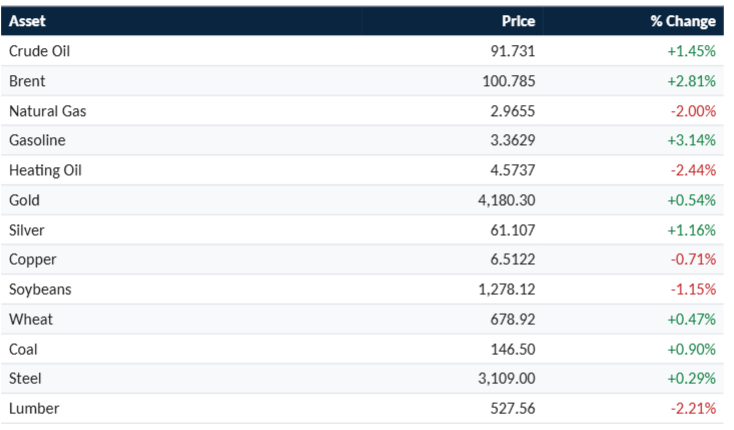
Oil jumps as the US sends a third carrier strike group and up to 10,000 more troops to the Middle East. Brent rose 4.4% to settle at $102.31 a barrel and West Texas Intermediate gained 2.7% to $92.87 after the Wall Street Journal reported that Marine Corps ships and additional troops will arrive by the end of November, and after Chinese refiners canceled some gasoline and jet fuel exports planned for October. The deployment could signal that Washington is preparing to escalate its war with Iran, with Trump reportedly telling aides he expects to resume bombing after the November midterms. Crude flows from the Middle East have effectively recovered to prewar levels, but the rebound looks fragile, with at least three tankers attacked this week as they tried to transit the Strait of Hormuz and fuel shipments still constrained.
US widens its wartime sanctions campaign to Iran's auto and rail sectors. The Treasury Department sanctioned Iran Khodro and SAIPA, which it said account for more than 90% of Iran's domestic auto market, along with the state-owned national railway company, a passenger rail operator, and a top private freight line, plus foreign suppliers in Indonesia, the UAE, and Turkey. The move, part of the "Operation Economic Outcast" campaign announced August 24, targets the land routes Tehran has leaned on to move petroleum, fertilizer, and chemicals since the US naval blockade cut off its shipments through the Strait of Hormuz.
MANAGEMENT & FED SPEAK
Scott Bessent, US Treasury Secretary, on the new Iran sanctions:
Bessent said the action "directly targets Iran's enablers" and lays the groundwork for the United States and its partners to "drain the regime's revenue once and for all."
Julie Sweet, CEO, Accenture, on the company's AI strategy:
Sweet said Accenture's focus is serving as a "bridge between AI and outcomes," even amid fears that the technology will disrupt the consulting business.
Elliott Hill, CEO, Nike, on the restructuring:
Hill told employees the plan "will result in fewer roles across Nike," and acknowledged that news like this creates uncertainty.
Sanjay Mehrotra, Chairman and CEO, Micron Technology, on rewarding employees:
Mehrotra said the company is "very pleased and proud" to reward team members in line with its record performance, even as the planned pay increases will dampen margins relative to Street expectations.
CORPORATE ACTIONS & EARNINGS CALENDAR
Top Ex-Dividend Companies for Friday, October 2:
Upcoming Earnings (Friday, October 2):
No events
Economic Calendar (Friday, October 2):
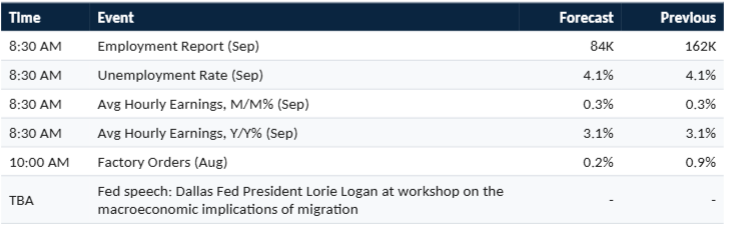
That's the wrap for today. Attention now turns to Friday's September jobs report, which will show whether the labor market is resilient enough to keep the Fed's hiking option alive, even as oil, the Iran standoff, and a restless global bond market keep yields and equities on edge.
Related post