AMD (NASDAQ:AMD) Crosses $1 Trillion: What the Valuation Now Assumes About AI Growth
AMD crossed a $1 trillion market capitalisation after strong second-quarter results, with Data Center revenue more than doubling. The valuation now hinges on management's 2027 growth forecasts, a wide forward earnings gap with Nvidia, and

Key Highlights
- AMD's market capitalisation crossed $1 trillion for the first time on Monday, as the shares hit a record high.
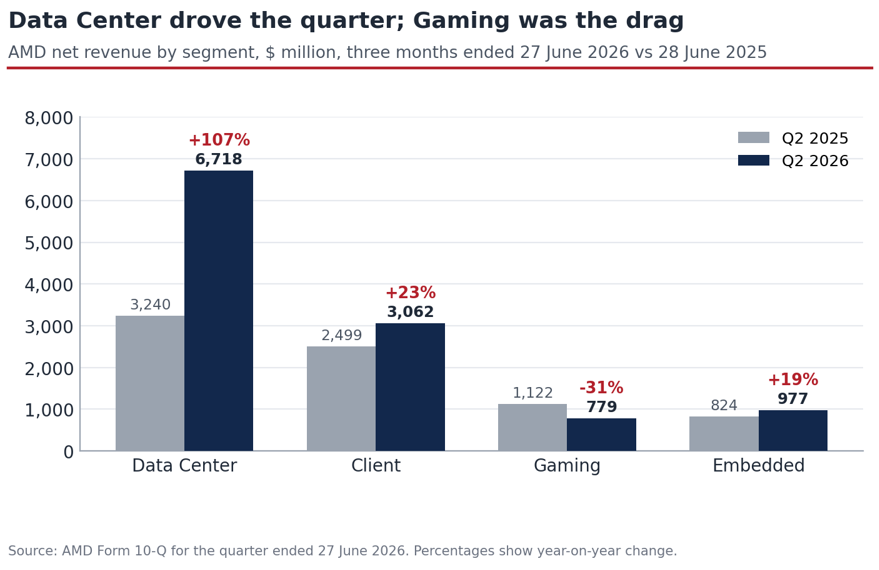
- Second-quarter revenue rose 50% to $11.5 billion, with Data Center revenue more than doubling to $6.7 billion.
- Management says it expects Data Center revenue to more than double in 2027, which raises the bar for execution.
- AMD trades at about 41 times forward earnings, against 16.3 times for Nvidia, so valuation is sensitive to growth delivery.
- Customer concentration, supply limits, financing commitments and warrant dilution are the main risks to the growth outlook.
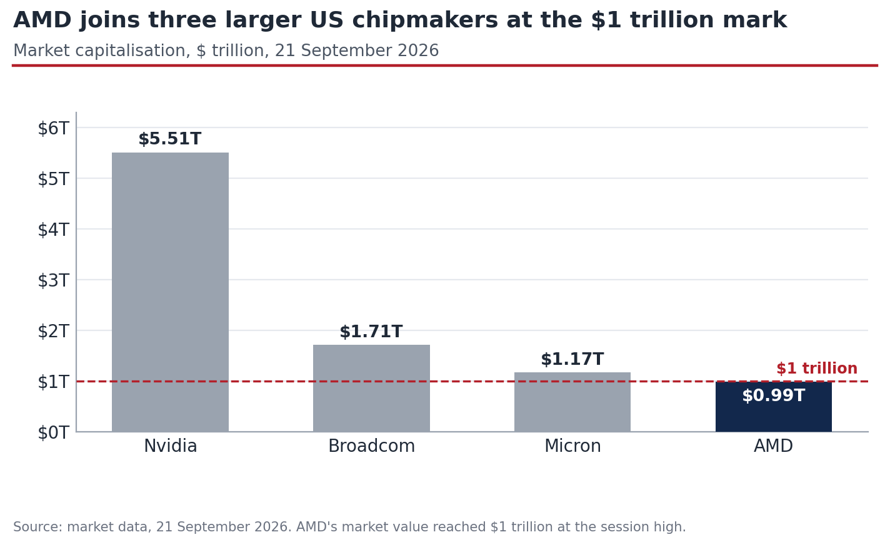
On Monday 21 September, Advanced Micro Devices (NASDAQ:AMD) crossed a market capitalisation of $1 trillion for the first time, as its shares rose about 9% to a record near $616 during the session. It is the fourth American chipmaker to reach the mark, after Nvidia (NASDAQ:NVDA), Broadcom (NASDAQ:AVGO) and Micron Technology (NASDAQ:MU).
The milestone matters less than the assumptions behind it. A $1 trillion valuation is a claim on years of future earnings, so the useful questions are how much of that growth is already in reported results, how much rests on management's forecasts, and what could interrupt it.
A milestone reached in a broad semiconductor rally
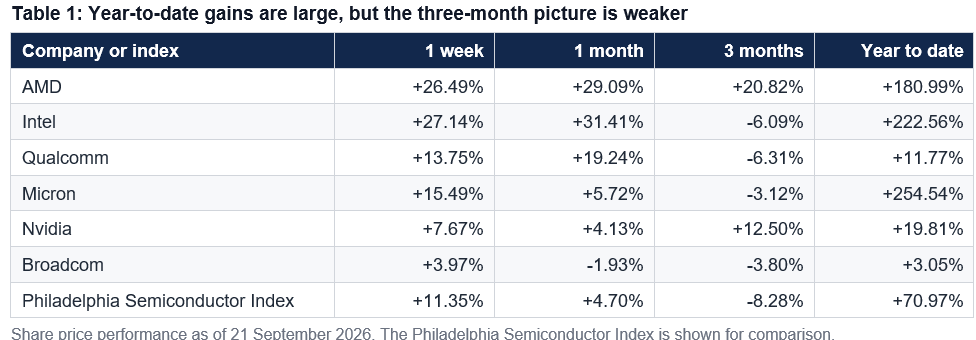
AMD's move was not isolated. The shares have gained about 26% over the past week and are up about 181% this year, against about 71% for the Philadelphia Semiconductor Index. Most chip stocks rose on Monday, with Intel (NASDAQ:INTC) and Qualcomm (NASDAQ:QCOM) among the gainers, and the index reached a one-month high.
The rally follows a cooler spell. The Philadelphia Semiconductor Index is up about 71% this year but down about 8% over three months, and Intel, Qualcomm, Micron and Broadcom are all lower over that period, so most of the year's gains came earlier. Only AMD and Nvidia are higher over three months. Enthusiasm faded as investors scrutinised hyperscaler spending on AI, while higher oil prices tied to the US-Iran conflict and expectations of higher-for-longer interest rates added pressure. One market strategist said investors now see AI as the one area able to work in a slowing economy. That is a claim about relative growth, and it is worth testing against the numbers.
The ranking is instructive. Nvidia is worth about $5.5 trillion, Broadcom $1.7 trillion and Micron $1.2 trillion, leaving AMD the smallest of the four at about $1 trillion after it touched the mark at the session high. That a memory maker outranks AMD suggests investors are valuing the AI supply chain broadly, from accelerators to networking and memory. Micron, up about 255% this year, has outpaced AMD, while Nvidia, up about 20%, has lagged both.
What the second-quarter filing shows
The reported numbers are strong. Net revenue was $11.5 billion, up 50% from $7.7 billion a year earlier. Data Center revenue rose 107% to $6.7 billion and now makes up 58% of the total, up from 42%. Management said EPYC server processor sales grew more than 70% and Instinct accelerator sales more than doubled.
Profitability needs closer reading. Operating income on management's adjusted measure was $3.1 billion, a 27% margin. GAAP operating income was $2.0 billion, after $544 million of acquisition-related amortisation and $503 million of stock-based compensation. The year-earlier quarter carried about $800 million of export-control charges on MI308 accelerators, according to management, which inflates the year-on-year improvement.
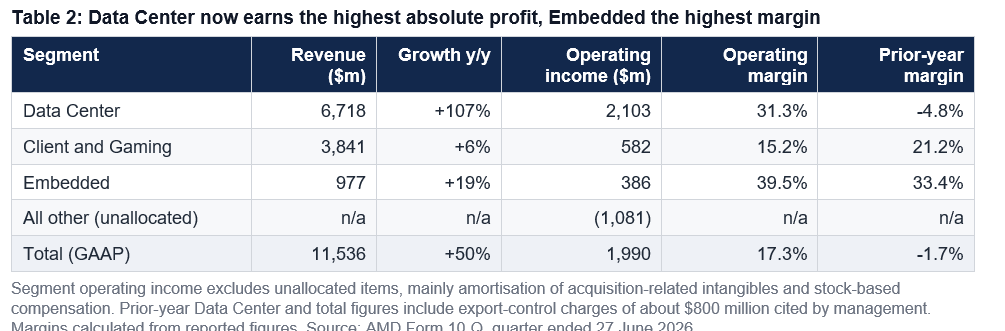
GAAP net income of $2.3 billion also included $598 million of other income, up from $98 million, which the filing attributes mainly to unrealised gains after the public listing of non-marketable equity securities. That is a valuation gain, not core operating profit. Free cash flow was $1.6 billion in the quarter, below net income, while inventory has risen to $8.5 billion from $7.9 billion at the end of 2025 and receivables to $7.3 billion from $6.3 billion.
The growth case rests on management's forecasts
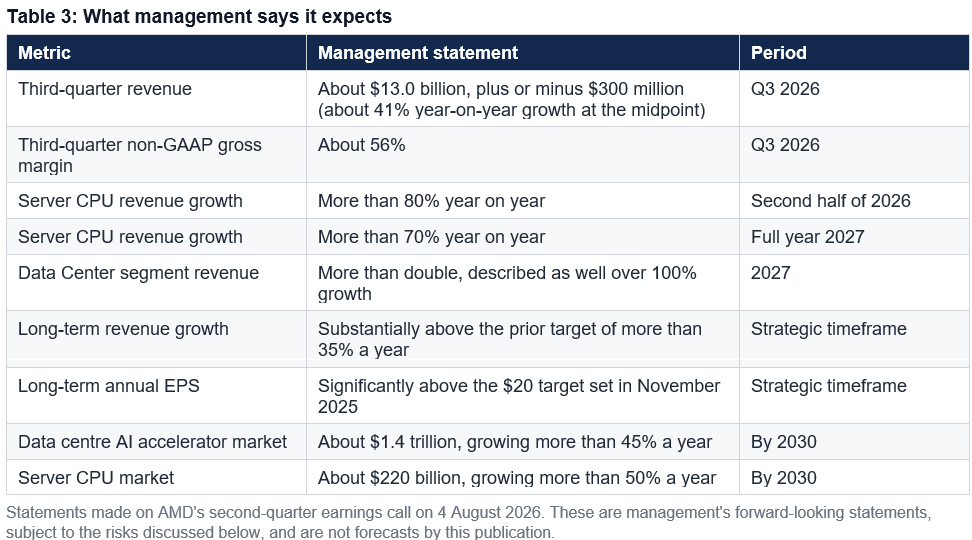
Beyond the quarter, the equity story depends on management's forecasts. The company's chief executive said on the earnings call that server CPU revenue should grow more than 80% year on year in the second half of 2026 and more than 70% in 2027, and that Data Center revenue should more than double in 2027. Asked how much work the word "more" was doing, management said the Data Center figure should be well over 100%.
Customer commitments give the forecast substance. OpenAI and Meta Platforms (NASDAQ:META) each intend to deploy up to 6 gigawatts of AMD GPUs, under agreements described in the filing. Anthropic plans up to 2 gigawatts of MI450 series GPUs, starting in the first half of 2027, and Microsoft (NASDAQ:MSFT) will deploy the Helios rack system on Azure. Helios shipments are due to begin late in the third quarter and ramp through the fourth. Third-quarter revenue guidance is $13 billion, plus or minus $300 million, or about 41% growth at the midpoint.
The company has also lifted its longer-term ambitions and its market sizing, summarised below.
What a $1 trillion valuation assumes
Expectations were already high in August, when the shares fell despite results that beat estimates and guidance above forecasts. AMD trades at about 41 times expected earnings for the next 12 months, just below its ten-year average of 44 times, while Nvidia, more than five times larger by market value, trades at about 16.3 times. Forward multiples rest on earnings estimates, and other providers show a higher figure for AMD, so the comparison is best read as indicative rather than exact.
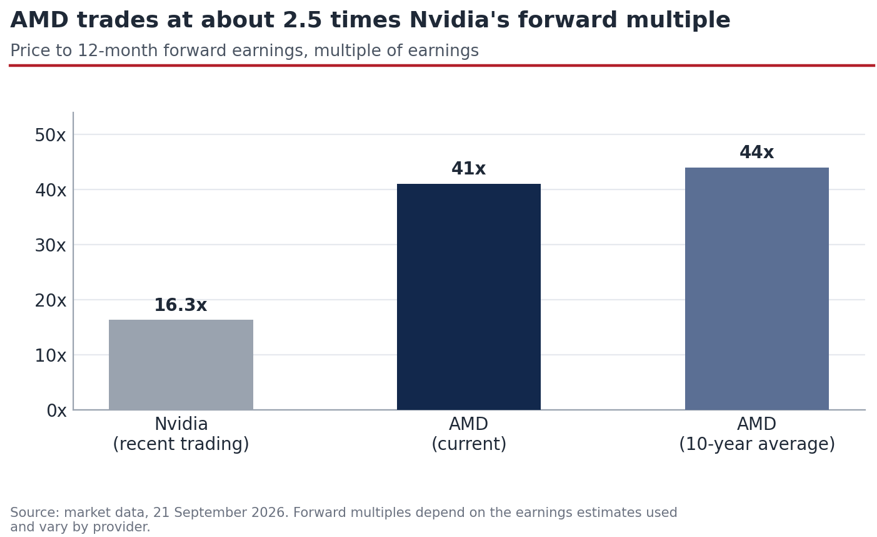
Two readings of the gap are possible. The first is that investors expect AMD's earnings to compound faster from a smaller base, with its Instinct accelerators early in their ramp and its server CPU share rising. Nvidia's chief executive has also said he expects to double chip sales next year, but doubling is arithmetically easier for the smaller company. The second is that investors apply a lower multiple to Nvidia because they doubt how long its earnings can stay this high. Multiples alone cannot settle which is right. AMD's own average is also a limited yardstick, as it spans years when earnings were far smaller and the business leaned more on PCs and gaming.
The share count matters too. AMD had about 1.63 billion shares outstanding at the end of July, so $1 trillion corresponds to a price of about $612 a share. The OpenAI and Meta agreements each came with a warrant to buy up to 160 million shares at $0.01, together about 20% of shares outstanding. The warrants vest in tranches linked to accelerator purchase milestones and to conditions on AMD's share price or performance, and none had vested by the end of June. If they do, they would represent demand secured and ownership ceded, and per-share measures would be spread over a larger base.
Risks beneath the multiple
The filing is candid about concentration. AMD depends on a small number of customers for a substantial share of revenue and receivables, and the gigawatt-scale agreements make that dependence more visible. It also warns that some customers may struggle to secure data centre capacity, power or capital, and may ask suppliers for alternative financing or deferred payment. AMD's own commitments are growing accordingly: about $30.3 billion of unconditional purchase commitments, up to $4.1 billion of exposure under lease guarantees for commercial partners, and, since the quarter closed, investment commitments of up to $5.0 billion and data centre leases with $9.5 billion of future payments.
Supply is a constraint as well as a strength. The chief executive described server CPU supply as tight and said much of this year's demand was not forecast, though supply is expected to improve in 2027, with good visibility on high-bandwidth memory allocation for that year. The filing nonetheless flags an industry-wide memory shortage that could raise customers' build-out costs. The chief financial officer noted that data centre AI carries a gross margin slightly below the company average, so product mix will matter as Helios scales.
Outside the data centre the picture is softer. Gaming revenue fell 31%, and management is planning for a weaker PC market in the second half as memory and component costs weigh on demand. Macro conditions still matter: the doubts over hyperscaler spending, interest rates and oil prices that cooled the sector may not be resolved by one day's rally. Export controls, which cost AMD about $800 million a year ago, show how policy can affect results.
What to watch
- The pace and margin of the Helios ramp in the fourth quarter.
- Whether third-quarter revenue lands within the $13 billion guidance range.
- Hyperscaler commentary on AI capital spending.
- The speed at which server CPU supply improves.
- Whether any warrant tranches linked to OpenAI or Meta vest.
In effect, a $1 trillion valuation is a statement that demand for AI computing will keep broadening beyond a single supplier and continue at pace. The reported numbers support the first half of that statement. The second half depends on factors AMD does not control, including customers' access to power, capital and memory, and on investor sentiment on AI spending. Outcomes could plausibly land on either side of what the market has priced.