Anatomy of a Supply Shock: The Fed Rate Hike You Might Be Misreading
This piece is part of Understanding Economics, where we take one economic term and explain it through something actually happening right now, rather than a textbook example. Here, that term was a supply shock, the reason the Fed raised interest rates into an oil crisis it has no power to fix.

September's rate rise was aimed at a problem interest rates cannot solve. That is not a mistake, and the reasoning is worth following.
KEY HIGHLIGHTS
- The Fed raised rates to 3.75-4.00 percent on September 16, its first increase since 2023, despite growth and employment forecasts moving in the right direction.
- Brent crude rose from near 57 dollars a barrel in January to above 100 dollars after Middle East shipping routes were disrupted, trading near 109 dollars in September.
- Headline inflation at 3.4 percent against core inflation at 2.4 percent points to pressure originating in energy rather than domestic demand.
- Monetary policy cannot reverse a supply disruption. It can only prevent a one-off price rise from becoming a lasting one.
- The distinction sets the boundary of what central banks can achieve when inflation originates outside the economies they govern.
A Rate Rise Aimed at a Distant Target
On September 16th the Federal Reserve raised interest rates for the first time in three years. It did so knowing that the force driving American inflation lies several thousand miles away, in a stretch of water over which it holds no authority whatsoever.
The Federal Open Market Committee, the group of officials who set the Fed's benchmark interest rate, voted unanimously to lift its target range to 3.75-4.00 percent. Raising rates makes borrowing more expensive across the economy, which normally slows spending and cools inflation. That decision would be unremarkable in an economy growing too fast for its own good. This one was not growing too fast. Growth for 2026 was revised upward to 2.3 percent. The unemployment projection was cut to 4.1 percent. Both figures moved in the direction that ordinarily argues against tightening, not for it.
What had changed was the price of oil, and it had changed for reasons no American interest-rate decision could touch. Understanding why the Fed raised rates anyway means separating two kinds of inflation that look identical on a monthly price report and behave nothing alike underneath it.
Two Kinds of Inflation
Inflation is usually a demand story. Households and firms want to buy more than the economy can supply, prices rise to close that gap, and a central bank raising rates attacks the problem at its source by cooling the spending that caused it in the first place. This is inflation working the way most people assume it always works, and it is the case interest rates were built to handle.
A supply shock, the subject of this piece, inverts that logic. It is a sudden disruption to the cost or availability of something the economy depends on, arriving from outside the economy rather than from within it. Nothing has changed about what people want to buy. What has changed is the cost of producing and moving it. Prices rise and output falls at the same time, a combination ordinary demand-driven inflation rarely produces, because ordinary demand-driven inflation comes with growth, not against it.
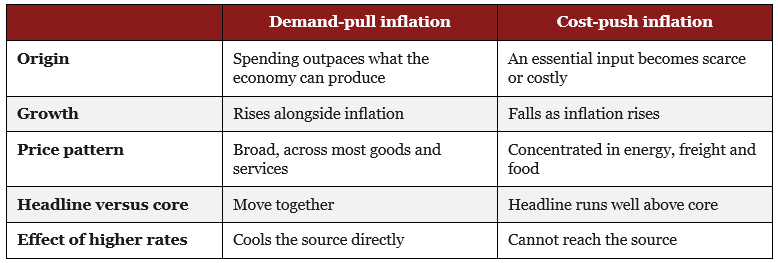
Table 1: The two inflations diverge on almost every observable dimension, most consequentially on the final row.
That final row is where the policy problem sits. Against demand-pull inflation, higher rates work directly on the cause. Against a supply shock, they never reach it. No interest rate refills an oil tanker or reopens a shipping lane.
The Shock Itself
Since fighting between the United States, Israel and Iran escalated in February 2026, the Strait of Hormuz, the narrow sea passage between Iran and the Arabian Peninsula through which tankers must travel to leave the Persian Gulf, has been repeatedly disrupted. That single passage ordinarily carries roughly a fifth of the world's traded oil and liquefied natural gas, which makes it one of a handful of points on the map where a local disruption becomes a global one. When it closes even partially, the amount of oil reaching the world market falls regardless of what any government elsewhere decides to do.
The price response was immediate. Brent crude, the international benchmark price most oil contracts are priced against, traded near 57 dollars a barrel in January. It rose above 100 dollars within weeks of the escalation and peaked near 113 dollars in April. It has since eased, but not far, trading near 109 dollars in mid-September, roughly double its level before the conflict began.
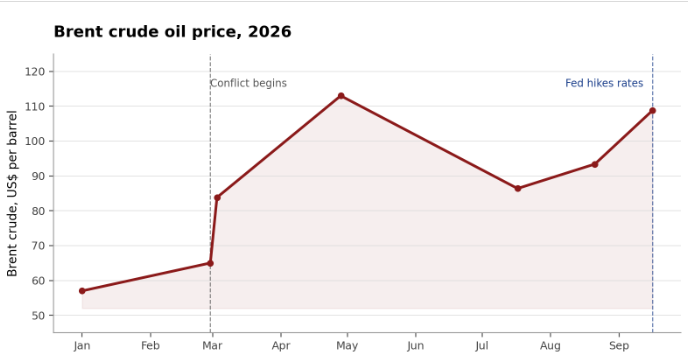
Figure 1: The step change arrives at the point of conflict, not through any gradual shift in demand.
The shape of that line carries its own evidence. Demand-driven price rises tend to build gradually as an economy heats up over months. This one steps up almost vertically at a single moment, which is what a supply disruption looks like once it is plotted against time rather than described in words.
What the Data Reveals
Oil does not remain in the oil market. It enters the cost of almost anything grown, manufactured or transported, because most goods spend part of their life on a truck, ship or plane. Diesel, the fuel of freight and agriculture, has reached roughly 6 dollars a gallon in the United States, raising delivered costs across goods that have no direct connection to energy at all.
The clearest evidence sits in the gap between two measures of inflation. Headline inflation, which counts every category including food and energy, held at 3.4 percent in August. Core inflation, which strips out food and energy specifically because they swing sharply for reasons that often have nothing to do with the domestic economy, ran cooler at 2.4 percent. A full percentage point separates the two.
Were American households and businesses simply spending beyond what the economy could produce, both measures would be climbing together, since demand-driven inflation does not spare one category and ignore the rest. Instead the pressure concentrates in exactly the categories a foreign supply disruption would touch, while the underlying domestic trend sits far closer to the Fed's target. The inflation is imported rather than homegrown, and the gap between headline and core is how that shows up in the numbers.
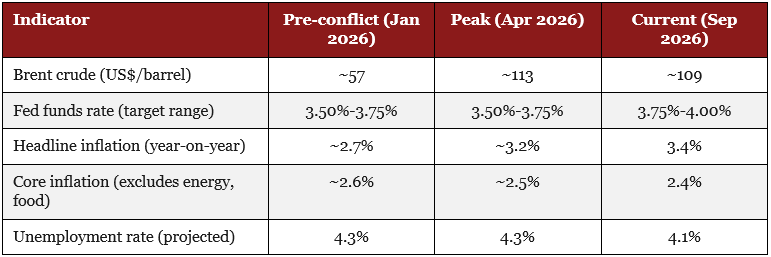
Table 2: Selected indicators before, during and after the oil price shock. Figures are approximate and drawn from Federal Reserve projections and published market data.
Why Raise Rates Against a Problem They Cannot Fix
This produces an apparent contradiction worth sitting with. If interest rates cannot lower the price of oil, and oil is what is driving inflation higher, what did September's rate rise actually accomplish?
The answer lies in a distinction economists draw between two stages of a price shock. The first stage is the direct rise itself: oil gets more expensive, and everything built from oil gets marginally more expensive with it. Left alone, this stage fades once the disruption ends, in the same way a one-off toll on a road stops affecting your weekly spending once you stop paying it. The second stage is different and more dangerous. If the higher prices last long enough, people stop treating them as temporary. Workers who expect prices to stay elevated ask employers for larger pay increases to keep up. Employers who expect their own costs to stay elevated raise the prices of what they sell before they are forced to, rather than waiting and absorbing the hit. Once that happens, the inflation has taken on a life independent of the oil price that started it, and it does not go away simply because the original disruption ends.
A central bank cannot do anything about the first stage. It can influence the second, because raising the cost of borrowing discourages exactly the kind of pre-emptive price and wage increases that turn a temporary shock into a lasting one. That is the specific and narrow job September's rate rise was doing. With sixteen of eighteen Fed officials projecting at least one further increase this year, the Committee is signalling that it currently views the risk of that second stage as more dangerous than the growth it might sacrifice by acting against it.
The Cost of Acting
The decision is not free, and any account that presents it as obviously correct is leaving something out. An oil shock has already reduced how far a household's income stretches by making fuel more expensive, functioning much like an unlegislated tax collected by events overseas rather than by any government. Raising interest rates on top of that removes even more spending power from an economy already absorbing that external hit, which is why growth forecasts, while still positive, are not without risk from here.
A central bank facing this choice is trading some growth for the credibility of its inflation target, the public's confidence that prices a year or two from now will behave roughly as promised. Losing that confidence is expensive to win back. In the early 1980s, after a decade in which the Fed had allowed inflation to become entrenched in exactly the way described above, restoring that confidence required interest rates high enough to push unemployment above ten percent, a far larger and more painful correction than would have been needed had the problem been addressed earlier. That history is part of why today's Fed treats the risk of delay as costly even when acting early carries a price of its own. Reasonable economists still disagree about where that balance sits, which is why supply shocks reliably produce the sharpest disputes in monetary policy.
The Stagflation Question
The word stagflation has reappeared in commentary around this episode, and the relationship between the two ideas is worth stating precisely, since they are often used as though they mean the same thing. A supply shock is an event: a disruption to the cost or availability of something the economy needs. Stagflation is a possible consequence of a severe and prolonged one, describing a sustained period in which high inflation and weak growth persist together for long enough that a central bank cannot address either problem without making the other worse.
Current evidence points to the shock rather than the sustained condition. Unemployment is projected near 4.1 percent, growth remains positive, and core inflation sits closer to target than headline. The 1970s episode that gave the term its meaning combined inflation and unemployment both running in double digits across several years, an order of magnitude beyond present conditions.
A shock lasting long enough to embed itself in expectations would change that assessment. A prolonged closure of Hormuz shipping routes, evidence of energy costs entering wage settlements, or a visible loss of confidence in the Fed's target would each mark a step in that direction. None has occurred so far. Each remains plausible, and preventing exactly this kind of drift is what September's rate decision was designed to do.
A Recurring Problem
Supply shocks of this kind are neither rare nor confined to energy. Shipping bottlenecks during the pandemic were one. Crop failures are. So are export restrictions on critical minerals and disruptions to semiconductor production, both increasingly common as global supply chains fracture along political lines. The pattern repeats in each case: prices climb, output suffers, and a central bank finds itself constrained in the same particular way, able to influence how the shock spreads but not its source.
What the current episode makes visible is the actual boundary of what a central bank can do. The Federal Reserve can influence how Americans borrow, spend and set prices. It cannot influence whether tankers pass safely through a contested strait on the other side of the world. As that kind of disruption becomes a recurring feature of markets rather than an occasional interruption, the distinction between inflation a central bank caused and inflation it merely inherited is likely to matter a great deal more than it has in a generation.
IN SHORT
A supply shock raises prices and slows growth at the same time by disrupting something the economy depends on, from outside the economy itself. Interest rates cannot undo the disruption. They can only stop it from convincing everyone that the higher prices are here to stay.