ASX Pre-Market: Tuesday, 22 September 2026
ASX SPI 200 futures point to a firmer open, up 29 points, or 0.33%, to 8,809, after Wall Street surged overnight as oil prices and bond yields tumbled and AI-linked stocks led a broad rally, with the Nasdaq closing at a fresh record.

Welcome to your morning briefing on overnight Wall Street action and what's set to move the ASX 200 at the open.
ASX Futures
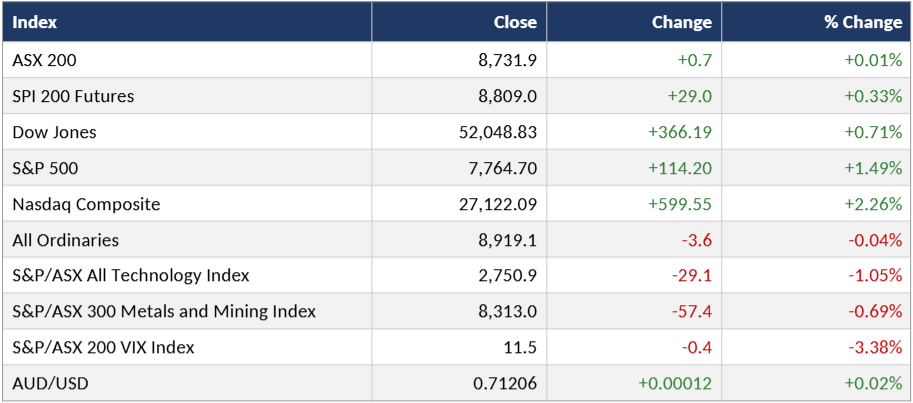
SPI 200 futures were up 29 points, or 0.33%, to 8,809, pointing to a firmer open after Monday's local session finished essentially flat. The stronger lead follows Monday's close, where the ASX 200 edged up just 0.7 points, or 0.01%, to 8,731.9, and comes as Wall Street surged overnight as tumbling oil prices and bond yields fuelled a sharp rally in technology and AI-linked names.
Overnight Leads + This Morning
Monday's local session was mixed beneath a flat headline, with the ASX 200 closing just 0.7 points higher at 8,731.9 while the All Ordinaries slipped 3.6 points, or 0.04%, to 8,919.1. Advancers edged past decliners 145 to 134 on the S&P/ASX 300, but only five of eleven sectors finished green as traders rotated defensively ahead of next week's RBA decision. Financials led, with insurers NIB Holdings, Medibank Private and Suncorp firmer alongside Macquarie Group and the big four banks. Health Care extended its strong start to the financial year, led by a 5.3% surge in Cochlear and a further gain in CSL. Energy finished positive despite falling crude, as refiners Viva Energy and Ampol benefited from lower input costs, even as coal names Coronado Global Resources, New Hope and Whitehaven fell sharply on weaker coking and thermal coal prices. Information Technology was the session's worst performer, down 1.6%, facing AI disruption risk rather than AI opportunity even as the Nasdaq rallied overnight. Perpetual tumbled 15.1% after rejecting a $22.50-a-share takeover proposal from EQT, while Telix Pharmaceuticals fell 11.7% on news of a $3.3 billion acquisition of German isotope producer ITM.
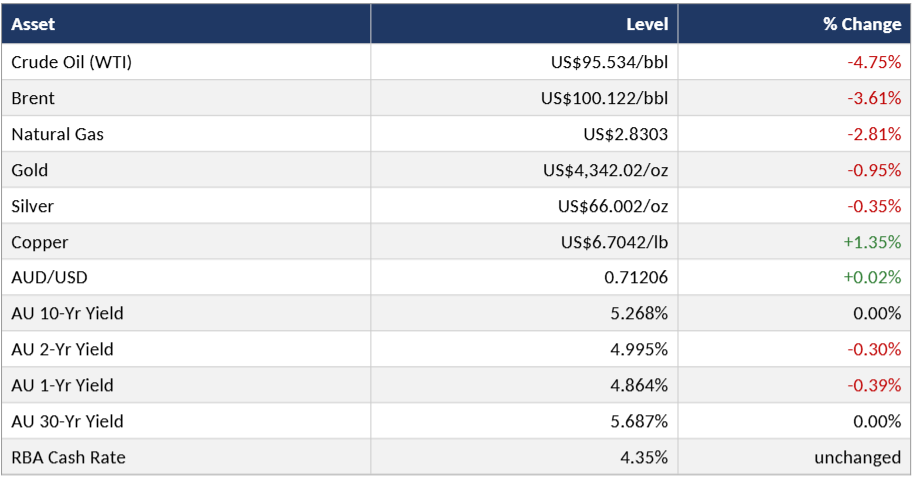
Overnight, Wall Street surged as falling oil prices and easing Treasury yields fuelled a rally led by technology and AI-linked names. The S&P 500 jumped 114.20 points, or 1.49%, to 7,764.70, within 0.4% of its record high, the Nasdaq Composite leapt 599.55 points, or 2.26%, to a fresh record close of 27,122.09, its first since June, and the Dow added 366.19 points, or 0.71%, to 52,048.83. Chip stocks led, with Intel surging 12%, AMD rising 10% to cross a $1 trillion market cap for the first time, and Meta Platforms jumping more than 11% on optimism around its Muse AI product. Brent fell 3.4% to $100.34 and WTI dropped 4.5% to $95.78, both sliding as Trump signalled he would probably be open to meeting Iranian President Masoud Pezeshkian at this week's UN General Assembly and decided against bombing Houthi militants for now. The US ten-year Treasury yield eased more than four basis points to 4.951%, retreating from the 5% threshold it crossed last week for the first time since 2023. Bitcoin rose above $86,000, its highest level since late January, as risk appetite broadened.
Close Levels
Analytical View
Monday's local session showed a market still working out how to price a Reserve Bank that now looks almost certain to hike. The flat headline obscured genuine rotation beneath it: capital flowed into the market's most liquid, fully franked defensives, financials and health care, while technology and materials were sold to fund the move, a pattern repeated through much of the month. Perpetual's fall on its rejection of EQT's takeover proposal and Telix's slide on its ITM acquisition were the standout single-stock stories, but the broader signal was macro: five sectors up, six down, in a session traders described as defensive positioning ahead of next week's RBA meeting.
Overnight, Wall Street's session was a genuinely broad risk-on move, though not without a warning sign beneath the surface. The rally was driven by a rare alignment of easing oil prices, falling bond yields and renewed AI-trade enthusiasm, with the Nasdaq's record close capping a sharp reversal from a mostly lower week. Yet more S&P 500 stocks fell to fresh 52-week lows on Monday than rose to new highs, thirty against seven, even as the index closed within 1% of a record, a combination that has occurred only twice before, in December 1999 and July 1929, both ahead of major market tops. That divergence does not necessarily signal an imminent reversal, but it suggests Monday's rally was narrower under the hood than its headline numbers implied, concentrated in communication services, technology and consumer discretionary while much of the rest of the market lagged. For the ASX 200, the overnight easing in oil and yields is a genuine tailwind into Tuesday's open, though the same RBA question that shaped Monday's session remains unresolved.
What could change the picture: Australia's flash September PMI and August labour force data are due this week, ahead of the RBA's own rate decision on 28-29 September, with markets now pricing a 91% probability of a hike that would take the cash rate to 4.6%.
Commodities & Rates
Home & Away
Names with a foot in both camps today, ASX movers with direct overseas read-through, and overseas news with a local echo.
Falling oil prices create a split signal across Australian energy stocks. Brent fell 3.4% to $100.34 and WTI dropped 4.5% to $95.78 overnight as Trump's openness to meeting Iran's president reduced some of the geopolitical risk premium in crude. That is a negative read-through for upstream producers Santos (ASX:STO), Woodside Energy (ASX:WDS) and Beach Energy (ASX:BPT), since lower benchmark prices reduce the reference price for oil and gas-linked revenue. The effect is different for refiners: Viva Energy (ASX:VEA) and Ampol (ASX:ALD) had already risen on Monday as cheaper crude reduced input costs, and the further overnight decline could extend that refining-margin tailwind, subject to product prices and crack spreads.
Copper's overnight rebound gives miners some relief after Monday's weakness. Copper gained 1.35% to $6.7042/lb overnight after the ASX 300 Metals and Mining Index fell 0.69% on Monday. The move is a more supportive commodity signal for copper-exposed miners including BHP (ASX:BHP) and South32 (ASX:S32). BHP produced around 1.95 million tonnes of copper in FY26, while South32 holds a 45% interest in the Sierra Gorda copper mine in Chile. The broader metals read-through still depends on Chinese industrial demand.
Trump-Xi summit is a second-order read-through for Australian miners. President Trump is due to meet Chinese President Xi Jinping later this week, with tariffs and critical minerals among the issues under discussion. For China-exposed Australian resource companies, the significance lies less in the summit itself than in any subsequent shift in Chinese industrial demand, trade barriers or critical-mineral supply chains. BHP and Rio Tinto (ASX:RIO) remain the most relevant names given their large iron ore businesses and BHP's substantial copper exposure.
Local Catalysts
Kestelman's Brand Collective snaps up Glue Store, The DOM and Running Bare. Billionaire Larry Kestelman's Brand Collective has acquired the IP and customer database of failed youth fashion chain Glue Store from Accent Group, along with online discounter The DOM and activewear label Running Bare, to anchor a new marketplace division. Chief executive David Thomas said the deal gives the group access to more than half a million customers and a direct channel to sell brands including Champion, Reebok and Superdry, with Glue and The DOM relaunching before Christmas and Running Bare in the new year. Brand Collective posted sales of more than $600 million last financial year and plans to open 40 new stores this year.
Morgan Stanley flags One Nation's rise as a risk to retail and housing stocks. A Morgan Stanley research note found retailing and housing development stocks are among those most exposed to One Nation's growing political influence, alongside infrastructure and utilities groups dependent on foreign investment. The party's platform includes removing more than 750,000 temporary migrants over three years and capping net overseas migration at about 130,000 annually, which the broker said would be a meaningful headwind to growth and could push up wages in labour-intensive sectors. The party also proposes exiting the Paris Agreement and government-backed 30-year fixed mortgages at 5%, a proposal Morgan Stanley called "highly problematic." The latest AFR/Redbridge/Accent Research poll showed One Nation on a 28% primary vote against Labor's 29%.
Regal Partners sees a path to BHP and Commonwealth Bank both trading at $100. Regal Partners investment director Charlie Aitken told clients the fund expects a multi-year rotation out of Commonwealth Bank and into BHP, forecasting both stocks could eventually trade at around $100 a share. BHP has risen more than 30% this year to a record $68.77 in August on surging copper prices, while CBA has fallen 6% to around $152 amid concerns over slowing credit demand and falling property prices. Regal argued Australian banks face indirect exposure to stress in the private credit sector following developer Bathla's collapse, and that the sector's roughly 23% weighting in the ASX 200 faces further pressure from the upcoming Firmus and Glencore dual listings. Other fund managers were more cautious on BHP specifically, with Ten Cap trimming its position after the stock's 10% August rally.
Global News
Trump and China's Xi Jinping to hold summit as trade talks continue. President Trump is set to meet Chinese President Xi Jinping later this week to discuss tariffs, critical minerals and broader economic ties, following weekend talks in New York between Treasury Secretary Scott Bessent and Chinese Vice Premier He Lifeng that Bessent described as a "very successful engagement." China's Foreign Ministry confirmed Xi will make a state visit to the United States between 23 and 25 September.
Greenland-linked stocks surge on US-Denmark security pact. Shares in several US-listed companies exposed to Greenland soared after the United States and Denmark reached a security agreement on the Arctic territory, expected to be signed during this week's UN General Assembly. Greenland Energy jumped 159%, Greenland Mines rose more than 200% and Critical Metals Corp gained nearly 37%. Greenland's Prime Minister Jens-Frederik Nielsen said the deal would "ensure and strengthen the security of Greenland, the Kingdom of Denmark, the United States and the Western Alliance."
Paramount clears final hurdle in $154 billion Warner Bros Discovery merger. Paramount reached a settlement with 12 state attorneys general and the Writers Guild over lawsuits challenging its $110 billion acquisition of Warner Bros Discovery, clearing the way for a deal that will combine two major Hollywood studios, two subscription streaming services and dozens of television channels. Paramount shares fell 2.9% on the news while Warner Bros Discovery jumped 10.8%, with Paramount committing to release 30 movies a year across the combined studios.
OpenAI proposes global standards for frontier AI safety. OpenAI published a set of proposals focused on alignment research and recursive self-improvement, calling for international cooperation to build technical standards for frontier AI models. The proposals follow similar recommendations from Anthropic last week, part of a widening industry response to warnings from AI researchers about the technology's potential risks.
Management & Fed / RBA Speak
Michele Bullock, Governor, Reserve Bank of Australia, on the inflation outlook:
Addressing a House of Representatives Economics committee on Friday, Bullock said inflation risks previously flagged by the Reserve Bank "appeared to be materialising," pointing to the Middle East conflict, the AI infrastructure boom and extreme weather as pressures pushing prices higher. She said the bank remained focused on ensuring inflation "does not become embedded into price and wage-setting decisions."
Jim Chalmers, Treasurer of Australia, on the 2026 Intergenerational Report:
Chalmers said the report's forecast that deaths would outnumber births by the 2060s reflected a population that "will change in shape and size and faster than we previously thought," describing the artificial intelligence revolution as "the most consequential new emphasis" in the report and "the biggest economic transformation of our lifetime."
Alberto Musalem, President, Federal Reserve Bank of St. Louis, on the case for further tightening:
Musalem said additional interest rate increases may be needed to meet the Fed's inflation goal, warning that without further policy restraint, inflation is "more likely to be substantially above our 2 per cent target in 18 months than at target." He described the Fed's current 3.75% to 4% range as "on the accommodative side."
Corporate Actions & Earnings Calendar
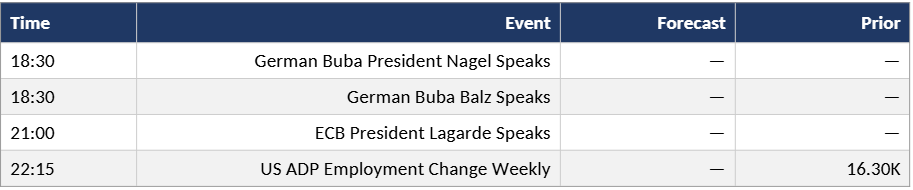
Economic Calendar (Tuesday, 22 September):
Ex-Dividend Today (Tuesday, 22 September 2026):

Closing Line
That's the pre-market wrap for today. The ASX looks set for a firmer open, with SPI 200 futures pointing to a 0.33% gain as Wall Street's overnight rally, powered by falling oil prices, easing bond yields and a resurgent AI trade, offers a broad tailwind into Tuesday's session. Australia's flash PMI and labour force data are due this week ahead of the RBA's rate decision on 28-29 September, with markets now pricing a 91% probability of a hike.