ASX Post-Market Wrap: 22 September 2026
The ASX 200 climbed to its highest close since September 10 as a plunge in oil prices eased inflation fears and powered a Nasdaq record, lifting technology, consumer discretionary and real estate stocks together. RBA officials Sarah Hunter and Michele Bullock both flagged further rate hikes, with Bullock also warning of a possible "AI bubble."

Tech Roars Back as Falling Oil Sends Wall Street to a Record and Bond Yields Lower
Welcome to ASX Post-Market Wrap, your quick end-of-session rundown of what moved the Australian market today, plus what's shaping global sentiment into tonight's Wall Street open.
Markets Today
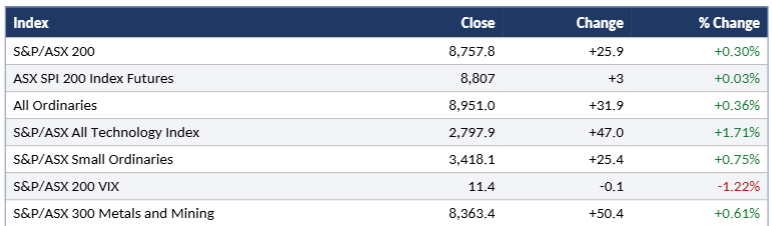
The ASX 200 rose for the second time in three sessions on Tuesday, adding 25.9 points, or 0.30%, to 8,757.8, its highest close since September 10 and a clean break from last week's three-month low. It was a broad, healthy advance: in the S&P/ASX 300, advancers beat decliners by a solid 172 to 104, and seven of eleven sectors finished in the green. The move traced directly back to overnight Wall Street, where a 3.4% plunge in oil prices eased inflation fears, pulled bond yields lower, and sent the Nasdaq to its first closing record since June. That combination handed Technology, Consumer Discretionary and Real Estate a rare simultaneous winning session locally, while Utilities and Energy were the session's only real losers as bond-sensitive defensives fell out of favour and oil and gas producers tracked the crude price down.
Analytical View
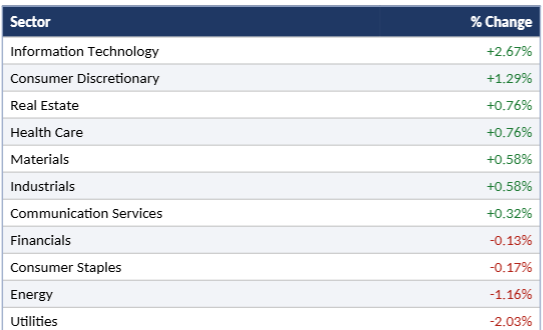
Information Technology was Tuesday's best sector, up 2.7% for its best session since August 28, and for once the Nasdaq's record overnight close resonated directly locally. Lower bond yields — the direct product of falling oil easing inflation expectations — reduce the discount rate applied to long-duration technology earnings, and a Nasdaq record likely forced some local fund managers to add exposure to a sector that has been one of the market's most persistent underperformers this year. Catapult Sports, Nuix, Megaport, NextDC, Life360 and WiseTech Global all gained, several by more than 4%. Consumer Discretionary caught the same lower-oil tailwind through a different channel, up 1.3% as falling crude flows directly to consumers through cheaper petrol, easing the cost-of-living pressure that has weighed on the sector all year; Corporate Travel, Bapcor, Lovisa, Light & Wonder and Universal Store were among the sharpest gainers as investors bought back into the most beaten-down names. Real Estate added 0.8% as the textbook bond-proxy beneficiary of falling yields, led by Ingenia Communities, Stockland, Lifestyle Communities and Goodman Group, in a sector that had been under sustained pressure from elevated yields through September. Health Care rose 0.8%, extending its run as the ASX's most consistent performer through both good sessions and bad, with Telix Pharmaceuticals, Starpharma and CSL all higher.
Materials added 0.6% on a broad recovery in base metals and critical minerals names, as COMEX copper gained a further 0.7% in Asian trade after rising 1.1% overnight on strong Chinese demand; Aeris Resources, Aurelia Metals, 29Metals, Sandfire Resources and Nickel Industries were among the beneficiaries, while rare earths and critical minerals names including Lynas Rare Earths, IperionX, Viridis Mining and Minerals and Iluka Resources all advanced. Industrials and Communication Services both edged higher too, up 0.58% and 0.32% respectively, while Financials was the only real laggard among the majors, down 0.13% in a session where lower yields should logically have been a tailwind; ANZ and Macquarie bucked the drift, while Commonwealth Bank, National Australia Bank and Westpac all slipped modestly. Consumer Staples was also mildly softer, down 0.17%. Utilities was Tuesday's worst-performing sector by some margin, down 2.03%, as the same falling yields that lifted Real Estate and Technology made bond-proxy income stocks less attractive relative to a market suddenly back in a risk-on mood. Energy fell 1.16% for its worst session in a week as Brent crude futures plunged 3.4% overnight before steadying in Asian trade; Woodside, Karoon Energy, Santos and New Hope Corp all fell, though the sector again split cleanly, with refiners Ampol and Viva Energy moving the other way as cheaper crude improves their margins.
The bigger picture is a market finally getting the combination it has spent weeks waiting for: oil retreating from danger territory, the US 10-year yield slipping back under 5%, and the AI trade reasserting itself after tech heavyweights led Wall Street's best session since early August. Attention now turns to Wednesday's arrival of Chinese leader Xi Jinping in Washington for his first visit in over a decade, with artificial intelligence, tariffs, the Iran war and rare earths all expected on the agenda alongside a widely anticipated extension of the fragile trade truce. Elsewhere, the Bank of Japan's rate rise last week to a 31-year high has done little to support the yen, which sits near a three-week low after two dissenting votes and a lack of explicit hawkish guidance disappointed investors, while the US dollar index sits near a seven-week high as traders lift the odds of an October Fed hike to 56%, from 43.5% a week earlier.
What could change the picture: flash September PMI and August labour force data due later this week, and the RBA's own rate decision on September 28-29, where hike odds have moved higher through the day as officials have spoken.
Sector Performance
Winners & Losers
Top 5 Gainers:
- IEL (Idp Education Ltd): +20.67% to $2.16
- SRL (Sunrise Energy Metals Ltd): +12.71% to $20.48
- CRN (Coronado Global Resources Inc): +9.76% to $0.225
- A4N (Alpha Hpa Ltd): +9.26% to $0.59
- EOS (Electro Optic Systems Holdings Ltd): +8.22% to $11.32
Top 5 Decliners:
- TGN (Tungsten Mining NL): -15.58% to $0.325
- CYL (Catalyst Metals Ltd): -14.37% to $5.78
- EIQ (Echoiq Ltd): -7.75% to $0.655
- XRF (XRF Scientific Ltd): -7.52% to $1.66
- LFS (Latitude Group Holdings Ltd): -6.42% to $0.875
Volume Outliers
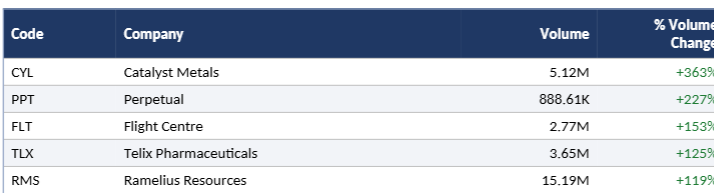
Stocks trading furthest above their 90-day average volume:
Broker Moves
52-Week Highs & Lows
Highs:
Lows:
Near Highs
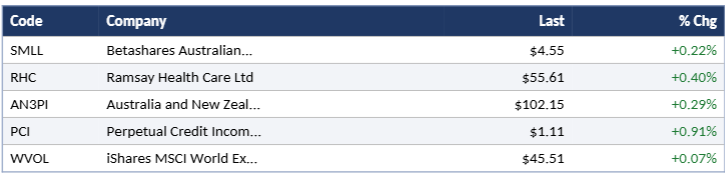
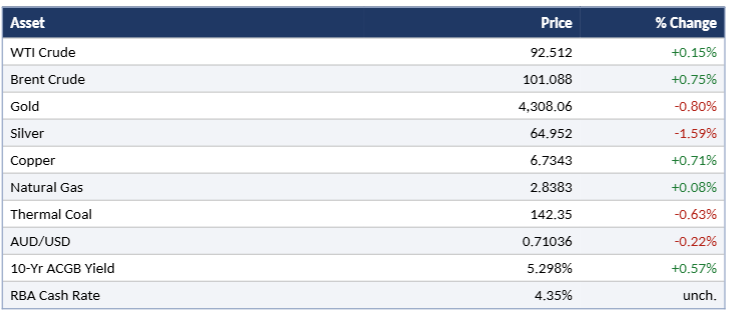
Commodities & Rates
Top Stories: Australia
Australian fuel prices hit six-month high as second Middle East energy route is hit. The average price of unleaded petrol has climbed back above $2.30 a litre, its highest level in nearly six months, after drone attacks damaged a second Middle East energy route and choked off more oil from global markets. The latest strikes follow the disabling of Saudi Arabia's East-West pipeline two weeks ago, which closed off the kingdom's primary bypass around the Strait of Hormuz and deepened fears the global supply crunch could worsen. Some analysts now warn of a worst-case scenario that could add a further 50 cents a litre at the bowser if the disruption persists.
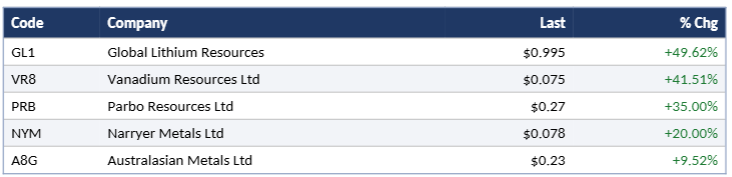
Global Lithium Resources agrees to $333 million takeover by Abu Dhabi's Titan Lithium Group. Global Lithium, backed by billionaires Chris Ellison and Gina Rinehart, has agreed to be acquired by Titan Lithium Group for $1.15 a share in cash, a near 75% premium to its recent share price, in a deal that hands the buyer control of the undeveloped Manna lithium project 100 kilometres east of Kalgoorlie. Shares surged 49.6% on the news. Global Lithium managing director Dianmin Chen recommended the offer to shareholders, saying it "fairly recognises the value and quality" of the project and lets shareholders "realise that value in cash today." A shareholder vote is expected later this year.
Accent Group chairman puts board up for re-election as Frasers takeover fight continues. Accent Group chairman Lawrence Myers has put the majority of the footwear retailer's board up for re-election at November's annual general meeting, as the company continues to fend off a hostile takeover approach from UK-based Frasers Group. "We are putting the question of board composition directly where it should be: in the hands of shareholders," Myers said. Frasers, which holds 22.9% of Accent, had its 65-cents-a-share bid rejected by the board in June as "materially inadequate." Accent's non-executive directors Donna Player and Anne Loveridge will stand for re-election alongside Myers, while Frasers' nominee director and Accent chief executive Daniel Agostinelli will not. The company reported flat sales of $1.64 billion and a 3.4% fall in earnings to $279 million for the year to June.
Trading platform Stake discloses data breach at third-party US supplier. Australian share trading platform Stake has told customers their personal information, including phone numbers, addresses, tax status and portfolio values, was exposed in a cybersecurity incident at DriveWealth, the third-party supplier that provides execution, custody and clearing services for its US trading arm. Stake said login credentials, bank account details and identity documents remained secure, and that no unauthorised trading, transfers or withdrawals had occurred on any account. The company has notified Australia's Office of the Information Commissioner and New Zealand's Privacy Commissioner and is contacting affected customers directly.
Tungsten Mining shares slide 14% after $50 million capital raise. Shares in Tungsten Mining fell 14.3% to 33 cents after the company secured commitments from institutional investors for a $50 million placement priced at 32 cents a share. Jefferies and Euroz Hartleys ran the raise, with proceeds earmarked for development of the company's Watershed project in Queensland. Despite the fall, Tungsten Mining shares remain more than triple where they traded a year ago.
Global Stories
Wall Street's AI trade roars back as Meta agent sparks a chip-stock rally. The S&P 500 jumped 1.5% overnight for its best session since early August, and the Nasdaq Composite surged 2.3% to its first closing record since June, as early signs of success for Meta's new AI agent lit a fire under the chip sector. Meta shares surged more than 11%, adding roughly US$192 billion in market value in a single day, while Intel jumped 12% and Advanced Micro Devices rose about 10% to briefly touch a US$1 trillion market capitalisation. Nvidia added 2% and fibre optic maker Corning climbed nearly 6%. Beneath the record headline, however, breadth was notably thin: more stocks in the S&P 500 fell to fresh 52-week lows than rose to 52-week highs, an unusual combination last seen in December 1999.
Xi Jinping arrives in Washington for first US visit in over a decade. Chinese leader Xi Jinping is due in Washington on Wednesday for a summit with President Trump, with artificial intelligence, tariffs, the Iran war and rare earths all expected to feature prominently. Treasury Secretary Scott Bessent said over the weekend that talks with Chinese Vice Premier He Lifeng had been a "very successful engagement," and that the tariff truce between the two countries — due to expire November 10 absent an extension — is likely to be maintained, alongside progress on a proposed reciprocal $30 billion tariff reduction covering non-critical goods. Most analysts expect the summit to deliver strong optics with limited substantive change, similar to Trump's visit to Beijing in May.
Oil ticks higher even after its sharpest four-day drop in months, as diplomacy and sanctions both loom. Brent and WTI crude both edged up in Tuesday trade, clawing back a small part of a combined slide of more than 9% over the prior four sessions, as markets weighed a possible diplomatic breakthrough against a fresh escalation in US pressure on Iran. Treasury Secretary Bessent said all Iranian airlines will be barred from receiving fuel, landing services or ticket sales from Wednesday, threatening to cut violators out of the dollar system. Iranian President Masoud Pezeshkian is due to address the UN General Assembly in New York this week and hold a series of sideline meetings, with markets watching for any sign of direct US-Iran engagement that could further ease supply concerns.
Gold slips as easing oil dims the odds of further Fed tightening. Gold eased to around US$4,308 an ounce, giving back some ground as falling oil prices reduced the perceived need for further Federal Reserve rate hikes. Fed officials remained divided on the path ahead: some policymakers have argued the central bank cannot ignore repeated supply-side shocks and must respond even at the cost of near-term economic hardship, while others see a case for additional hikes given inflation has now run above target for more than five years.
Asian markets mixed as Taiwan hits a record high and Japan remains closed. Taiwan's Taiex touched a fresh intraday record on tech strength, led by chipmakers riding the same AI wave that lifted Wall Street, while South Korea's Kospi and mainland China's CSI 300 both edged higher. Japanese markets were closed for a holiday. Alibaba shares rose in Hong Kong after the Chinese tech giant unveiled a new AI chip it says triples the performance of its predecessor, alongside plans to expand its cloud data-centre capacity to more than 20 gigawatts by 2032.
Management & RBA Speak
Sarah Hunter, Assistant Governor (Economic), Reserve Bank of Australia, on the case for further rate hikes:
Speaking in a podcast interview, Hunter confirmed the need for further hikes this year, reiterating the central bank's warning that inflation has remained "too high for too long" and risks becoming embedded in household and business price-setting behaviour. Her comments lifted market pricing for a hike at next week's RBA meeting to as high as 95%.
Michele Bullock, Governor, Reserve Bank of Australia, on the risk of an AI bubble:
Speaking at a Committee for Economic Development of Australia fireside chat, Bullock acknowledged there is a risk the world could be seeing an "AI bubble," even as she said artificial intelligence would deliver significant productivity benefits over time. In the meantime, she said the rush to build AI data centres is "adding" to short-term inflation pressure. Bullock also used the appearance to rule out the RBA targeting house prices directly, and to push back on the idea that higher interest rates themselves drive inflation, arguing the two are "a different thing." Market pricing for next Tuesday's rate decision stood at around 90% following her remarks, having moved higher through the day as officials spoke.
Closing Line
That's the wrap for today's session. Flash PMI and August labour force data are the next domestic checkpoints this week, with the RBA's own rate call on September 28-29 now the market's central focus after a day of hawkish signalling from both Hunter and Bullock.