Biotech Stocks Before ESMO: When Does Good Clinical Data Move the Price?
Positive trial results do not always lift a share price, and a rising share price does not always rest on good news. Six biotech stocks, from Moderna to Zenas, are judged by three tests: how much is already priced in, how long the cash lasts, and what catalyst comes next. With the ESMO congress opening on October 23 and Treasury yields near 5.1%, the bar for good data is high.


Key Highlights
- Good clinical data do not guarantee a rise in biotech share prices.
- Moderna and ORIC trade near 52-week highs ahead of ESMO 2026 and key readouts.
- Cash runways stretching from 2028 into 2029 shape dilution risk for clinical-stage companies.
- Treasury yields near 5.1% raise the discount rate on distant biotech cash flows.
Biotech investors live with an awkward fact. Good news does not always lift a stock, and a rising stock does not always have good news behind it. On Tuesday six companies rose as healthcare pushed toward 52-week highs: Moderna (NASDAQ:MRNA), argenx (NASDAQ:ARGX), Rapport Therapeutics (NASDAQ:RAPP), ORIC Pharmaceuticals (NASDAQ:ORIC), Revolution Medicines (NASDAQ:RVMD) and Zenas BioPharma (NASDAQ:ZBIO). Set side by side, their moves show when data matters and when the price has already moved.
The useful question is not whether the news was positive. It is how much of the outcome was already in the share price, how long the company can fund itself, and what event comes next. Those three tests organize what follows, and the setting makes them sharper. The European Society for Medical Oncology congress opens in Madrid on October 23 and runs to October 27, and Treasury yields near 5.1% reduce the present value of cash flows that arrive years from now.
When Good News Is Not Enough: Rapport and argenx
Two stocks show that a positive result and a rising price are different things.
Rapport Therapeutics
What happened. Shares rose about 2.6% to $29.33, a modest gain. A Phase 2 trial of RAP-219 in acute bipolar mania met its primary endpoint, with a 3.1-point placebo-adjusted improvement on the Young Mania Rating Scale at week 3 and a p-value of 0.045. The trial enrolled 253 adults. Shares rose sharply early in the session before fading.
Why it matters. The details explain the reaction. The effect was smaller than the roughly 4 points the company had targeted, discontinuation was 24.6% against 11.8% on placebo, and the statistical margin was thin. The market had its own threshold for clinical meaning, and the result sat near it.
The runway. Cash of $436.1 million is expected to fund operations into the second half of 2029. An FDA meeting is planned for the first quarter of 2027.
argenx
What happened. Shares rose about 6.3% to $877.50 after Phase 3 ALKIVIA data in myositis met their primary endpoint, with a 15.4-point advantage on the total improvement score and a p-value of 0.0011. Phase 2 celiac data were positive and offset an earlier halt to a Sjogren's trial.
Why it matters. The shares have repeatedly given back gains made on pipeline news and sit inside a 52-week range of $661.85 to $1,072.75. Strong data are therefore being weighed against a share price that has not tracked them steadily.
The base. Vyvgart, the first approved FcRn blocker, generated about $4.2 billion in product sales in 2025, up roughly 90%. Concentration in one franchise is the structural risk. Results arrive on October 22.
When the Price Runs Ahead of the Data: Moderna and ORIC
The next pair is the mirror image. Both stocks are near 52-week highs before the data that could justify, or test, the move.
Moderna
What happened. Shares rose about 5.8% to $240.00, close to a 52-week high of $242.29 and more than ten times the low of $22.28. Investors are positioning for full Phase 3 data on intismeran, a personalized melanoma vaccine developed with Merck (NYSE:MRK), due at ESMO. Options pricing implies a one-day move of about 19% after third-quarter results on November 6.
Why it matters. The company reports a loss of $8.15 per share and has guided for 2026 revenue growth of up to 10% and year-end cash of $4.7 billion to $5.2 billion. After a sharp rise, the readout carries expectations as well as science. Sell-side opinion remains cautious on valuation, and insider selling by the president is on record.
ORIC Pharmaceuticals
What happened. Shares rose about 9.2% to $13.89, near a 52-week high of $14.68. The company will present enozertinib data at ESMO from first-line patients with EGFR atypical mutations in non-small cell lung cancer, with a company call on October 23 and a poster on October 26.
Why it matters. ORIC has no product revenue, so value rests on clinical results and access to capital. A second program, rinzimetostat, is in the Phase 3 Himalayas-1 trial with Bayer's darolutamide in prostate cancer. Cash of $388 million is expected to fund operations into the second half of 2028, and a Phase 3 trial for enozertinib is planned for early 2027.
When a Launch or a Date Anchors the Case: Revolution Medicines and Zenas
The last pair has something the others lack: a nearer commercial or regulatory marker.
Revolution Medicines
What happened. Shares rose about 6.7% to $194.28 after the company began treating patients in the Phase 3 RASolve 308 trial. It tests zoldonrasib with pembrolizumab and chemotherapy in first-line metastatic RAS G12D non-squamous lung cancer, a group about 4% of cases with no approved targeted therapy.
Why it matters. The trial builds on the launch of Rasonque in pancreatic cancer, which the European committee has also backed, though with a narrower label than the US one. The nearer test is revenue: one estimate for third-quarter Rasonque sales is $19.5 million, against a consensus of roughly $26 million. Insider selling and a price below the 52-week high of $224.31 are overhangs.
Zenas BioPharma
What happened. Shares rose about 11% to $29.64 after a large broker started coverage and upbeat Phase 3 INDIGO extension data supported obexelimab in IgG4-related disease. Phase 2 multiple sclerosis data are due on Thursday.
Why it matters. The PDUFA date of May 27, 2027 gives the story a regulatory anchor. The funding record is less comfortable: the last quarterly loss was wider than expected, the company reports a loss of $8.99 per share, and it has a history of share dilution.
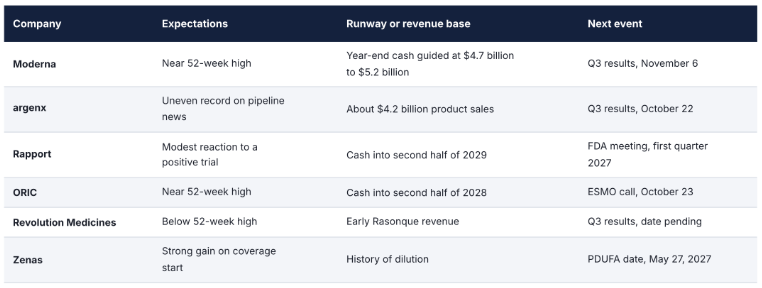
The Three Tests, Side by Side
What the Six Moves Add Up To
The pattern is consistent. Where a stock has already risen a long way, as at Moderna and ORIC, the data must clear a high bar. Where data are good but the share price has a record of giving back gains, as at argenx and Rapport, the market is judging quality of evidence, not just the headline. And where a launch or regulatory date anchors the case, as at Revolution Medicines and Zenas, investors can measure progress against a calendar.
Risks follow the same logic. Crowded positioning ahead of ESMO can leave little room for a neutral result. A rate environment near 5.1% penalizes assets whose value lies years away. Funding needs can force dilution if data disappoint. For institutional investors, the discipline is to separate the quality of the data from the price already paid for it. The next three weeks will test that discipline across all six.
This article is for information only and does not constitute investment advice. Figures reflect Tuesday's trading session.
.png)