Eleven Financial Dividend Stocks Go Ex-Dividend: Where Do Earnings and Credit Risk Stand?
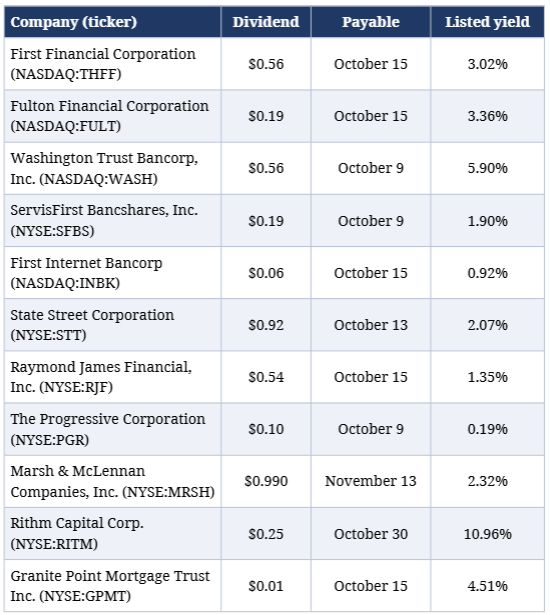
Eleven bank, insurance, wealth and mortgage REIT stocks go ex-dividend on October 1, 2026. The article sets each payout beside net interest margins, credit costs, capital ratios and the gap between GAAP and distributable earnings.


Key Highlights
- Eleven financial stocks trade ex-dividend on October 1, 2026, with payments from October 9 to November 13.
- Dividends range from $0.01 at Granite Point to $0.990 at Marsh & McLennan.
- Rithm Capital's listed yield of 10.96% leads the group, followed by Washington Trust at 5.90%.
- Five banks report net interest margins from 2.39% at First Internet to 4.33% at First Financial.
- Two mortgage REITs report GAAP and distributable earnings on different bases.
A dividend is announced in a single line, but it rests on earnings, credit quality and capital that take pages to describe. Eleven financial companies trade ex-dividend today, October 1, 2026. From today, new buyers of these shares do not receive the next payment, which goes to holders of record on October 1.
The eleven fall into three groups: banks, insurers and wealth managers, and mortgage real estate investment trusts (REITs).
The Payout Calendar
Banks: One Business, Five Different Margins
Five banks pay today. Their net interest margin, the spread between what a bank earns on loans and securities and what it pays for funding, separates them more than any other figure. First Financial (NASDAQ:THFF) reports 4.33%, ServisFirst (NYSE:SFBS) 3.63%, Fulton (NASDAQ:FULT) 3.60%, Washington Trust (NASDAQ:WASH) 2.73% and First Internet (NASDAQ:INBK) 2.39%.
Acquisitions explain part of the activity. Fulton completed its purchase of Blue Foundry Bancorp on April 1 and attributes $17.5 million of the quarter's rise in net interest income to it. First Financial closed CedarStone Financial in March, adding $292 million in loans and $313 million in deposits. It also reports its eleventh consecutive quarter of loan growth and net income of $22.7 million, or $1.91 per share, against $18.6 million, or $1.57.
Funding and capital form a second thread. Washington Trust reports Federal Home Loan Bank advances of $456 million, 54% lower than a year earlier, and deposits $314 million above June 2025. Its common equity tier 1 (CET1) ratio, a regulatory capital measure, was 11.89%. Fulton's CET1 ratio was approximately 12.1%. ServisFirst reports a 2.80% cost on interest-bearing deposits and net income of $85.8 million against $61.4 million. Its $0.19 dividend is quoted after a two-for-one stock split that took effect August 21, when the last pre-split payment was $0.38. Because its quarterly per-share figures predate the split, net income is the measure used here.
First Internet sits at the other end of the earnings range. Net income was $2.4 million, or $0.27 per share, against $0.2 million a year earlier. Its provision for credit losses, the money set aside for loans that may not be repaid, was $13.4 million, down from $16.3 million in the first quarter. Nonperforming loans were 1.58% of total loans against 1.63%, and net charge-offs to average loans were 1.77% against 1.65%.
Insurers, Custodians and Wealth Managers: Premiums, Fees and Assets
Four companies draw on premiums, fees and client assets rather than on a lending margin alone.
Progressive (NYSE:PGR) reports net premiums written of $21,077 million, against $20,076 million a year earlier, and quarterly net income of $3,311 million, or $5.67 per share. Its combined ratio, which sets claims and costs against premiums, was 87.3% against 86.2%. Progressive also publishes monthly results, which cover a different period: June alone showed net income of $779 million and a combined ratio of 90.0%.
Marsh & McLennan (NYSE:MRSH), which operates under the Marsh name, reports GAAP earnings of $2.63 per share and adjusted earnings of $2.96. Underlying revenue growth was 3% in Risk and Insurance Services and 8% in Consulting.
State Street (NYSE:STT) describes its $0.92 dividend as a 10% increase on the $0.84 declared for the prior quarter. Earnings were $3.65 per share against $2.17 a year earlier, and assets under custody and administration stood at $57.86 trillion. The company returned $631 million to shareholders in the quarter, $400 million through repurchases and $231 million through common dividends. Its CET1 ratio was 10.8%.
Raymond James (NYSE:RJF) reports record net revenues of $3.93 billion for its fiscal third quarter and client assets of $1.92 trillion. GAAP earnings were $3.01 per share and adjusted earnings $3.14, a figure that excludes $25 million of after-tax acquisition-related costs.
Mortgage REITs: Two Earnings Measures, Two Pictures
Mortgage REITs report GAAP net income beside a distributable measure, and the two can differ in sign as well as in size.
Rithm Capital (NYSE:RITM) reports GAAP net income of $20.2 million, or $0.04 per share, and earnings available for distribution of $338.9 million, or $0.60 per share. The bridge between them includes $181.1 million of realized and unrealized losses, $87.9 million of depreciation and amortization and $21.9 million of transaction expenses. Book value was $12.33 per share, and $139.6 million of common dividends were distributed in the second quarter. Preferred dividends for its Series A to F securities are declared separately and payable November 16.
Granite Point (NYSE:GPMT) reports a GAAP net loss to common stockholders of $62.0 million, or $1.29 per share, and a distributable loss of $37.7 million, or $0.79 per share. Before realized gains and losses, the distributable loss was $0.10 per share. Its dividend is $0.01, against $0.05 for the second quarter. Book value was $5.70 per share after $3.44 per share of CECL reserves, the allowance for expected credit losses. Two real estate owned assets carry a value of $90.7 million, unrestricted cash was $58.5 million and total leverage was 1.9 times.
Three Threads Across the Eleven Payouts
The first thread is where growth came from. Fulton and First Financial completed bank acquisitions during the year, and Raymond James completed Clark Capital. The three quantify the effect in different ways. Fulton attributes $17.5 million of the rise in net interest income to Blue Foundry. First Financial reports $292 million in acquired loans and $313 million in acquired deposits. Raymond James excludes $25 million of after-tax acquisition-related costs from its adjusted earnings.
The second thread is the cost of credit. Fulton's provision for credit losses was $4,897 thousand in the second quarter against $14,442 thousand in the first. First Internet's was $13.4 million against $16.3 million. First Financial's was $1.3 million against $2.0 million a year earlier, and its net charge-offs were $2.7 million against $1.7 million.
The third thread is how far apart the earnings measures sit. Rithm's earnings available for distribution of $0.60 per share compare with GAAP net income of $0.04, and its reconciliation lists $181.1 million of realized and unrealized losses among the items in between. Granite Point's distributable loss was $0.79 per share, or $0.10 before realized gains and losses, while its GAAP loss was $1.29. Fulton reports $0.60 adjusted against $0.52 GAAP, Raymond James $3.14 against $3.01, and Marsh & McLennan $2.96 against $2.63.
Conclusion: Three Foundations Under One Payout Date
One ex-dividend date covers payouts that rest on different foundations. For the banks, the foundation is a lending margin and a capital ratio. For the insurers, custodians and wealth managers, it is premiums, fees and client assets. For the two mortgage REITs, it is a distributable measure that sits apart from GAAP net income. The same date therefore covers a $0.01 payment from Granite Point and a $0.990 payment from Marsh & McLennan, each described by a different set of figures.
Payments arrive between October 9 and November 13. Boards decide each quarter's amount, and listed yields come from a dividend table rather than company filings, so they move with share prices. Earnings data cover periods that ended June 30, 2026. This article is informational and does not recommend buying, selling or holding any security.
Related post