Robinhood Rewrites the Active Trader Playbook: AI Agents, Perpetuals, Weekend Trading, Earnings Contracts
Robinhood is moving beyond zero commissions with AI agents, round-the-clock equities and leveraged crypto perpetuals. This analysis weighs the growth outlook against liquidity, leverage and regulatory risk.


Highlights
- Robinhood Markets unveiled AI agents, weekend stock trading, crypto perpetual futures and earnings contracts at HOOD Summit 2026.
- More than 150,000 customers have opened agentic trading accounts since May, a demand signal for the brokerage's growth outlook.
- Weekend equities trading would lift weekly market access from 120 hours to 168, pending regulatory review.
- Leverage of up to ten times on Bitcoin and Ether perpetuals raises the risk management stakes for retail investors.
- Competition among brokers is shifting from price to hours, speed and automation.
Once every major broker charged nothing to trade stocks, price stopped being a point of difference. What remains is capability: which markets a platform opens, when it opens them, and how much of the work it can automate.
Robinhood (NASDAQ: HOOD) set out its answer on Tuesday evening in Houston. Chief executive Vlad Tenev framed the strategy in one sentence: "Ownership doesn't work without markets, and markets don't work without traders." The product list behind it covers AI agents, round-the-clock equities, crypto perpetuals, binary earnings contracts, longer options hours and higher intraday margin.
Most items are staged over coming weeks and months, and several depend on regulators. Shares were little changed on Wednesday, which suggests investors are waiting for evidence of adoption rather than pricing in the plan.
Agents: Automation Moves Inside the App
Robinhood opened agentic trading in May, letting technically confident customers connect their own third-party AI agents to their accounts. The company says agents now call its tools almost 30 million times a day. If those calls came evenly from the 150,000 accounts, the average would be about 200 a day per account. That is machine-paced activity, not a person checking a phone.
The new step is Robinhood Agents, built into the app itself. A customer names an agent, opens a dedicated account and picks a model from several leading AI laboratories, including OpenAI. Three design choices deserve attention:
Segregated capital: The agent can reach only the funds in its dedicated account, which caps the worst case at the amount allocated.
Approval by default: Manual sign-off on each trade is on at setup, though customers can switch it off.
Standing instructions: Loops, due soon, turn a strategy into an instruction that runs repeatedly, including overnight. The agent stops being a research assistant and becomes an unattended market participant, at the point where the approval safeguard is easiest to remove.
Agent Apps add a marketplace layer. Eleven outside providers will sell premium data and tools, each with a one month free trial. Nine carry published prices, from 5 dollars a month for weather-based supply chain analysis to 30 dollars for options activity data. Together they total 103 dollars a month, or 1,236 dollars a year, a meaningful hurdle for a small account. The economics favour the platform. Robinhood keeps the customer, the account and the execution, while vendors supply the intelligence and pay for distribution. Subscription income does not depend on trading volume, and a strategy refined inside one broker's agent is costly to move elsewhere.
Weekend Trading: Adding 48 Hours to the Market Week
Robinhood plans to let customers trade a curated list of US stocks and exchange traded funds around the clock, including weekends, pending regulatory review. It extends the 24 Hour Market launched in 2023, which runs from Sunday at 8pm to Friday at 8pm Eastern time. The weekend session is powered by Bruce ATS, an alternative trading system.

The weekend adds 48 hours, a 40 per cent increase over today's 24 Hour Market and more than five times the regular session.
More hours do not guarantee more liquidity. Prices are set by counterparties, and on a Saturday there may be few of them. Thin order books can widen spreads and produce prices that differ from the next official open. The promise of acting on breaking news is only as good as execution quality when few others are trading. A curated list of names, rather than the full market, suggests Robinhood understands this.
Perpetual Futures: Leverage Enters the Menu
Perpetual futures will reach eligible US customers in the coming months through Robinhood Derivatives and Bitstamp. The eight tokens are Bitcoin, Ether, Solana, XRP, Dogecoin, Cardano, Chainlink and HYPE. The contracts never expire. Leverage reaches ten times on Bitcoin and Ether and three times on the rest. Through the end of the year the fee is one basis point, or 0.01 per cent, which is one dollar on a 10,000 dollar trade.
Before fees and maintenance requirements, the adverse price move that exhausts margin is roughly the inverse of the leverage applied.
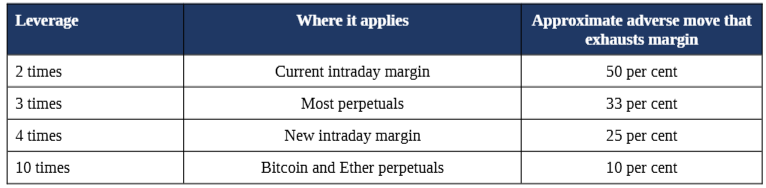
In practice, positions are closed before margin is fully gone, so real thresholds are tighter. Crypto assets have historically moved by such amounts in short periods. Stop-loss and take-profit orders, a live liquidation price and risk alerts help, but they do not change the underlying exposure.
Earnings Contracts and Trading Tools
Earnings contracts carry the same logic into corporate results. These binary options, offered through Cboe Global Markets in Robinhood's prediction markets hub, settle on outcomes such as an earnings beat or a revenue target. They require options approval and begin rolling out in the coming weeks, ahead of third-quarter earnings season. Robinhood Social, now live for eligible US customers, will add a live earnings experience that lets users watch calls and trade as they happen.
Fee waivers on perpetuals and earnings contracts run through year-end, with Cboe's waiver subject to regulatory review, so their financial contribution will not be visible until later. Smaller upgrades raise activity further:
Options hours: Trading will run from 7:30am to 4:15pm from October, 8 hours 45 minutes against the usual 6.5, or 35 per cent more.
Order types: One-cancels-the-other orders, which pair a profit target with a stop-loss, arrive for equities in October.
Margin: Eligible customers can opt in next month to intraday buying power of up to four times, double the current level.
The Competitive Field
Robinhood now competes on several fronts. Coinbase Global (NASDAQ: COIN), a crypto-native exchange, has expanded into derivatives and other financial products. Charles Schwab (NYSE: SCHW), a traditional brokerage, added 24/7 trading in select cryptocurrency futures on its thinkorswim platform this year. Robinhood's advantage is integration: stocks, options, crypto, prediction markets and automation under one login. Its exposure is the mirror image. The more complex the product set, the greater the reputational and regulatory cost if retail losses become a public story.
Key Risks
Regulatory environment: Weekend trading is explicitly pending review, and supervisors may probe surveillance and investor protection.
Liquidity: Thin weekend order books can widen spreads. Spread and execution data once sessions begin will show whether the concern is justified.
Leverage: Ten times exposure can liquidate a position on a modest move. Liquidation rates and any change to limits are worth watching.
Agent behaviour: Models can misread conditions, and Loops repeat errors on a schedule. Approval settings, error rates and the allocation of losses deserve scrutiny.
Behavioural risk: Longer hours, easier automation and higher leverage raise the opportunities to trade. Academic research on retail trading has repeatedly linked frequent activity with weaker returns for typical participants.
Verdict: Access Is Expanding Faster Than Evidence of Better Outcomes
The upside case is credible. A broader platform, recurring revenue from data subscriptions and agent usage, deeper engagement and a bundle that rivals will find hard to copy quickly could strengthen Robinhood's growth outlook. Early demand for agentic accounts supports the premise.
The downside case is just as plausible. Weekend liquidity may prove too thin, leveraged crypto products may magnify losses for less experienced users, and regulators may respond more firmly than the company expects. Many of the announced products are not yet live, so the evidence that matters has yet to be produced.
For institutional investors, the useful test is not how many products a broker launches but how its infrastructure behaves under stress. Faster access makes good decisions quicker and bad ones costlier.