Fed Raises Rates to 4% as Growth Outlook Firms, Inflation Risk Persists
The Federal Reserve raised its benchmark interest rate on Wednesday for the first time since 2023, and every voting member backed the move. The decision followed eight weeks in which inflation data repeatedly ran hotter than forecast, eroding the case for holding rates steady. What sets this decision apart is not the size of the increase but what accompanied it: the committee raised its growth forecast in the same meeting it raised rates, a pairing that is unusual by historical standards and worth examining on its own terms.

KEY HIGHLIGHTS
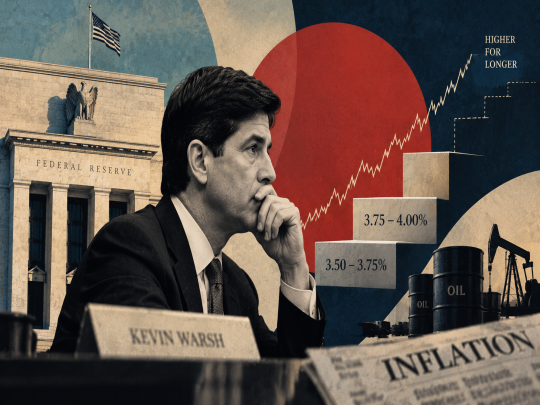
- The Federal Reserve raised the federal funds rate by 25 basis points to a target range of 3.75 to 4.00 percent in a unanimous 12 to 0 vote, its first increase since 2023.
- GDP growth projections for 2026 were revised upward to 2.3 percent from 2.2 percent in June, even as the policy rate rose.
- The median federal funds rate projection for 2026 climbed to 4.1 percent from 3.8 percent in June, implying a steeper near-term rate path.
- Core PCE inflation is projected at 3.4 percent for 2026, with a gradual return toward the 2 percent target expected by 2028 and 2029.
- Nearly all participants judged inflation risk as weighted to the upside, while growth risk was described as broadly balanced.

Wednesday's move followed a summer in which incoming data steadily eroded the case for holding rates steady. Twelve of twelve committee members ultimately agreed the case for waiting had run out, a sharper consensus than the fractured 9 to 3 vote that held rates in July. The projections released alongside the decision, covering growth, inflation, unemployment and the rate path through 2029, show a committee that is tightening from a position of relative confidence rather than one reacting defensively to a weakening economy.
A Unanimous Decision
Wednesday's policy statement was approved by a 12 to 0 vote, a marked shift from July, when three regional Reserve Bank presidents dissented in favour of an immediate increase and the committee instead held rates steady at 3.50 to 3.75 percent. The unanimity of this decision is notable in its own right. A split vote would have supported a narrative of a hawkish minority pushing through an unpopular move. Instead, the full committee, spanning the Washington-based governors and the rotating regional bank presidents, endorsed the increase together.
Chair Kevin Warsh did not submit individual projections for the accompanying Summary of Economic Projections, consistent with his practice since taking the position, leaving 18 participants in the projection set even as all 12 voting members backed the decision. Sixteen of those 18 participants anticipate at least one further 25 basis point increase before year-end, with four expecting two additional moves and two projecting the Committee will hold at the current level.
This Decision in Context

Comparing the July and September FOMC meetings. SOURCE: FEDERAL RESERVE, FOMC STATEMENTS, JULY 29 AND SEPTEMBER 16, 2026.
Growth Outlook, Revised Higher Not Lower
The most striking element of the Summary of Economic Projections is not the rate increase itself but what accompanied it. Officials raised, rather than lowered, their median forecast for real GDP growth in 2026, to 2.3 percent from 2.2 percent in the June projections. Growth estimates for 2027 through 2029 were also revised marginally upward or held broadly steady.
A rate increase is conventionally understood as an act of demand suppression, intended to slow growth in order to cool inflation. When a central bank raises rates while lifting its growth forecast, it signals a different diagnosis: that the economy can absorb tighter financial conditions without a meaningful loss of output, whether because underlying productivity has strengthened or because the inflation driving the decision stems primarily from supply-side pressures rather than excess demand. A demand-driven problem is typically resolved by rate increases large enough to slow hiring and spending until price pressure fades, a path that tends to raise unemployment as a byproduct. A supply-driven problem, by contrast, can persist even as the labour market stays healthy, since the source of the pressure, in this case an energy shock tied to the U.S.-Iran conflict, sits largely outside the reach of domestic monetary policy.
This reading is consistent with the Committee's own projections: unemployment is expected to hold at 4.1 percent through 2026 and 2027 even as the policy rate rises, a combination that would be unusual if it were fighting demand-side overheating. The revised growth forecast should therefore be read not as a signal that tightening carries no cost, but as evidence the labour market is judged resilient enough to absorb a higher rate path without the abrupt slowdown that has historically accompanied inflation-fighting cycles, provided the energy shock itself does not prove more durable than currently assumed.
Table 1. Median Economic Projections, September 2026
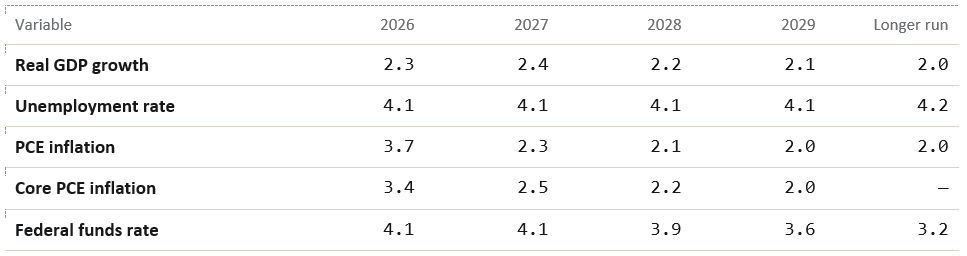
Percent. Federal funds rate shown at year-end midpoint of appropriate target range. SOURCE: FEDERAL RESERVE, SUMMARY OF ECONOMIC PROJECTIONS, SEPTEMBER 16, 2026.
Inflation Still Elevated
Inflation projections tell a more familiar story of persistence. The median forecast for headline PCE inflation in 2026 was revised up to 3.7 percent from 3.6 percent in June, while core PCE inflation, which excludes food and energy, rose to a median of 3.4 percent from 3.3 percent. Both measures are expected to decline steadily through 2029, converging near the committee's 2 percent objective only in the final year of the forecast horizon. Part of the persistence reflects an energy shock: oil prices have traded above 100 dollars a barrel in recent weeks amid the ongoing U.S.-Iran conflict, and August's consumer price data showed underlying inflation accelerating rather than cooling.
The projected path is also notable for its shape rather than only its level. Headline PCE inflation is forecast to fall from 3.7 percent in 2026 to 2.3 percent in 2027, a decline of 1.4 percentage points in a single year, before slowing to a more gradual descent toward target over 2028 and 2029. That front-loaded drop assumes the current energy shock is transitory rather than structural, an assumption the Committee has made explicit in its statement language but has not fully tested against incoming data.
Core PCE inflation, which strips out food and energy and should therefore be less directly exposed to the oil shock, is still projected at 3.4 percent for 2026, only a tenth of a point below the headline figure. That narrow gap suggests price pressure has already begun spreading beyond energy into the broader basket of goods and services the Federal Reserve tracks most closely, a pattern that has historically proven harder to unwind than an isolated commodity shock. If core inflation fails to decelerate in line with the 2027 projection, the case for the additional hikes priced into the dot plot would strengthen considerably.
Figure 1. PCE vs. Core PCE Inflation: Median Projected Path
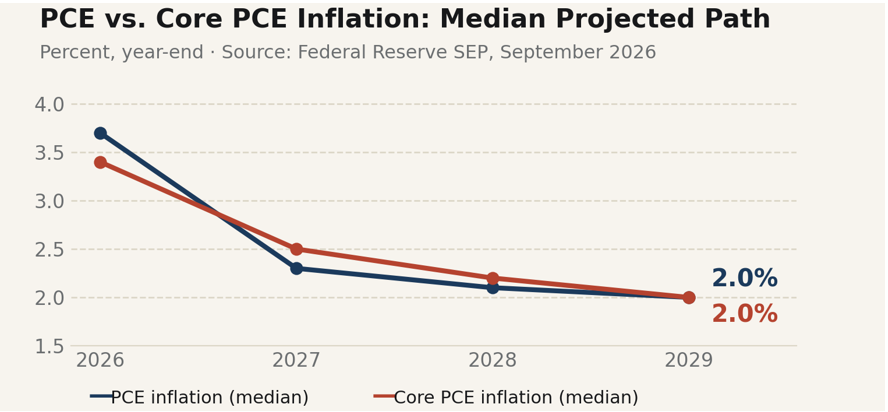
Percent, year-end. September 2026 projections. SOURCE: FEDERAL RESERVE, SUMMARY OF ECONOMIC PROJECTIONS.
The Rate Path: What the Dot Plot Shows
The median projection for the end of 2026 climbed to 4.1 percent, from 3.8 percent in June, implying that officials now expect at least one further increase this year beyond the one just delivered. The 2027 median holds at 4.1 percent as well, but the range of individual projections widens considerably that year, running from 3.1 to 4.4 percent and indicating meaningful disagreement among committee members about how much further tightening will ultimately be required. By 2029, the median projected rate falls to 3.6 percent, and the longer-run median, representing the rate consistent with stable inflation and full employment once temporary shocks fade, remains close to its previous estimate at 3.2 percent.
The widening dispersion in the 2027 projections is the more instructive data point than the median itself. A range of 3.1 to 4.4 percent for a single year, submitted by the same 18 participants, implies real disagreement about how persistent the inflation shock will prove and how aggressively it should be met, a wider spread than the Committee typically shows this far out. That is not in tension with Wednesday's unanimous vote: agreeing that some tightening was warranted now does not require agreeing on the ultimate destination. Tellingly, the longer-run median has barely moved, from 3.1 to 3.2 percent, even as the 2026 and 2027 medians rose by 30 and 50 basis points respectively, suggesting the Committee views this as a steeper near-term path toward an unchanged destination rather than a upward revision of where rates ultimately need to settle.
Table 2. September 2026 Projections vs. June: 2026 Median
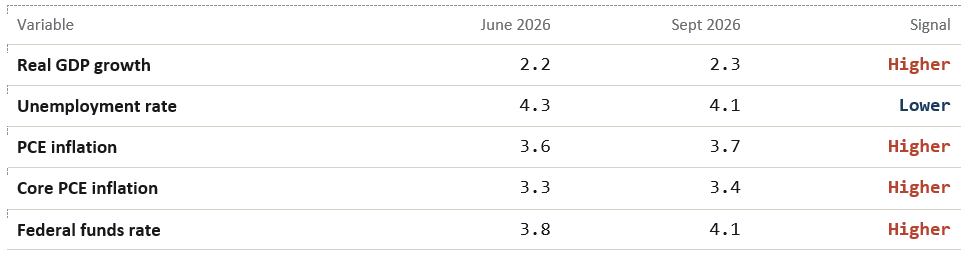
Percent. Signal reflects the direction of the revision between June and September. SOURCE: FEDERAL RESERVE, SUMMARY OF ECONOMIC PROJECTIONS, JUNE 17 AND SEPTEMBER 16, 2026.
Risk Assessment: Inflation Skewed Up, Growth Balanced
The Summary of Economic Projections also records each participant's qualitative assessment of risk, and the pattern is unambiguous. An overwhelming majority of participants described the risks to both headline and core PCE inflation as weighted to the upside. Risks to GDP growth and unemployment, by contrast, were characterised predominantly as broadly balanced, suggesting officials view the inflation overshoot, not the rate increase itself, as the primary threat to the outlook.
This asymmetry between the growth and inflation risk assessments is the clearest statement of institutional priority in the entire projection set. Balanced risk across all four variables would signal genuine uncertainty about which way the economy might break; instead, the near-unanimous upside skew on inflation, paired with balanced growth and unemployment risk, indicates the Committee has already settled on inflation as the dominant threat and is positioning policy accordingly, even at the cost of accepting some downside growth risk if the energy shock proves more damaging than assumed. It also explains why the vote was unanimous despite the wide dispersion in the 2027 rate path: agreement on which risk matters most does not require agreement on how much tightening it warrants. For markets, the practical takeaway is that incoming inflation data is likely to move the rate path more than incoming growth data over the next several meetings, since a downside growth surprise would need to be unusually large to outweigh a committee already oriented toward treating inflation as the binding constraint.
Table 3. Participants' Predominant Risk Assessment, September 2026
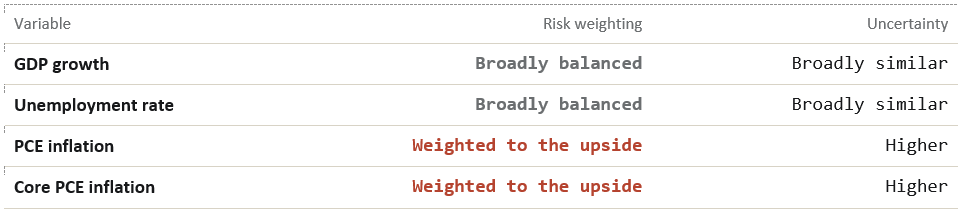
SOURCE: FEDERAL RESERVE, SUMMARY OF ECONOMIC PROJECTIONS.
The Vote in Perspective, and the Real Rate
Set beside July's fractured vote, September's unanimity is the more consequential data point of the two. The chart below places both meetings side by side.
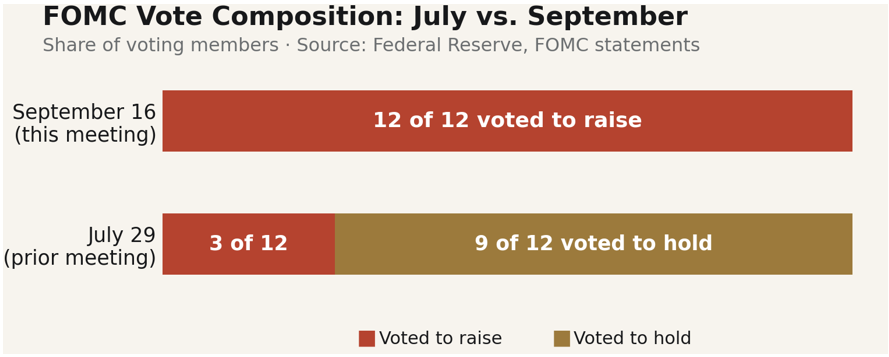
SOURCE: FEDERAL RESERVE, FOMC STATEMENTS.
Expressed in real terms, the increase is less dramatic than the headline 25 basis point move suggests. The midpoint of the new target range is 3.875 percent; measured against the Committee's own median core inflation projection of 3.4 percent for 2026, the implied real federal funds rate is roughly 0.5 percent, only modestly higher than the approximately 0.3 percent implied before the increase, and considerably looser than the near-2-percent real rate reached at the peak of the 2022 to 2023 tightening cycle.
This gap between the nominal and real policy stance matters for how much restraint the Federal Reserve is actually applying. If core inflation falls as projected, toward 2.5 percent in 2027 and 2.2 percent in 2028, the real rate rises mechanically even without further hikes, tightening conditions on its own. Conversely, if core inflation proves stickier than projected, the real rate could stay low enough to do little to slow demand, the scenario the Committee's upside-weighted inflation risk assessment appears to be guarding against. That is why the additional hikes flagged in the dot plot matter beyond their headline size: each further 25 basis point increase now raises the real rate, and therefore actual restraint, by more than the same move would have achieved earlier in the cycle, when inflation was higher and the real rate correspondingly more negative.
What to Watch Into October
None of this settles the question of how much further tightening lies ahead. The following four points are worth tracking between now and the next decision.
- Whether October and November inflation data reinforce or challenge the case for a further increase at the October 27 to 28 meeting.
- The size of the dispersion in 2027 rate projections, which signals genuine disagreement within the committee about how far this cycle goes.
- The behaviour of longer-term Treasury yields alongside a higher policy rate, with direct implications for mortgage and corporate borrowing costs.
- Whether the energy shock tied to the U.S.-Iran conflict eases or persists, since it remains the primary driver of the current inflation overshoot.