From bitcoin to dogecoin, Polymarket's 15-minute crypto bets, explained
Polymarket US launched 15-minute Bitcoin Up or Down contracts in September 2026. This primer explains how they work, how they compare with binary options, and the settlement and regulatory risks that may shape their growth outlook.

Key Highlights
- Polymarket US launched 15-minute Bitcoin Up or Down contracts on 22 September 2026, allowing up to 96 settlement rounds a day.
- The contracts handled about $91.8 million in their first full week, roughly 91% of Bitcoin volume on the US exchange.
- Economically, an Up or Down share resembles a binary option, a product banned for sale to retail clients in the EU, UK and Australia.
- Research links five-minute contracts to settlement manipulation and finds the effect largely absent at 15 minutes.
- New York has sued the operator of Polymarket US, and the regulatory environment is likely to shape the growth outlook.
Bitcoin never closes, and Polymarket has built a product to match. Every 15 minutes a new question opens, resolves and is replaced, up to 96 times a day. On the exchange's US app the format drew about $91.8 million in its first full week. That explains why rivals are watching, and why regulators are.
What a 15-minute market looks like
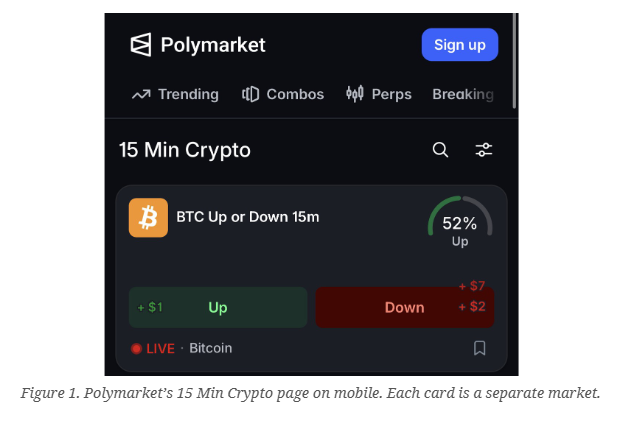
The 15 Min Crypto page lists one card per asset, and every card has the same four parts, marked in Figure 2.
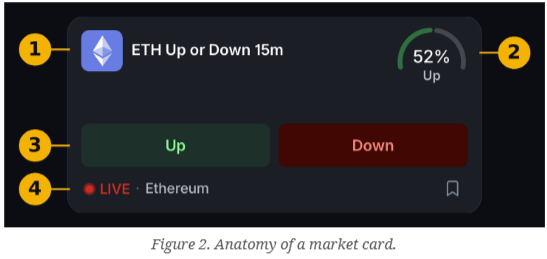
- The market name, which fixes the asset and the 15-minute horizon.
- A gauge showing the implied probability of Up, updated live.
- Two buttons for trading Up or Down shares.
- A LIVE tag and an asset label, showing that a round is in progress.
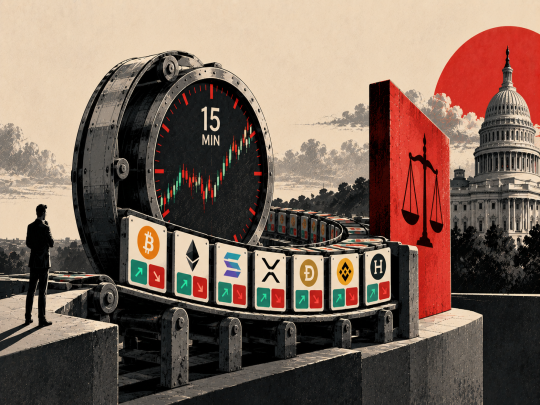
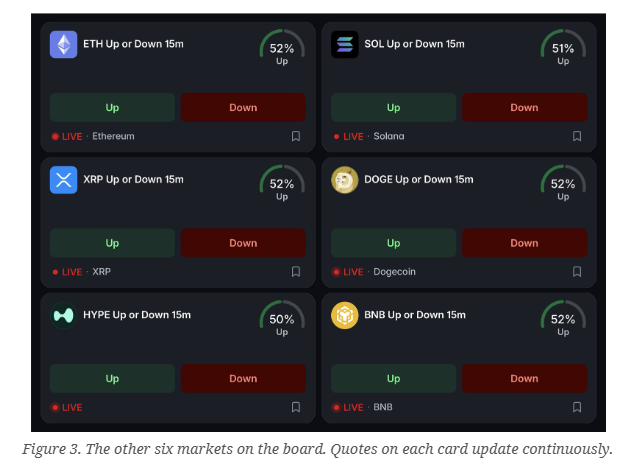
The page lists seven assets: Bitcoin, Ether, Solana, XRP, Dogecoin, BNB and HYPE, the token of the Hyperliquid exchange. Figure 3 shows the six beyond Bitcoin. The design is spare. A card carries only a question, a live quote and two buttons. The order book and full rules sit one tap deeper.
How a round works
The window opens and its starting price becomes the reference. Traders buy Up or Down shares at prices between 0 and 100 cents, where 40 cents implies a 40% probability, and can sell before the window closes. At the close, Up pays $1 a share if the asset finished at or above its starting price and nothing otherwise. Down is the mirror image.
Resolution relies on Chainlink, an oracle network that aggregates quotes from several sources. Polymarket's published US rules, as reported by CCN, average index readings before each endpoint rather than using one exchange's print.
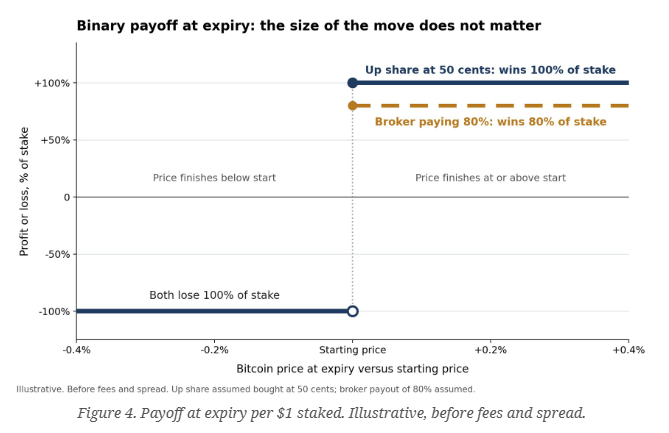
The size of the move does not matter. In one interval reported on the US app, Bitcoin began at $84,209.48 and ended at $84,344.37, a rise of about 0.16%. Holders of Up were paid in full, as they would have been by a rise of one cent.
The binary option parallel
Strip away the app and an Up or Down share is a binary option, also called an all-or-nothing or digital option. It pays a fixed sum if a condition holds at expiry and nothing otherwise. Here the strike is the window's starting price, the expiry is 15 minutes, and the share price in cents reads as an implied probability. Only the side of the strike matters, as Figure 4 shows.
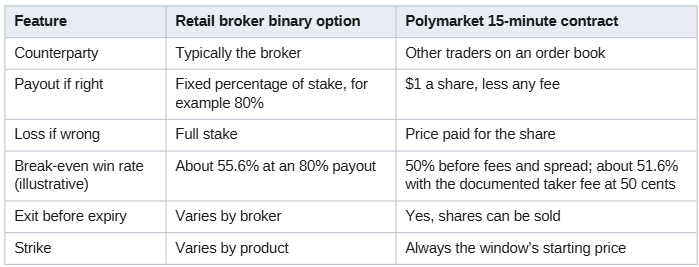
The structure around the contract is what differs from the product regulators restricted. In the retail broker model, the broker sets the payout and is typically the counterparty. On an exchange such as Polymarket, traders deal with each other and a winning share pays the full $1, so the costs are the spread and fees. The figures below are arithmetic about structure, not guidance.
Turnover, not direction, is the product
Price changes over a quarter of an hour are close to symmetric, so quotes for these contracts tend to sit near even odds. The appeal of the format is therefore turnover, not forecasting accuracy. Each contract resolves four times an hour, returning capital to traders who can redeploy it at once.
Fees are built around that fact. On Polymarket's global platform, taker fees on 15-minute crypto markets arrived in January 2026. They peak near 50% odds and can reach about 3%. The documentation example of 100 shares at 50 cents implies a fee of about $1.56 on a $50 trade, which lifts a taker's break-even win rate to roughly 51.6%. Fee schedules are subject to revision. The fees are returned daily in USDC to liquidity providers, a design meant to reward quoting and deter latency arbitrage.
Demand in the first week
According to DeFi Rate's analysis of trade records, all verified Bitcoin markets on the exchange drew about $625,000 in the week to 21 September. In the first full week after launch, 15-minute contracts alone drew about $91.8 million. Daily volume rose from $2.4 million to $27.7 million while average trade size barely moved, which points to more frequent or more widespread trading, not larger tickets.
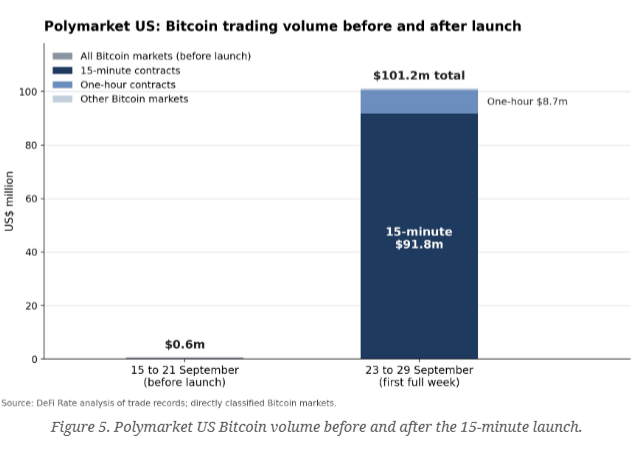
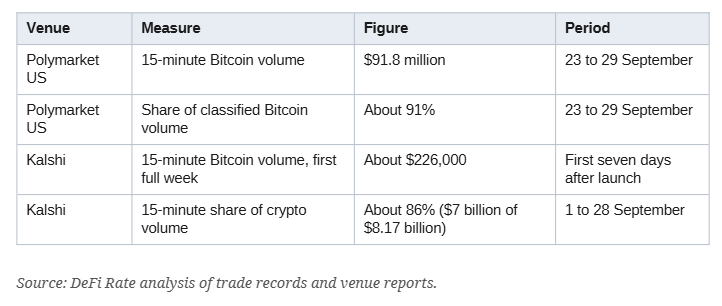
The Kalshi comparison is imperfect, since launch dates, bases and reporting conventions differ. Volume is also gross, so turnover can overstate the capital at risk, and trade records are not unique traders. Whether liquidity holds once novelty fades is the better test.
Settlement design and manipulation risk
The 15-minute format answers an earlier problem. Polymarket introduced five-minute Bitcoin contracts on 12 February 2026. A working paper by researchers at Stanford University and Singapore Management University, "Settlement Manipulation in Prediction Markets", examined nearly 16,000 of them. It found spikes in spot order flow on Binance just before settlement, followed by reversals. Media coverage reports an estimate that 821 suspected accounts earned about $8.2 million, with roughly $1.28 million transferred from ordinary traders.
When a payout hinges on one price observation at the end of a short window, a modest push in spot markets can flip the outcome cheaply. The pattern was much weaker at 15 minutes, and the authors argue that settlement design, not prediction markets as a class, is the vulnerability. Polymarket has said it does not believe manipulation occurred, but has indicated it plans to add average-price settlement to some markets over the next year. The paper predates the US launch and does not test the US contracts. The incentive to influence settlement does not vanish at 15 minutes. It becomes costlier.
Where the regulatory environment bites
Polymarket US is operated by QCX LLC, a CFTC-designated contract market that Polymarket acquired, reportedly for $112 million. That gives it a federal footing it lacked in January 2022, when it paid a $1.4 million civil penalty after the CFTC found it had offered off-exchange event-based binary options.
The label carries weight elsewhere. ESMA prohibited the marketing, distribution and sale of binary options to retail clients from July 2018, the FCA followed with a permanent UK ban, and ASIC banned them in Australia from May 2021 after finding that about 80% of retail clients lost money. The contracts therefore resemble, without being identical to, the products those rules targeted. Whether an exchange wrapper changes the analysis is a question for regulators and courts.
Federal standing has not insulated Polymarket US. Two days after launch, New York's attorney general sued QCX, alleging an unlicensed gambling operation. According to CCN, the 33-page petition does not name the Bitcoin product but seeks a broader order against unlicensed event contracts. On 28 September the CFTC filed a proposed rule treating event contracts as swaps, alongside an interim final rule excluding casino-style gambling products, for federal review. The texts were unpublished at the time of reporting, and three petitions on conflicting appellate rulings are before the US Supreme Court.
The 15-minute contract sits closest to the boundary because it pays on a variable already traded in spot, futures and perpetual markets, not on a real-world event such as an election. A ruling that draws the line around price-based contracts would probably matter more here than to most of Polymarket's catalogue.
Growth outlook: factors on both sides
For institutional investors, the relevance lies less in the contracts themselves than in what they reveal about retail-facing venues competing with crypto derivatives exchanges for trading flow.
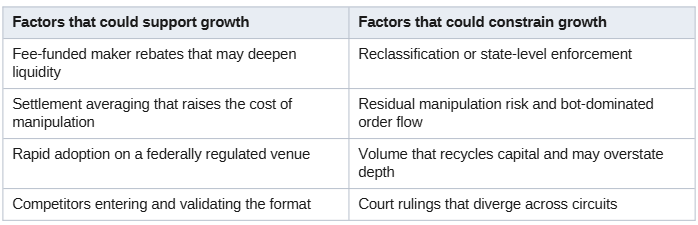
Four indicators should clarify which side gains ground: the CFTC proposals once published; the New York case and the pending Supreme Court petitions; changes to settlement methodology and fees; and whether volume holds after launch effects fade, judged against spreads and order book depth.
The bottom line
Polymarket's 15-minute markets show that demand for short-horizon, rules-based price exposure exists, at least at launch. They do not show that the format is durable. Durability depends on two structural questions: whether settlement can be made costly to manipulate, and whether regulators treat a contract that resembles a binary option as an event at all. Until both are answered, the feature that drives turnover, a clock that resets four times an hour, will keep drawing scrutiny.
This article is for information only and does not constitute investment advice. Prediction-market contracts carry a risk of total loss. Figures reflect published data at the time of writing.