Before You Trade: What Prediction Markets Actually Risk
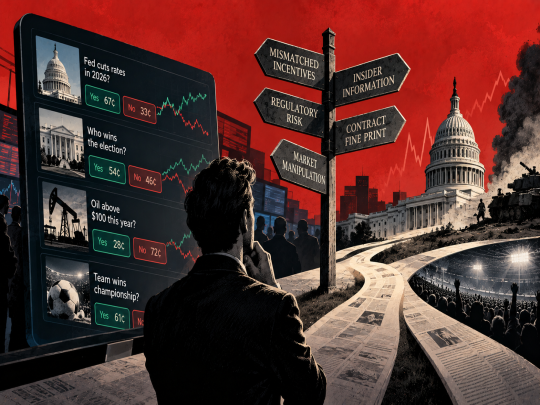
Prediction markets look simple: a question, a price, a buy button. Beneath that sit seven distinct risks, each one already costly to someone.

Key Highlights
- Binary risk is real but not absolute: you can exit anytime before resolution, but if you hold to the end, the contract pays a full dollar or nothing, with no partial credit for having been directionally right.
- The "peer-to-peer" pitch doesn't match the data: a small, sophisticated slice of traders capture most of the profit.
- A handful of traders haven't just been better informed, they've had access to information they were never supposed to have at all, a distinct and more serious risk than ordinary skill.
- Some contracts create a financial incentive to cause the very outcome they're pricing, a problem with a two-decade-old government precedent and a live 2026 example.
- Contracts can settle on fine print that diverges sharply from their plain-English headline, a gap that's already produced a lawsuit on one platform and a governance overhaul on another.
Every prediction-market app looks the same regardless of what's underneath it: a headline question, a price between zero and a dollar, a buy button. That simplicity is the product. It's also the problem.
A binary contract doesn't reward you for being close, only for being right at the exact moment it settles. The person who took the other side of your trade may have been better positioned than you before either of you placed a bet. A contract can resolve against you over a technicality most traders never read. And the platform itself can be perfectly legal in your state today and shut down there by a judge next month. None of that has anything to do with your prediction. It's the risk sitting underneath it, and each of the seven risks below has already cost someone real money.
Binary Risk: No Partial Credit If You Hold to the End
Start with the instrument's basic shape, because everything else builds on it. A prediction-market contract can be sold at any point before it resolves, there's a live order book the whole time a market is open, so being right early doesn't require sitting still. You can take profit or cut a loss well before the question is actually settled.
The gap shows up only if you hold to the end. A contract that resolves does so at exactly one dollar or exactly zero, no residual time value the way a losing option retains right up until expiry. A trader who correctly senses that something will happen but gets the timing wrong, right about the event, wrong about the deadline, can watch the price rise for a while and still walk away with nothing if they hold through the final tick on the wrong side.
The subtler risk sits between those two facts: exit liquidity late in a contract's life. As a resolution date nears, volume often thins out precisely because the outcome is becoming obvious, so the spread between what you'd like to sell at and what a buyer will actually pay can widen right when you most want out. A contract trading at a few cents late in its life isn't necessarily a bargain, it may just be a market with almost nobody left on the other side. The practical defense isn't refusing to hold a position, it's deciding in advance whether you plan to exit before resolution or ride it to settlement, and sizing accordingly, since only one of those two paths carries the all-or-nothing risk.
Adverse Selection: Why the Fact Someone Took Your Trade Should Worry You
Both major platforms describe themselves as peer-to-peer, no house, no built-in edge, just traders on either side of a contract and a fee collected regardless of outcome. That's accurate for the fee structure. It's a different claim from "you're likely trading against someone with no more sophistication than you have," and that claim doesn't hold up.
This isn't counterparty risk in the usual financial sense, nobody is worried Kalshi or Polymarket will fail to pay out a winning contract. The concern is subtler: the fact that someone was willing to take the other side of your trade is itself a signal, and often not a good one. A Wall Street Journal analysis found that roughly one account in a thousand on Polymarket captured two-thirds of all trading profits, netting close to half a billion dollars between them, while most accounts studied lost money. Kalshi has disclosed a similar pattern of its own: close to three losing traders for every profitable one in a typical month. That's not a fee problem or a bad-luck problem, it's evidence that the pool of people willing to trade against you skews toward those with a durable edge.
A separate piece of the same problem is who's actually providing the liquidity you're trading against. DraftKings CEO Jason Robins, building a rival product of his own, has made the sharper version of this point publicly: platforms marketing themselves as genuinely peer-to-peer understate how much of their actual liquidity comes from professional market-makers rather than fellow amateurs. That's a different mechanism from the WSJ's skill-concentration finding, a market-maker isn't necessarily better-informed, they're running a business built on pricing risk efficiently, but the practical effect on a retail trader is similar either way. A tight, fast-moving price isn't proof that a broad, informed crowd agrees, it can just as easily mean sophisticated money arrived first, whether through superior information or superior infrastructure, and everyone else is pricing in behind it.
Information Asymmetry: Some Counterparties Didn't Predict the Outcome, They Knew It
Adverse selection is about the pool of people willing to trade against you skewing toward those with an edge. Information asymmetry is a sharper, more specific version of that problem: it's not that your counterparty forecast the outcome better, it's that they already knew it, because they had access to something you couldn't possibly have had.
This risk tends to be more concentrated on a prediction market than in a lot of other trading, because a contract often hinges on one discrete, knowable fact rather than a broad mix of factors. Whether a specific word gets said in a speech, whether an event happens by a deadline, these are questions where a single person with early access to the right fact can have an edge that's close to decisive, not just marginally better information.
Two settled CFTC cases back this up. A White House aide with years of advance access to the president's unreleased remarks used that access to trade Kalshi contracts on whether specific words would appear in a speech, netting over $107,500 before paying it back plus a $65,000 penalty. A former congressman ran a smaller version of the same play, wagering on a contract tied to an event he personally controlled, and settled for roughly $35,000. Both were caught by the exchange's own surveillance, a real point in the industry's favor, but being caught doesn't undo the trade: everyone who took the other side of those specific contracts before either case became public lost money to someone who wasn't predicting anything at all. Any contract tied to information controlled by a small, identifiable group, a company's earnings language, a government announcement, an individual's own scheduled actions, carries a version of this risk by default, whether or not anyone ever gets caught trading on it.
Moral Hazard: When the Bet Creates an Incentive to Cause the Outcome
This is a different problem again, and it's easy to conflate with information asymmetry, but the mechanism is distinct. Information asymmetry is about someone trading on foreknowledge. Moral hazard is about a contract creating a financial reason for someone to make the outcome happen in the first place.
In mid-2026, Kalshi launched contracts letting traders bet on flight cancellation rates at specific airports. Critics raised an immediate, simple concern: anyone holding a position that pays out on disruption has, at least in theory, a financial reason to want disruption, whether through something as passive as incentivized inattention or something more direct. This isn't a new worry invented by prediction markets. In 2003, the Pentagon's research arm was preparing to launch a market letting traders bet on political and economic outcomes across the Middle East. Two senators denounced it publicly as a "federal betting parlor on atrocities," and the program was cancelled the very next day, before anyone had a chance to explain that the market never actually let anyone bet on a specific assassination. Economists who studied the episode later largely agreed that characterization was overblown. The deeper concern it exposed wasn't: a market that prices an outcome someone might be able to influence points a financial incentive in exactly the wrong direction, and that tension resurfaces every time a new contract's subject matter overlaps with something a participant could plausibly affect.
Interpretation Risk: The Contract Means What Its Rules Say, Not What It Sounds Like
Every contract carries specific settlement language written before the market opens, and the gap between a headline question and the actual resolution criteria is where a real share of financial disputes on these platforms have originated.
This has already produced a class-action lawsuit on Kalshi, after a market settled according to a carve-out clause that traders argued wasn't adequately disclosed, and a full governance overhaul on Polymarket, after a single concentrated stake was able to push a market to an outcome most participants considered wrong. In both cases, the losing side wasn't wrong about the real-world facts, they were caught by settlement mechanics that didn't work the way they'd assumed. A contract that sounds simple in its headline can still hinge on a specific data source or a narrow exception clause buried well below it, and that gap is a risk of its own, independent of whether you correctly call the news.
Liquidity Risk: The Price May Not Reflect Real Consensus
A prediction-market price is only meaningful as a probability if enough independent money produced it. Outside the handful of highest-volume political, sports, or macro contracts, a large share of markets on these platforms trade thinly.
In a thin market, a single moderately sized trade can move the displayed price several points without reflecting any real change in the odds, meaning the number being read as a "market-implied probability" may already be distorted by whoever traded last, and could be distorted further by the next order that comes in. The interface doesn't distinguish a price built from thousands of trades from one built from a handful, both are shown with identical, false precision.
Jurisdictional Risk: The Ground Can Shift While You're Standing On It
Every risk so far concerns the trade itself. This one has nothing to do with whether your analysis is right, and everything to do with whether you'll be allowed to hold, add to, or exit a position at all, in whatever state you happen to be trading from.
State and federal regulators are actively fighting over exactly this question, with genuinely opposite rulings already on the books in different states and a case now likely headed to the Supreme Court. A platform that looks and behaves identically everywhere today isn't guaranteed to stay available in the same form, in every state, for as long as you plan to hold a position, a risk with essentially no equivalent in a listed stock, whose legality doesn't depend on which state a brokerage app happens to be open in.
Before You Place the Trade
None of the seven risks above are solved by trading more carefully in the ordinary sense, they're built into what this instrument is. A short baseline worth applying anyway: size every position as if it may settle to zero, read the actual settlement rules before entering rather than after a dispute, check volume and spread before trusting a price on anything outside the most active markets, and trade only with money you could lose entirely without it touching anything that matters.
The Price of a Probability
A prediction market converts collective belief into a price, and that price is a genuine, well-evidenced estimate of probability, not a guess dressed up as one. But probability was never certainty, and the risks that come with this specific instrument, an all-or-nothing payoff if held to the end, uneven and sometimes illegitimately informed counterparties, incentives that can point the wrong way, contracts that settle on fine print, prices that can be thinner than they look, and legal ground that can move mid-position, don't have clean equivalents in the instruments most traders already know how to size for.
None of this makes the instrument a bad one. It makes it a genuinely new one, still being priced, litigated, and regulated in real time, and worth trading, if at all, with that fact held firmly in mind rather than assumed away. Understanding what these risks actually are, not just knowing a checklist, is what separates taking them on knowingly from being surprised by them later. That's the whole difference between a trader who loses money to bad luck and one who loses it to something they could have seen coming.
Read the Full Series
This is the final part of our five-part series on prediction markets. Catch up on the earlier parts:
- Part 1: When the Crowd Becomes the Analyst: Inside the Rise of Prediction Markets
- Part 2: When the Hedge Becomes the Bet: Inside Wall Street's Race to Own Prediction Markets
- Part 3: Two Prediction Market Giants, Two Very Different Ways of Deciding Who's Right
- Part 4: When No One Agrees Who's in Charge: Inside Prediction Markets' Regulatory Chaos
Related post