What Happens If Trump Loses Congress? Lessons From Reagan to Biden for Markets
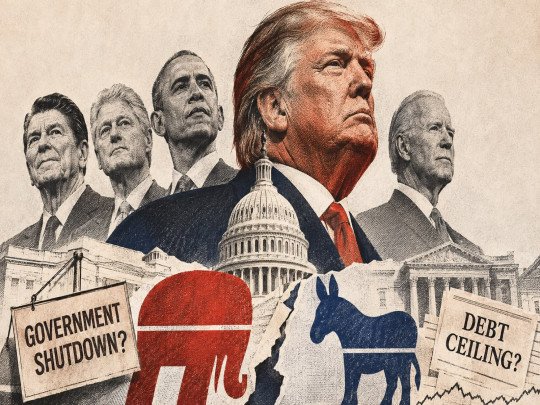
Of the last five presidents to lose a chamber of Congress at a midterm, four then faced a government shutdown or a debt-limit standoff within two years. Strategists expect Donald Trump to face one in 2027 whatever tomorrow's result. The record shows what comes with it, and why this midterm tests the courts as much as Congress.

Key Highlights
- A midterm rarely changes laws. It changes who controls money, investigations and appointments.
- Four of five presidents who lost a chamber then faced a shutdown or borrowing-limit fight.
- Government funding runs out on 11 December. A borrowing limit follows in 2027.
- The Supreme Court let Mr Trump fire regulators but blocked his emergency import taxes.
- Shares rose in the year after every post-war midterm, but borrowing costs are higher now.
Ronald Reagan's Republicans lost 26 seats in the House of Representatives, the larger chamber of Congress, in 1982, during a recession. Two years later he won 49 of 50 states. Barack Obama's Democrats lost 63 House seats in 2010, and the following summer S&P Global Ratings, an agency that grades how safely governments repay their debts, took away the United States' top grade for the first time. The cause was a standoff with Congress over how much the government can borrow. Both presidents took a beating from the voters. Only one then saw his country's credit grade cut. The difference was what came next. Mr Reagan struck a deal with a Democratic House. Mr Obama met a Republican one that used the budget as a weapon.
That is the question the 3 November vote puts to Donald Trump. A midterm election, so called because it falls halfway through a president's four-year term, rarely changes a law, because the president can veto any bill. It changes leverage: who controls the money, who can demand answers, who approves the president's appointees. A president who loses that leverage governs by executive order, a direction that skips Congress, and a court then decides whether the order stands. Tomorrow's vote tests two checks at once, Congress and the courts.
The House has 435 seats and the Senate 100. Republicans hold the House 218 to 214 and the Senate 53 to 47, and Democrats need a net gain of four seats in each to take control. Mr Trump's approval rating is near the lowest of his presidency: 32 per cent in an Ipsos poll in late October and 30 per cent at the Pew Research Center. Since the Second World War the president's party has lost House seats in 18 of 20 midterms, by two dozen on average. Polls favour a Democratic House, and the Senate is too close to call.
What a midterm can and cannot change
Treasury Secretary Scott Bessent said on 20 October that a Democratic House could do very little to block the administration's agenda. On new laws he is right: overriding a veto takes two thirds of both chambers. But a midterm moves four other levers.
Money. Congress writes the spending bills, and parts of the government shut down when it fails to pass them. It also controls the debt ceiling, the legal cap on how much the Treasury can borrow, and missing it risks default. Whoever holds one chamber can turn both deadlines into bargaining chips.
History shows two endings. Bill Clinton lost 54 House seats in 1994, and Newt Gingrich's Republicans shut the government twice, in late 1995 and early 1996. Mr Clinton moved to the centre, struck a balanced-budget deal and left a surplus. The costlier ending came later. After a debt-ceiling fight in 2011, S&P cut the US credit grade and stocks fell sharply. Mr Trump lost 40 House seats in 2018, then shut the government for 35 days over a border wall and ended up without the money. In 2023 a debt-ceiling fight under Mr Biden ended in a deal, but Fitch Ratings, a second grading agency, cut the US grade that August. In October the 10-year Treasury yield, the interest rate the government pays to borrow for a decade and the benchmark for mortgages and company loans, touched 5 per cent.
This year's deadlines repeat the pattern. The stopgap law, a temporary bill that keeps the government funded while Congress argues over the real budget, expires on 11 December, in the lame-duck session, the weeks between the election and the new Congress taking its seats. The Bipartisan Policy Center projects that the Treasury reaches the debt ceiling between winter and mid-summer of 2027. Whoever wins inherits both.
A president can fight back by refusing to spend. After Richard Nixon did so, Congress passed a 1974 law that lets a president hold funds for 45 days while Congress considers cancelling them, then requires their release. On 25 September Mr Trump announced cancellations of more than 800 million dollars, timed so the money expires before Congress can respond. The Government Accountability Office, Congress's own watchdog, concluded on 29 September that the move is illegal. A Democratic House can write the budget it wants, but whether the money is spent ends before a judge.
Investigations. Committees run by the majority party can issue subpoenas, legal orders to hand over documents or testify. Enforcement is weak, because it runs through the president's own Justice Department or slow courts, but exposure still costs a president time. After Democrats won the Senate in 1986, their committees spent 1987 investigating Iran-Contra, a secret arms deal that broke a congressional ban, and Mr Reagan spent his last two years answering for it. The House can also impeach a president by simple majority, but removal needs two thirds of the Senate, and no president has ever been removed. Democrats are already seeking records on donors to the White House ballroom and on tariff exemptions given to companies.
Appointments. The Senate must confirm judges, cabinet members and governors of the Federal Reserve, or Fed, the central bank that sets US interest rates, and a majority can refuse. A Democratic Senate blocked Mr Reagan's Supreme Court nominee in 1987, and a Republican Senate refused even to hold a hearing for Mr Obama's in 2016. A Democratic Senate in 2027 would hold the same power over every future vacancy on the Fed's board.
War powers. Congress can try to rein in military action, but the record is weak. In 2019 Mr Trump vetoed two resolutions passed with the newly Democratic House, one to end US support for the war in Yemen and one to end an emergency declaration he used to redirect money to a border wall. Neither veto was overridden. The war with Iran, which began with US and Israeli attacks in February, has revived the tool. On 23 June the Senate adopted a resolution directing an end to the fighting by 50 votes to 48, and the White House called the vote of no significance. On 24 September a second attempt failed 49 to 50, with four Republicans joining Democrats.
One rule limits all four. Most Senate bills need 60 of 100 votes to move forward, a hurdle called the filibuster, so even a Democratic Senate cannot pass major laws alone. Congress is strong at saying no and weak at saying yes, which pushes presidents to act around it.
When presidents go around Congress
When Congress says no, presidents turn to executive orders and agency rules, and the courts decide whether they stand. Justice Robert Jackson set the test in 1952, when the Supreme Court told Harry Truman he could not seize the country's steel mills during the Korean War: a president's power is greatest when Congress backs him and weakest when he acts against its will.
Mr Obama learned this. After Republicans won the Senate in 2014 he used an executive order to shield millions of undocumented parents from deportation. A court blocked it, and in 2016 the Supreme Court split four to four, leaving the block in place. Mr Biden's plan to cancel student debt was struck down in 2023, because the Court ruled that Congress must approve a move of that economic size in clear terms.
Mr Trump has used the same tool. Critics say he has gone further than any predecessor. Allies reply that Mr Obama set the precedent. In 2026 the Supreme Court has split the difference:
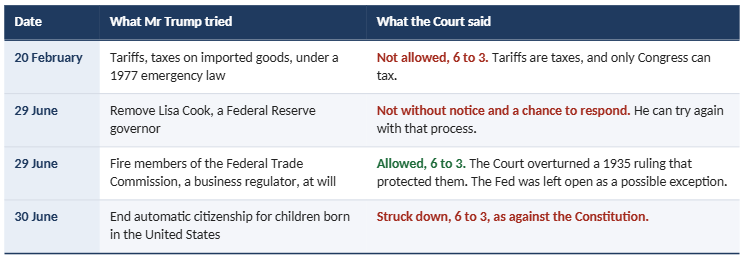
The pattern is consistent. The Court lets a president run the executive branch, and stops him when he reaches for powers the Constitution gives Congress or settles in its own text. Supporters of the firing ruling call it a restored constitutional design, in which independent agencies answer to the elected president. Critics call it the loss of an independent check.
The exceptions are fast-track emergency orders on money. In 2025 the Court declined to block a cancellation of foreign aid, and on 21 August it paused a lower court's order that had halted construction of the 400 million dollar White House ballroom for want of congressional approval. Those orders decide who holds the money while a case proceeds, not who is right. A divided Congress cannot pass the law the Court's reasoning invites, so the White House finds another route, as the tariff story below shows.
What is at stake for Mr Trump now
The courts have trimmed what Mr Trump can do alone. What remains is what only Congress can grant, fund or block, and each item hits a company first.
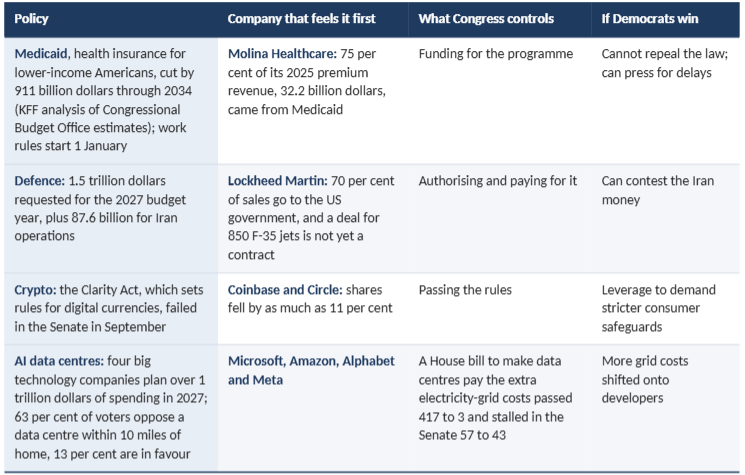
Tariffs show how courts and Congress interact. The February ruling came from a challenge led by Learning Resources, an Illinois toy maker. The White House then turned to a temporary global tariff under a law that limits it to 150 days, and a trade court held that unlawful in May. It expired in July, and a third law, with no time limit, now carries duties of 10 to 12.5 per cent on imports from 60 countries. Companies that paid the struck-down tariffs are seeking refunds of up to 175 billion dollars, according to the Penn Wharton Budget Model. For importers, the rate they pay is now decided in courtrooms before it is decided in Congress.
Interest rates are set by the Fed, not Congress. The Iran war set off an energy price surge, and the Fed raised rates to 3.75 to 4.00 per cent on 16 September. The 10-year yield closed above 5 per cent on 28 October. Mr Trump wants lower rates, but after the Cook ruling he cannot remove the people who set them without due process. What Congress can do is push the cost of borrowing up through a debt-ceiling fight.
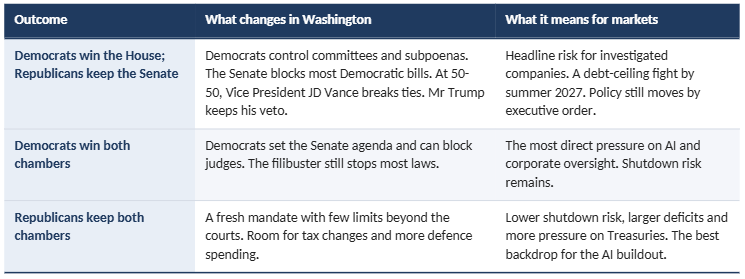
Three outcomes
Polls favour the first row and rate the last lowest.
What it means for markets
The S&P 500, an index of the 500 largest US companies, has gained 27 per cent since Mr Trump returned to office. The record after past midterms is good. Bank of America finds the index rose in every six-month and twelve-month period after a midterm since the Second World War, by 13 per cent and 14 per cent on average. Ned Davis Research counts eight times since 1930 that the president's party lost the House, and the index rose for the rest of that year in five. Morgan Stanley finds that under Republican presidents the index gained 23 per cent in the year after a midterm when Congress was split, against 16 per cent when Democrats held both chambers.
Three things differ this time. First, borrowing costs are high. A debt-ceiling fight that pushes the 10-year yield higher cuts share prices, because investors demand more return from shares when government bonds pay more. Second, the energy shock keeps inflation above the Fed's 2 per cent target, which limits interest-rate cuts. Third, the market's leaders are AI companies, the sector where investigations and data-centre rules are aimed. Courts also now set part of the policy risk that Congress once set, as the tariff refunds show. These are conditional risks, not forecasts, and 20 post-war midterms is a small sample.
Dates to watch, and the bottom line
- Election night, 3 November: the size of any Democratic House margin, and whether the Senate lands at 50-50.
- Lame-duck session, November to January: Republican confirmations rushed through before the new Congress sits.
- 8 to 9 December: the Fed meets. 11 December: the stopgap funding law expires.
- 1 January: Medicaid work rules begin.
- 2027: the debt-ceiling showdown.
- Courts: tariff-refund appeals, the challenge to the 60-country duties, the September cancellation, the ballroom, and any second attempt to remove Ms Cook.
A president who loses Congress does not lose power. He loses the ability to avoid negotiating over money. Mr Reagan and Mr Clinton bargained and recovered. Mr Obama and Mr Biden met borrowing-limit fights that cost the country its top grade from two rating agencies and pushed borrowing costs up. Mr Trump enters the vote with a Supreme Court that has given him the power to fire regulators and denied him the power to tax by decree, a Fed raising rates and a 10-year yield above 5 per cent. The vote decides who holds the gavel. The calendar, 11 December and the 2027 debt ceiling, decides what the gavel can break.