Salesforce Agrees to Buy Braze: Three Stocks, Three Reactions, One $5.66 Billion Question
Salesforce’s $47.50-a-share cash offer rewards Braze holders, raises questions about its own capital allocation and gives rival Klaviyo a new valuation benchmark.

Key Highlights
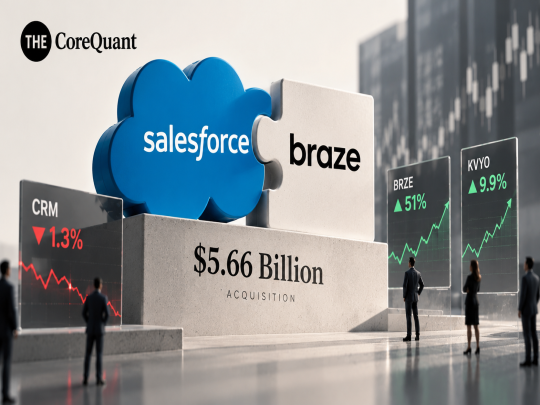
- Salesforce offers $47.50 in cash a share, a 58% premium to Braze's Monday close.
- Braze jumped about 51% while Salesforce slipped about 1.3% on Tuesday.
- Klaviyo, a listed rival, rose about 10% as investors reassessed the category.
- The $5.66 billion deal is expected to close in fiscal 2028, pending approvals.
Takeover announcements usually sort shareholders into winners and doubters. Tuesday's produced a third group as well. Salesforce (NYSE: CRM) agreed to buy Braze (NASDAQ:BRZE), the customer engagement platform, for $47.50 a share in cash, an enterprise value of about $5.66 billion. By midday in New York, Braze had jumped about 51% to roughly $45.49, from a Monday close of $30.04. Salesforce had slipped about 1.3% to around $239, from $242.45. Klaviyo (NYSE:KVYO), a rival outside the deal, had risen about 9.9% to $19.26.
Three stocks, three messages. Braze holders were paid a premium of about 58%. Salesforce holders were handed a question: what should $5.66 billion earn, and is this the best use of the cash? Klaviyo holders were handed a benchmark. Only the first is settled; integration, regulators and earnings will answer the rest.
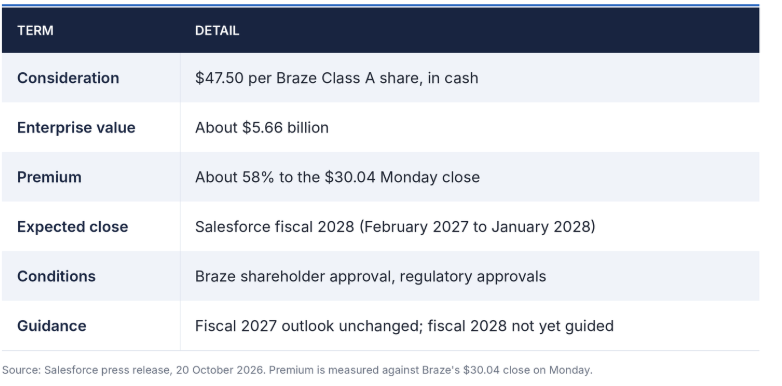
The Deal at a Glance
Braze: The Premium
Braze did the most moving, and the market was not entirely surprised. The Information reported in November 2024 that the company, whose shares had fallen about 30% that year, could become a takeover target, naming Salesforce and Adobe (NASDAQ: ADBE) as likely suitors. Nearly two years later, one of them has acted.
Shares changed hands around $45.49 at midday after a brief premarket halt, on volume above 50 million against an average of about 2.4 million. That puts them at the top of a 52-week range of $15.26 to $45.58, yet still about $2.01, or 4.4%, below the offer, and about 27% below the $65 at which Braze listed in November 2021. For long-term holders the premium is real, and so is the distance from the IPO price. For the market, the 4.4% gap is a running estimate of deal risk. On an all-cash offer that may take up to a year to close, it suggests completion is seen as likely but not assured, and a rival bid as unlikely.
Salesforce: The Question
Salesforce's move was smaller and more telling. The stock opened at $235.75, traded between about $235.60 and $244.14, and was near $239 at midday. At 21.8 times trailing earnings, it sits about 19% below its 52-week high of $296.05. The backdrop was uneasy: technology was softer on worries over how artificial intelligence spending is financed, even as ServiceNow (NYSE: NOW) and Adobe were reported higher. A 1.3% decline is not alarm. It is a note in the margin.
The note concerns accumulation, not size. Braze equals about 2.9% of a market value near $197 billion. But it follows the roughly $8 billion Informatica purchase, completed in May, and the $3.6 billion agreement for Fin, announced in June. Together the three come to about $17 billion, almost 9% of the company's value. Activist funds pressed Salesforce in early 2023 for more discipline on acquisitions, and the company now measures deals against a four-part test of customer success, strategic fit, faster innovation and long-term value. It says fiscal 2027 guidance is unchanged and has not guided fiscal 2028, so the effect of Braze on earnings remains unquantified for now.
Klaviyo: The Benchmark
Klaviyo's rise is the most interesting echo. Its shares gained about 9.9% to $19.26, from a $17.52 close. They remain about 42% below a 52-week high of $33.36, and had been under pressure after Goldman Sachs downgraded the stock to Neutral from Buy on 16 October, according to reports. Tuesday suggests investors are asking whether the Braze price offers a benchmark for the group.
The arithmetic invites the question. Klaviyo's market value of about $5.76 billion, less $832.6 million of cash at the end of June, implies an enterprise value near $4.9 billion, or roughly 3.2 times its 2026 revenue guidance of $1.526 billion to $1.534 billion. Salesforce is paying about 6.2 times Braze's guided revenue, for similar growth: Klaviyo's second-quarter revenue rose 26% to $370.6 million, against 26.2% at Braze.
The caveats matter. A takeover price includes a control premium that an ordinary share price does not. Klaviyo serves more than 205,000 customers, many of them small and mid-sized online merchants whose spending can be more sensitive to economic conditions than that of large enterprises, and its second quarter combined a non-GAAP operating margin of 14% with a GAAP operating loss of $15.0 million. A gap in multiples is a question, not a prediction, and nothing in the Braze announcement involves Klaviyo.
What Salesforce Is Buying
The $5.66 billion question starts with what the money buys. Braze sells software that lets brands respond to customer behaviour as it happens, coordinating messages across mobile apps, websites, email, SMS and WhatsApp. Customers include Canva, Equinox, Instacart (NASDAQ: CART), Urban Outfitters (NASDAQ: URBN) and Venmo, a unit of PayPal (NASDAQ: PYPL). Revenue in the quarter ended 31 July rose 26.2% to $227.2 million, and free cash flow reached a second-quarter record of $21.7 million, from $3.5 million a year earlier.
Salesforce presents Braze as the real-time layer of its stack, alongside Marketing Cloud, Data 360 and Agentforce, its platform for AI agents, whose annual recurring revenue reached $1.2 billion in the first quarter of fiscal 2027, up 205%. The logic is that an agent acting for a brand needs live signals about what customers are doing, and Braze is built to capture them at the scale of consumer apps. There is a distribution argument too: Salesforce serves roughly 150,000 customers, Braze about 2,800. Whether that becomes revenue is a hypothesis, since the announcement contains no synergy figures.
Is the Price Right?
At an enterprise value of $5.66 billion, Salesforce pays about 6.2 times Braze's guided revenue of $910 million to $913 million for the year to January. Against growth above 25% that looks moderate. Against a GAAP gross margin of 66.8%, slightly lower than a year ago as professional services, which tend to carry thinner margins, grew from $8.3 million to $19.6 million, it looks less so. The fair reading lies between the two.
The Road to Closing
Completion is expected in Salesforce's fiscal 2028, which runs from February 2027 to January 2028, a window of roughly three to fifteen months. Conditions include Braze shareholder approval and regulatory clearances. The announcement does not state any termination fee; the merger agreement, once filed, should. Regulators will weigh whether the overlap between Braze and Marketing Cloud in cross-channel messaging matters in a market with many vendors. The outcome is uncertain.
The risks cut both ways. For Salesforce, the upside is cross-selling into a vast customer base; the downsides are integration difficulty, the loss of engineers or customers during the long wait, and the strain of absorbing several deals at once. Customers who chose Braze partly for its independence may not welcome a closer embrace, which is why both companies say Braze will keep building under its own name and stay open to other data tools. For Braze holders, cash removes operating risk but caps the payoff at $47.50. If the deal failed, the shares would be priced again on fundamentals; Monday's $30.04 is a reference point, not a floor.
What to Watch Next
- The merger agreement and preliminary proxy filing, including any termination fee.
- Whether the Braze spread of about 4% narrows or widens as regulatory questions surface.
- Klaviyo's third-quarter results on 4 November, the next test of the category's valuation.
- Completion of the Fin deal, expected in the fourth quarter of Salesforce's fiscal 2027.
- Whether Salesforce quantifies Braze's contribution when it issues fiscal 2028 guidance.
Premiums are simple to calculate; returns are harder. Salesforce has paid a full price for a fast-growing asset that fits its AI strategy, and the market has asked for proof rather than applause. Whether the arithmetic of its serial dealmaking adds up will be settled by integration and results, not by the announcement.
.png)