The Inflation Habit
Inflation in America: Five years of rising prices have changed how Americans think. A heavily indebted government makes the habit harder to break

A regional grocery chain in the Richmond Fed's district has found itself in an odd position. With diesel up 30% in a year, it now costs more to truck a head of lettuce from California than the lettuce itself. The grocer cannot pass the difference on to shoppers who defect at the first price rise, so it eats the cost. Multiply that squeeze across thousands of firms and you have the past two days of economic news.
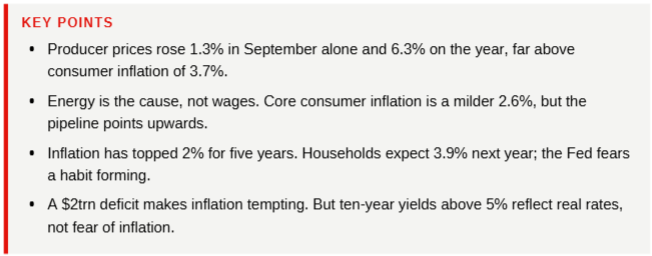
On Wednesday the government reported that consumer prices were 3.7% higher in September than a year earlier. On Thursday came the producer price index, which tracks what firms receive for their goods and services before anything reaches a shopper. It was worse. Prices at the factory gate jumped 1.3% in a single month, the biggest rise since March 2022, and are 6.3% higher than a year ago, the most since December 2022. Economists had expected less than half the monthly increase.
Three things stand out. The shock is real but narrow: it comes from energy. The habit is quieter and may matter more: Americans are getting used to rising prices. And behind both stands a government with $40trn of debt, for which inflation is an old and tempting way out.
The shock
Since the war with Iran began in late February, energy has led prices higher. Energy prices paid to producers rose 10.8% in September alone. Crude petroleum jumped 28% in the month and diesel 21%. That pushed up the cost of moving goods (transport and warehousing, up 3.4%) and the mark-ups of wholesalers and retailers (up 1.4%). At the pump, petrol rose 9.1% in the month, accounting for more than half of the rise in consumer prices. It is up 34% on the year.
The chart shows what happens next. Pressure is fiercest at the start of the supply chain and fades towards the shop.
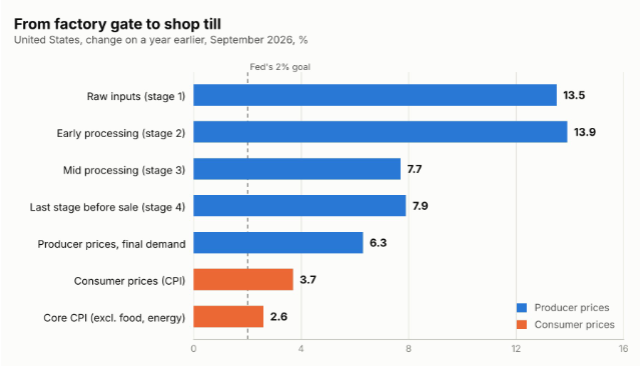
It fades mostly because firms are swallowing costs. The Fed's regional reports describe businesses holding prices, running discounts and watching profits shrink. But the cushion is thinning. Several firms say expiring hedges and contract renewals will push more of the increase into prices in coming months.
The data already hint at it. Core consumer inflation, which strips out food and energy, rose to 2.6% from 2.4%. Core producer prices rose 0.7% in the month, more than twice what economists forecast. Oil is the swing factor. Texan oilmen polled by the Dallas Fed do not expect crude exports from the Persian Gulf to normalise before mid-2027, and many Fed officials fear that the longer energy stays dear, the broader the price pressures will become.
The habit
Consumer prices have now risen by more than 2% a year for about 65 months in a row, the longest such run of this century. Since early 2021 inflation has averaged around 4.5%.
That matters because of how people behave. If shoppers expect prices to keep rising, they stop resisting increases. Workers ask for bigger pay rises to stay ahead. Firms raise prices in advance to protect margins. Each response makes the forecast come true, and the Fed's main tool, higher interest rates, loses force. The minutes of the Fed's September meeting record some officials fretting that, after more than five years above 2%, high inflation could start to shape wage- and price-setting.
There are signs this is starting. The New York Fed's survey shows households expecting inflation of 3.9% over the next year, up from 3.6% and the highest in more than three years. "They're starting to accept high inflation as just a fact of life," Beth Hammack, president of the Cleveland Fed, said last week. "That's concerning." She says she does not take it "for granted" that long-run expectations will stay anchored. In her district, households are no longer trading down but choosing: groceries or essential bills. Neel Kashkari, her counterpart in Minneapolis, heard from a union leader that inflation is "worse" than a recession for his members, and says it has changed how he weighs the Fed's twin goals, stable prices and maximum employment.
Acceptance is not contentment. The share of Americans blaming high prices for worse personal finances has passed 50% in the University of Michigan's survey for the first time. Joanne Hsu, who runs it, says consumers still "consider it an unacceptable fact of life".
Bond investors, who back their forecasts with money, are calmer. The inflation rate implied by ten-year Treasury prices is about 2.35%, close to the Fed's goal.
Who pays
Not equally. Pay was rising at about 3.1% a year as of August, against inflation of 3.4% then and 3.7% now. Staffing firms across the Fed's districts say pay rises often fall short of inflation, nudging workers to look elsewhere. More than half of the districts report that high-income households are carrying consumer spending. In New York, payroll firms see more hardship withdrawals from 401(k) retirement accounts. In the Cleveland district, 87% of surveyed non-profits, the highest share in the survey's history, say their clients are worse off than six months ago.
Home buyers feel it too. The 30-year mortgage rate averages 7.4%, the highest since November 2023, against about 6.3% a year ago. Pending home sales fell 4% in September, the biggest monthly drop in three years. Inflation is a tax that the better-off can hedge and the rest cannot.
The debt in the background
The government is the biggest borrower in the room, and inflation is the borrower's oldest friend. When prices rise faster than the interest the Treasury pays, the real value of what it owes shrinks, with no vote taken and no tax raised. Economists call this financial repression, and America practised it after the second world war, when the Fed capped bond yields while prices rose. Today's Fed is not doing that. But the temptation is there. The deficit for the year to September was $2.0trn, about 6% of GDP and $218bn more than the year before, and debt has passed $40trn. Interest payments alone rose by $115bn, or 11%. For now the sums flatter the Treasury: GDP in money terms grew at an annualised 8.5% in the second quarter, well above the roughly 5.1% on ten-year Treasuries.
The table sets the two sides against each other.
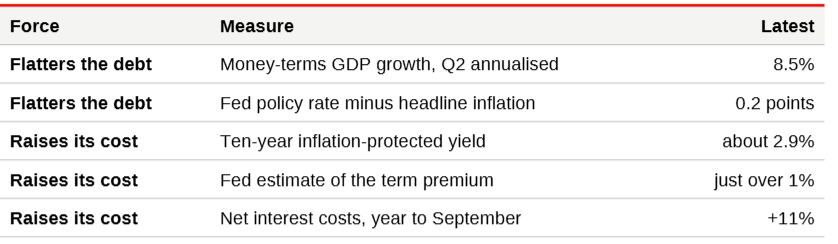
Investors, though, are not playing along. The ten-year yield closed at 5.19% on Wednesday, 123 basis points above its level before the war, and eased to about 5.1% on Thursday. Mortgage rates follow it. Yet most of that yield is real return rather than inflation compensation: inflation-protected ten-year bonds yield about 2.9%, nearly a point above the 2% long-run growth that Fed officials project. The term premium, the extra reward for locking money up in long bonds, is just over 1%. The minutes cite uncertainty over Treasury buybacks and competition from firms borrowing heavily to build artificial-intelligence infrastructure. Investors are charging for the supply of debt, not betting on debasement.
Growth will not save the day. The Committee for a Responsible Federal Budget reckons that balancing the budget by growth alone would take a decade of 7.2% annual expansion; real GDP rose 2.2% in the second quarter. Most Fed officials expect AI investment to raise productivity eventually, but cannot say by how much or when, and some worry the building boom could instead push prices up. Higher rates make the sums worse. Rates half a point above the Congressional Budget Office's forecast would add $1.9trn to deficits over ten years, and 1.5 points would add $6trn. Scott Bessent, the Treasury secretary, wants a deficit below 4% of GDP by the end of Donald Trump's term. Mr Trump has promised $5,000 cheques if Republicans sweep the midterms, and a divided Congress looks unlikely to agree on anything.
What the Fed can do
Not much without pain. The two goals, set by Congress, usually pull together. An energy shock pulls them apart, since higher rates cool prices but can cost jobs. For now jobs are not the constraint: unemployment was 4.1% in August, and officials see labour-market risks as broadly balanced.
On September 16th the central bank raised its policy rate by a quarter-point to 3.75-4%, with no dissent, and promised to "deliver price stability". Yet with inflation at 3.7%, the rate sits only 0.2 points above it, and 1.3 points above core inflation. After inflation, policy is hardly tight, and several officials judged it not restrictive or only mildly so.
Their projections point to more. The median official expects the policy rate to average 4.1% in both 2026 and 2027, implying one more quarter-point rise, and inflation by the Fed's preferred PCE gauge to fall from 3.7% this year to 2.3% next. Seventeen of 18 see risks to that forecast tilted upwards, and the Fed's staff do not see inflation reaching 2% until 2029. Traders expect another rise in December and more in 2027. Each rise also makes the Treasury's habits dearer, which is why the Fed must be seen to refuse that way out.
Higher rates hurt now and help later. Diane Swonk, chief economist at KPMG, compares inflation to a cancer: "Even when the cure hurts, it's better than letting it metastasize."
What to watch
The Fed meets again on October 27th-28th. Third-quarter GDP arrives on October 29th, the midterm elections fall on November 3rd, and October's consumer prices, due on November 10th, will show whether the producer-price surge is reaching shops.
A shock passes; a habit does not. If energy prices ease, the pipeline will empty and the headlines will cool. But the Fed will want to be sure that by then Americans have not quietly decided that 4% is the new 2%, and that Washington has not come to rely on it. After five years, neither can be taken for granted.
Related post