The Wall Street Wrap: October 15, 2026
US stocks recovered from an early AI-led rout on Thursday as the Dow gained 1.08% on a rotation into health care, materials, and financials. Producer prices jumped 1.3%, CoreWeave's credit stress deepened, South Korea's Kospi plunged 7.57%, and Proofpoint agreed to buy Varonis for $6.3 billion.


Stocks recover from an early AI-led rout as the Dow gains 1.1% on a rotation into value, producer prices jump 1.3%, and South Korea's Kospi plunges more than 7%
Welcome to Wall Street Wrap, your quick end-of-day rundown of what moved US markets today, plus what's shaping global sentiment overnight.
MARKETS TODAY
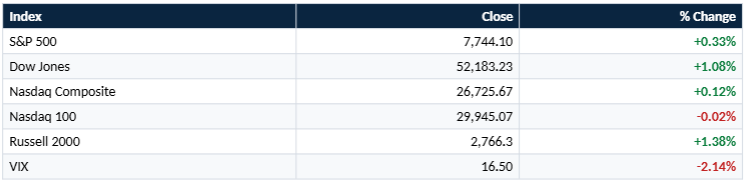
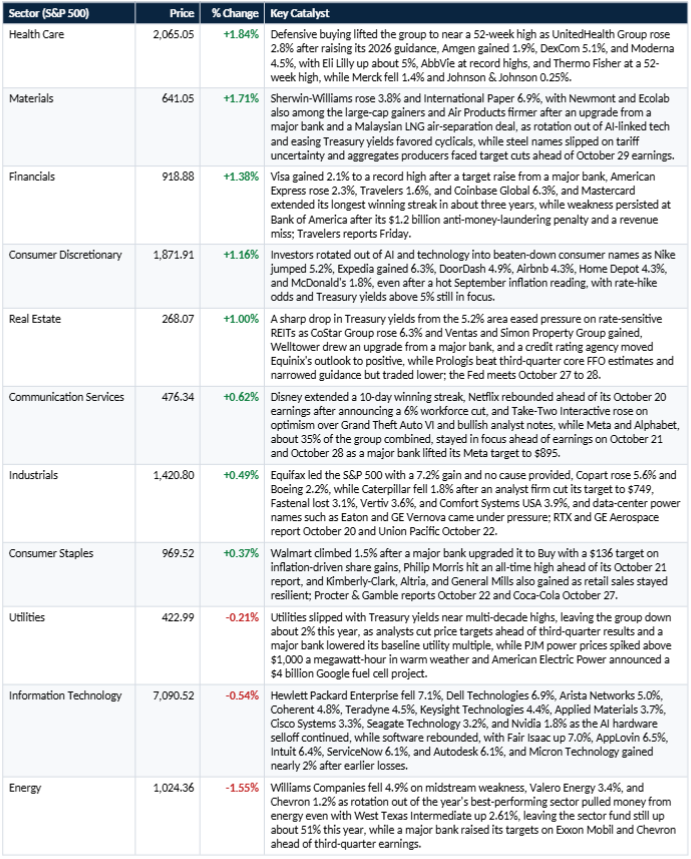
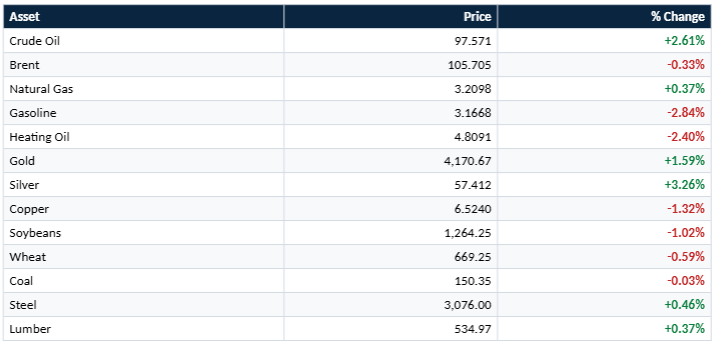
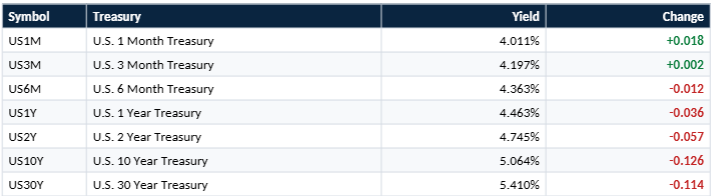
US stocks recovered from an early AI-led selloff on Thursday as investors rotated into value, with the Dow Jones Industrial Average gaining 1.08% to 52,183.23 and the S&P 500 rising 0.33% to 7,744.10. The Nasdaq Composite added 0.12% to 26,725.67 after trading down about 1.4% at its low, while the Nasdaq 100 slipped 0.02% to 29,945.07, the Russell 2000 gained 1.38% to 2,766.3, and the VIX fell 2.14% to 16.50. Producer prices rose 1.3% in September, the biggest monthly gain since 2022, and TSMC's cautious outlook for 2027 dented sentiment despite a record quarterly profit, though Walmart gained 1.5% and Nike jumped 5.2%. The 10-year Treasury yield fell 12.6 basis points to 5.064%, gold rose 1.59% to 4,170.67, West Texas Intermediate gained 2.61% to 97.571, and Brent slipped 0.33% to 105.705. Health care, materials, and financials led the sectors, while energy and technology fell.
ANALYTICAL VIEW
A rotation, not a rally, shaped the session. The Dow gained 1.08% and the Russell 2000 1.38% as money moved into health care, which rose 1.84%, materials at 1.71%, and financials at 1.38%, while technology fell 0.54% and energy 1.55% even as West Texas Intermediate rose. Beneath the flat Nasdaq 100 lay a split in technology: hardware names such as Hewlett Packard Enterprise, Dell Technologies, and Arista Networks fell between 5.0% and 7.1%, while software makers including Intuit, ServiceNow, and Autodesk rose more than 6%.
Bonds supplied the other half of the story. The 10-year Treasury yield fell 12.6 basis points to 5.064% as the technology selloff sent money into government debt, easing pressure on rate-sensitive groups such as real estate, which rose 1.00%, even as producer prices and retail sales pointed to firmer inflation. That tension runs through the AI trade, where higher borrowing costs are turning attention to how data-center build-outs are financed, a worry sharpened by the stress in CoreWeave's credit markets and by a record quarter at TSMC that did not stop the selloff.
What could change the picture: Whether Fed Chair Kevin Warsh's speech in Bangkok overnight and Friday's import prices and industrial production data move the odds of an October 27 to 28 rate hike, and whether the credit stress at CoreWeave and Oracle spreads to the wider AI trade.
SECTOR PERFORMANCE
WINNERS & LOSERS
Top 5 Gainers (across S&P, Nasdaq, Dow):
- Equifax Inc. (NYSE:EFX): +7.249%
- Reddit, Inc. (NYSE:RDDT): +7.201%
- Fair Isaac Corporation (NYSE:FICO): +6.99%
- International Paper Company (NYSE:IP): +6.85%
- AppLovin Corporation (NASDAQ:APP): +6.522%
Top 5 Decliners:
- Hewlett Packard Enterprise Company (NYSE:HPE): -7.115%
- Dell Technologies Inc. (NYSE:DELL): -6.934%
- Rocket Lab Corporation (NASDAQ:RKLB): -6.641%
- Everpure Inc. (NYSE:P): -5.718%
- Arista Networks, Inc. (NYSE:ANET): -5.035%
Note: Rocket Lab fell after delaying the first launch of its larger Neutron rocket until next year, and Dell fell with other AI hardware shares on funding worries; no specific cause was provided for the moves in Equifax, Reddit, Fair Isaac, International Paper, AppLovin, Hewlett Packard Enterprise, Everpure, or Arista Networks.
AFTER-HOURS MOVERS
Gainers:
- Varonis Systems, Inc. (NASDAQ:VRNS), +2.58% after hours: Shares rose to $48.56 after Proofpoint, which is owned by Thoma Bravo, agreed to acquire the company for $49.75 a share in cash, a deal valued at about $6.3 billion. The board approved the deal unanimously, Thoma Bravo has committed equity and secured debt financing, and Ontario Teachers' Pension Plan has agreed to invest in Proofpoint, with closing expected in the first half of 2027, after which the stock will stop trading on Nasdaq. The stock had closed 0.59% higher at $47.34.
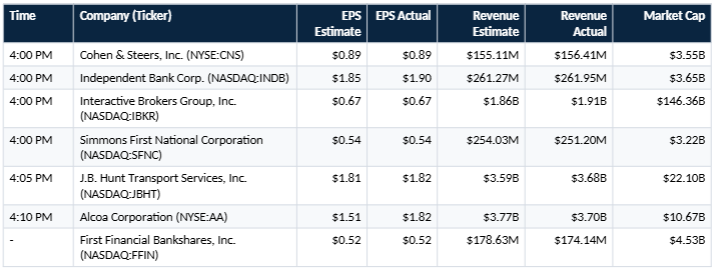
- Alcoa Corporation (NYSE:AA), +2.33% after hours: Shares rose to $41.36 after third-quarter adjusted earnings of $1.82 a share, well above the $1.51 estimate, on third-party revenue of $3.704 billion, a little below the $3.77 billion estimate. Net income attributable to Alcoa was $483 million, adjusted EBITDA excluding special items was $789 million, and free cash flow was $472 million, and the company reaffirmed its 2026 production and shipment ranges while flagging about $30 million of sequential headwinds in aluminum from higher raw material costs and planned maintenance. The stock had closed 0.85% higher at $40.42.
Decliners:
- J.B. Hunt Transport Services, Inc. (NASDAQ:JBHT), -2.55% after hours: Shares fell to $229.31 even though third-quarter earnings of $1.82 a share edged past the $1.81 estimate and revenue of $3.68 billion, up 20% from a year earlier, beat the $3.59 billion estimate. Operating income rose 2% to $247.1 million, with intermodal operating income up 18% and dedicated contract services down 22%, and no cause was tied to the decline in the sources. The stock had closed 1.36% higher at $235.31.
- First Financial Bankshares, Inc. (NASDAQ:FFIN), -1.39% after hours: Shares fell to $31.15 after third-quarter earnings of $0.52 a share matched estimates but revenue of $174.14 million missed the $178.63 million estimate. Net income rose 42% to $74.31 million as the net interest margin widened to 3.91% from 3.80%, and the chief executive called it another record quarter of net income. The stock had closed 2.27% higher at $31.59.
- Interactive Brokers Group, Inc. (NASDAQ:IBKR), -0.79% after hours: Shares fell to $85.35 after adjusted earnings of $0.67 a share matched estimates and revenue of $1.91 billion beat the $1.86 billion estimate, as customer daily average revenue trades fell 11% from the prior quarter to 4.27 million, below the 4.42 million consensus, and commission revenue missed. The board raised the quarterly dividend to $0.15 from $0.0875, payable December 14 to holders of record on December 1. The stock had closed 2.25% higher at $86.03.
COMMODITIES & RATES
US TREASURY YIELDS
TOP STORIES: US
Producer prices jump 1.3% in September, adding to bets on a Fed rate hike. The producer price index rose 1.3% from August, the biggest monthly gain since March 2022 and more than double forecasts of 0.5% to 0.6%, and 6.3% from a year earlier, the largest annual rise since December 2022, against a forecast of 5.5%. Producer goods prices rose 2.6% on the month as energy jumped 10.8% and gasoline 20.3%, but wholesale food prices rebounded 1.2% and the government tied almost half of the rise in processed goods for immediate demand to diesel, a sign of spillover beyond fuel. Retail sales rose 0.8% against forecasts of 0.3% to 0.4%, lifted by gasoline, while sales excluding autos, gasoline, building materials, and food services edged up only 0.1% and weekly jobless claims stayed below 200,000 for a fifth week at 199,000. Futures put the odds of a rate hike at the Fed's October 27 to 28 meeting near 30% and the chance of at least one by December at about 90%.
CoreWeave's credit stress deepens as AI debt worries spread, though its shares rebound almost 6%. Five-year credit default swaps on the AI cloud company topped 1,100 basis points, a level generally read as distress that implies roughly a 63% chance of default within five years, and the yield on its 2031 bonds rose as high as about 16%, after a 15% share-price slide on Wednesday. The company owes about $50 billion, Oracle's swap spread neared 300 basis points, and spreads on Meta, Alphabet, and Amazon also hit records, while Nvidia has agreed to buy any unsold CoreWeave capacity through April 2032 and one major bank puts the company's backlog above $100 billion. A research firm warned that about 80% of neoclouds could shut down by 2030 and that more than $3.5 trillion of AI spending could face impairment, and no company in the group has defaulted or signaled it may.
Strategists grow wary as breadth narrows beneath a strong earnings season. Third-quarter S&P 500 earnings are expected to rise 30.6%, but one major bank estimates that growth excluding the Magnificent Seven, technology, and energy firms is only 5%, down from 14% in the prior quarter, and 62% of index members trade below their 50-day moving averages. Another major bank dropped its overweight call on US equities, saying its indicators had reached levels historically seen at market peaks, while a third trimmed technology to market weight and rotated into health care. One private-bank strategist said it will take "very, very strong" results for the S&P 500, up 13% this year and about 3% below 8,000, to close that gap.
Anthropic's revenue jumps 45% in the third quarter, but the news does little to calm AI nerves. According to an investor who attended a pre-IPO meeting with the company's leadership, revenue rose to $16.8 billion from the previous quarter, and the company is targeting a valuation of $2 trillion. Some traders worried that the top line might not be growing fast enough to justify the gains in chipmakers, and the selloff has already led smart-ring maker Oura to postpone its listing.
Apple and Meta team up to run Muse Spark Open on Mac Studio computers. Meta's 816-billion-parameter open-weight model can run locally on two to four linked Mac Studios, and a machine with the required M5 Ultra chip and 256GB of memory costs at least $10,799. The tie-up between longtime rivals, which follows months of joint work under Apple's new chief executive John Ternus, is a show of confidence in Meta's rebooted AI effort, though the model is less capable than Meta's proprietary Muse Wonder.
Also today: Cboe Global Markets will extend options trading hours on Monday for 24 stocks and five ETFs, adding sessions from 7:30 a.m. to 9:25 a.m. ET and from 4:00 p.m. to 4:15 p.m. ET; FMC slid more than 38% in early trading after sharply cutting its third-quarter outlook, including a $625 million to $675 million hit from commercial actions; Freddie Mac said the 30-year mortgage rate held at 7.40%, ending a seven-week climb, while the 15-year rate eased to 6.71%; Tesla was set to show its next-generation Roadster on Thursday evening from a SpaceX test site in Texas, almost a decade after it began taking deposits; Amazon launched two Bee listening devices, the $75 Bee Frontier and the $100 Bee Eclipse; Venture Global signed deals with GE Vernova and Baker Hughes for up to 16 gas-fired power units of 720 megawatts each, to support off-grid power for data centers; and US Customs and Border Protection delayed a new mail-entry rule for small international shipments by 90 days to January 20, 2027, a move that should forestall higher prices for imported prescription drugs until after the midterm elections.
TOP STORIES: GLOBAL
Asia-Pacific markets tumble as South Korea's Kospi plunges 7.57%. The Kospi fell to 5,554.22 and the small-cap Kosdaq lost 7.65% to 760.82 as chip heavyweights SK Hynix and Samsung Electronics dropped more than 11% and nearly 10%, while Japan's Nikkei 225 lost 4.9% to 64,425.95 and the Topix fell 2.38% to 3,999.34. China's CSI 300 fell 1.23% to 4,166.01, Hong Kong's Hang Seng was down more than 1% in its last hour of trade, and Australia's S&P/ASX 200 ended flat at 8,719.7. Memory stocks have slid on worries about a new chip architecture from China's ChangXin Memory Technologies and on a South Korean newspaper column that warned of oversupply in 2029, a view other analysts have not echoed, with SK Hynix down 26% and Samsung 22% over five days; Elon Musk added that China "will be making a LOT of RAM in 2028."
TSMC posts a sixth straight record profit while ASML says it cannot keep pace with demand. Third-quarter net profit rose 69% to T$763.1 billion, above forecasts, and TSMC guided fourth-quarter revenue to $52.3 billion to $54.3 billion from $33.73 billion a year earlier, lifting its 2026 revenue growth forecast to about 44% and keeping capital spending at $60 billion to $64 billion. Its second Arizona fab has completed construction, with mass production due in the third quarter of 2027 and Texas under evaluation for further expansion. ASML, whose shares fell about 5% in Europe on Thursday, said supply of its chip-making tools will fall short of demand in 2027 and 2028, with customers already discussing orders for 2029 and 2030.
The International Energy Agency speeds up emergency oil releases as attacks on shipping keep the Gulf on edge. The agency agreed to release more than 20 million barrels of diesel as soon as possible, short of the 50 million barrels once considered and equal to less than a day of global diesel demand, with about 330 million barrels of the 400 million pledged in March already released. Fears over supply persisted after Wednesday's sinking of a Singapore-registered ship in the Strait of Hormuz and Iran's vow that it is "counting the moments" until it can strike US warships, and a media report, which could not be independently confirmed, said the US military has drawn up options for renewed strikes that include its largest non-nuclear bomb. West Texas Intermediate rose 2.61% to 97.571 while Brent slipped 0.33% to 105.705.
China says rare earths will keep flowing to Europe, and India says the first phase of a US trade deal is nearly done. China's commerce ministry said Beijing is willing to keep approving rare earth export licenses to Europe whether or not the US-China trade truce, extended to January, is renewed. In New Delhi, trade minister Piyush Goyal said the first tranche of an India-US deal is in final legal drafting but that India will proceed only if it gains a tariff edge over rivals such as Bangladesh, Vietnam, and Indonesia, after a February framework cut the tariff on most Indian goods to 18% from 50%.
MANAGEMENT & FED SPEAK
Jensen Huang, Chief Executive, Nvidia, on CoreWeave:
Huang said "CoreWeave's financial strength is improving every day" and that he sees no need for Nvidia, which holds about a 10% stake in the company, to backstop it. He added that he is optimistic because its cost of capital is falling, and his comments helped the neocloud group pare its losses.
Mike Intrator, Chief Executive, CoreWeave, on the market reaction:
In an internal memo to employees, Intrator said that building a new type of technology company brings "periods of time when the market misunderstands and acts irrationally." He told staff the company is confident in a backlog that "more than supports all of our debt obligations."
Beth Hammack, President, Federal Reserve Bank of Cleveland, on Fed communication:
Hammack said she is "all ears" for an argument that central bank silence would help households and businesses make better decisions and strengthen the Fed's credibility, but called it "a pretty hard argument to make." Her remarks, made in an interview on Monday, pushed back on Chair Kevin Warsh's call for a quieter Fed, as officials have spoken publicly more than 40 times since the September rate hike.
C.C. Wei, Chief Executive, Taiwan Semiconductor Manufacturing Company, on 2027 planning:
Wei said consumer and price-sensitive end markets are being challenged by rising component prices and macroeconomic uncertainty, and that "we are being prudent in our business planning going into 2027." On US expansion beyond Arizona, he said the company has sent teams to evaluate sites, adding "Texas is one."
Sarah Breeden, Deputy Governor for Financial Stability, Bank of England, on AI-enabled cyber risk:
Breeden said advances in AI now pose a "systemic risk" to the global financial system and that banks can no longer count on their defenses holding. "It's not enough now to assume that the cyber attackers won't get through," she said, adding that the central bank is working with lenders on recovery options for core services.
CORPORATE ACTIONS & EARNINGS CALENDAR
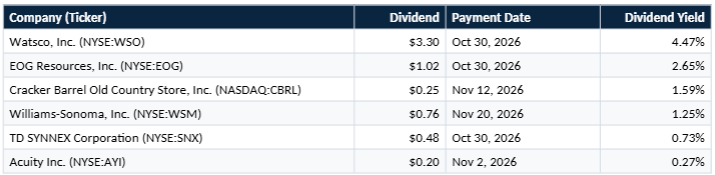
Top Ex-Dividend Companies for Friday, October 16:
Earnings Reported After the Close (Thursday, October 15):
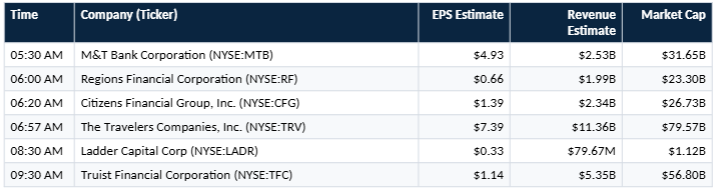
Upcoming Earnings (Friday, October 16):
Economic Calendar (Friday, October 16):

That's the wrap for today! Attention turns to Fed Chair Kevin Warsh's speech in Bangkok overnight, Friday's import prices and industrial production data, results from Truist, Travelers, and M&T Bank, and whether the AI selloff finds a floor with the 10-year Treasury yield near 5.06% and the Fed's October meeting less than two weeks away.
Related post