The Wall Street Wrap: October 8, 2026
US stocks slipped Thursday as the Nasdaq fell 1.25% after OpenAI’s revenue came in below earlier reports, hitting AI shares. Brent jumped 4% to $104.28 on Iran tensions, while Treasury yields eased. After hours, Humana surged and Alignment Healthcare plunged on Medicare ratings, and telecoms fell on SpaceX’s spectrum deal.

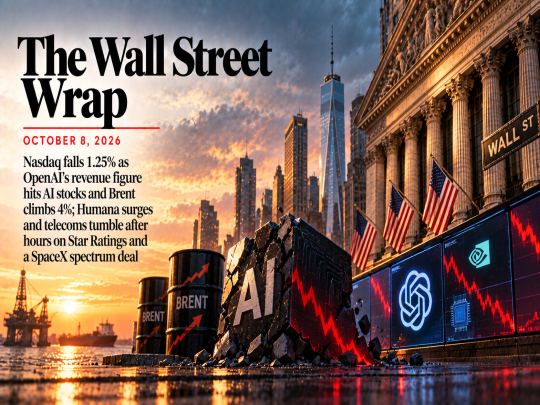
Nasdaq falls 1.25% as OpenAI's revenue figure hits AI stocks and Brent climbs 4%; Humana surges and telecoms tumble after hours on Star Ratings and a SpaceX spectrum deal
Welcome to Wall Street Wrap, your quick end-of-day rundown of what moved US markets today, plus what's shaping global sentiment overnight.
MARKETS TODAY
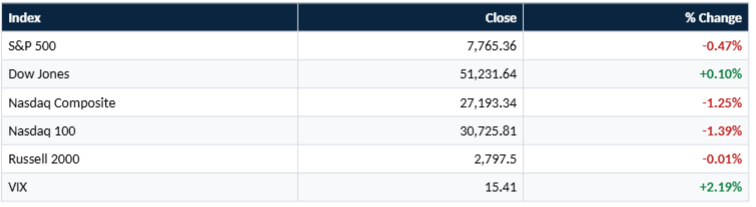
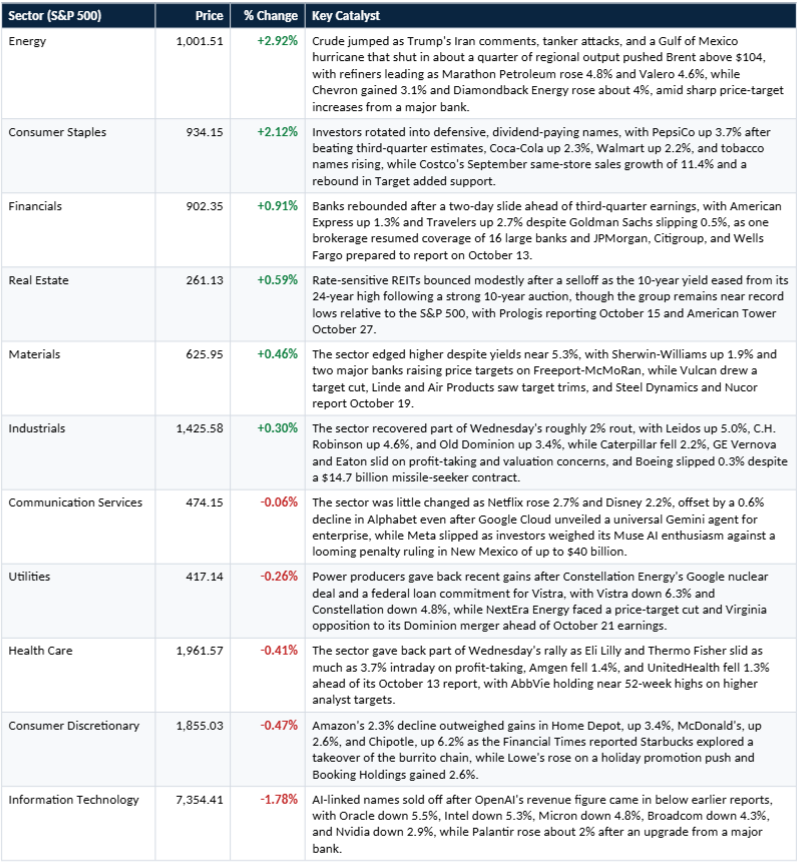
US stocks fell on Thursday as new details about OpenAI's revenue pressured the artificial intelligence trade, offsetting a rally in energy and consumer staples shares. The Nasdaq Composite slid 1.25% to 27,193.34 and the S&P 500 lost 0.47% to 7,765.36, while the Dow Jones Industrial Average edged up 51.77 points, or 0.1%, to 51,231.64, with Home Depot and Chevron among its biggest gainers. The Nasdaq 100 dropped 1.39% to 30,725.81, the Russell 2000 was little changed at 2,797.5, and the VIX rose 2.19% to 15.41. The 10-year Treasury yield eased to about 5.23% from this week's 24-year high after a solid 30-year auction, while Brent crude climbed 4.07% to settle at $104.28. Energy and consumer staples led the sectors, and information technology fell the most.
ANALYTICAL VIEW
The day's damage was concentrated in one corner of the market. Information technology fell 1.78%, the worst of the 11 S&P 500 sectors, after OpenAI told investors its annualized revenue reached about $50 billion at the end of September rather than the $68 billion widely reported, a gap a person familiar with the matter attributed to the larger figure including partners' gross revenue. Oracle dropped about 5.5%, Intel 5.3%, Broadcom 4.3%, and Nvidia 2.9%, and the Philadelphia Semiconductor Index fell more than 3%, yet the broader market held up because money rotated elsewhere: energy rose 2.92%, consumer staples 2.12%, and financials 0.91%, and six of the 11 sectors finished higher. The split shows how much of the market's recent strength rests on a single theme, with the Nasdaq 100 down 1.39% while the Dow finished higher.
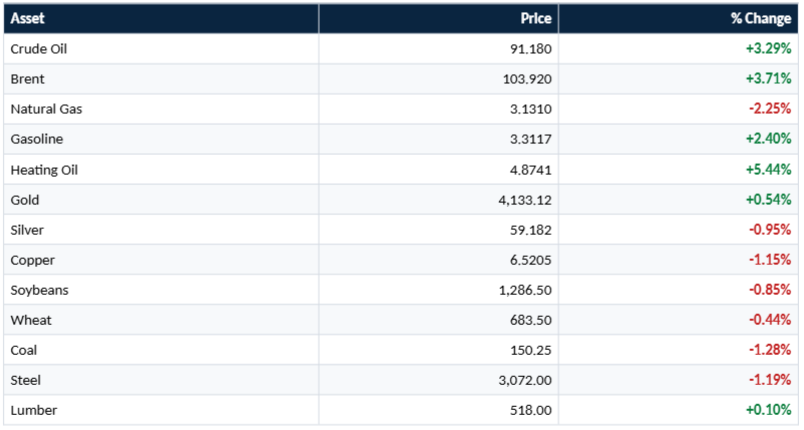
Rates and oil supplied the rest of the story. Brent jumped about 4% after President Trump said late Wednesday that a deal with Iran was not something he wanted, then fell back from its highs when he pledged on Thursday not to attack before the midterm elections, while Treasury yields eased from 24-year peaks after a 30-year auction that cleared at 5.618%, 31 basis points above September's result. Two Fed officials, Governor Christopher Waller and St. Louis Fed President Alberto Musalem, said more rate hikes are coming, though Waller allowed that they need not come at consecutive meetings. One strategist argued that energy-driven inflation has shifted the Fed's outlook and the long end of the curve, and that an Iran deal taking oil from $90 to $70 would bring yields down meaningfully, while adding that equities have been resilient and that yields could settle in a range of 5% to 6%.
What could change the picture: Whether Friday's preliminary consumer survey and a Fed speaker add to the case for further hikes, and whether Brent holds above $100 after Trump's pledge removed the near-term threat of strikes while tanker attacks and a Gulf of Mexico hurricane continue to constrain supply.
SECTOR PERFORMANCE
WINNERS & LOSERS
Top 5 Gainers (across S&P, Nasdaq, Dow):
- CoStar Group, Inc. (NASDAQ:CSGP): +8.007%
- Chipotle Mexican Grill, Inc. (NYSE:CMG): +6.207%
- GoDaddy Inc. (NYSE:GDDY): +6.152%
- Accenture PLC (NYSE:ACN): +5.96%
- Gartner, Inc. (NYSE:IT): +5.189%
Top 5 Decliners:
- Coherent Corp. (NYSE:COHR): -9.628%
- Astera Labs, Inc. (NASDAQ:ALAB): -9.209%
- CoreWeave, Inc. (NASDAQ:CRWV): -7.767%
- Nebius Group N.V. (NASDAQ:NBIS): -7.354%
- ARM Holdings PLC (NASDAQ:ARM): -6.482%
Note: Chipotle rose as the Financial Times reported that Starbucks explored a takeover, while AI infrastructure names led the decliners on a day when OpenAI's revenue figure pressured the group; no specific cause was provided for the gains in CoStar, GoDaddy, Accenture, or Gartner.
AFTER-HOURS MOVERS
Gainers:
- Humana Inc. (NYSE:HUM), +12.78% after hours: Shares jumped to $436.59 after Medicare Advantage Star Ratings published by the Centers for Medicare & Medicaid Services on October 8 showed its largest contract recovered to 4 stars from 3.5 in the 2027 ratings, restoring eligibility for federal quality bonus payments that could lift earnings in 2028. The upgrade follows a ratings collapse in 2024, when the share of members in plans rated at least 4 stars fell from 94% to 25% for the following year, and the stock had closed 2.37% lower at $387.12.
- Securitize Corp. (NYSE:SECZ), +6.16% after hours: Shares rose to $13.44 after the company launched Securitize Stocks, a platform for eligible US, EU, and other approved-jurisdiction investors to trade tokenized US equities backed 1:1 by the underlying shares, starting on Solana with USDC settlement. The initial 12 names include Apple, Nvidia, Tesla, Microsoft, Palantir, and SpaceX, and the stock had closed 11.05% higher at $12.66 after a 10% drop on Wednesday.
- Park Aerospace Corp. (NYSE:PKE), +3.34% after hours: Shares rose to $30.65 after the company reported fiscal second-quarter earnings of $0.21 per share against $0.16 expected, on revenue of $20.79 million versus $20.01 million expected and up from $16.38 million a year earlier. Net earnings were $4.53 million, adjusted EBITDA was $5.29 million, and gross margin was 34.3%, while six-month net earnings reached $8.07 million on revenue of $39.10 million. The stock had closed 1.37% higher at $29.66.
- Calix, Inc. (NYSE:CALX), +2.74% after hours: Shares rose to $37.07 after the board raised its share repurchase authorization by $100 million, announced after the close, following a run of customer news that included Astound's completed 50G-PON trial and Chariton Valley's adoption of its Agent Workforce Cloud. The stock had closed 1.52% higher at $36.08 in a session when the Philadelphia Semiconductor Index fell more than 3%, and its next results are due November 2.
- Oil-Dri Corporation of America (NYSE:ODC), +0.36% after hours: Shares edged up to $84.67 after the company reported fiscal fourth-quarter adjusted earnings of $1.00 per share on record quarterly revenue of $129.3 million, up 3% from $125.2 million, with net income up 10% to $14.4 million. For the full year, net sales rose 2% to $493.8 million, net income rose 6% to $57.0 million, and cash reached a record $73.7 million, while the Retail & Wholesale group's operating income fell 5% to $9.3 million on higher transportation costs for cat litter. The stock had closed 3.92% lower at $84.37.
Decliners:
- Alignment Healthcare, Inc. (NASDAQ:ALHC), -21.01% after hours: Shares fell to $6.88 after the Star Ratings downgraded its largest California contract to 3.5 stars from 4, a contract that accounted for about 81% of its membership as of September 2025. The insurer had been an industry outperformer, with 100% of members in plans rated at least 4 stars for 2026, and the stock had closed 1.87% higher at $8.71.
- AT&T Inc. (NYSE:T), -7.52% after hours: Shares fell to $23.00 after SpaceX announced a definitive agreement to acquire Grain Management's nationwide 800 MHz spectrum portfolio, up to 14 megahertz of paired low-band spectrum, subject to FCC approval, which would give Starlink Mobile a terrestrial layer that penetrates building walls and position it as a direct rival to wireless carriers. Grain acquired the portfolio from T-Mobile in August, and the FCC this week approved Starlink Mobile's Gen2 constellation of 15,000 satellites. The stock had closed 1.63% higher at $24.87.
- Verizon Communications Inc. (NYSE:VZ), -6.80% after hours: Shares fell to $43.20 on the same deal, which SpaceX's chief executive called a "very big deal," which followed a joint venture formed last week by Verizon, AT&T, and T-Mobile to expand satellite and direct-to-device coverage in underserved areas, an effort from which Starlink was notably absent. The stock had closed 1.27% higher at $46.35.
- T-Mobile US, Inc. (NASDAQ:TMUS), -6.69% after hours: Shares fell to $159.85 as one industry expert noted the spectrum is a limited amount and that reliable urban building coverage would still require ground towers, while the FCC said Wednesday it would vote on auctioning 25 megahertz of prime spectrum for satellite-to-phone services. The stock had closed 2.18% higher at $171.31.
COMMODITIES & RATES
US TREASURY YIELDS
TOP STORIES: US
Nvidia, Oracle, CoreWeave, and other AI stocks sink after OpenAI's revenue comes in below earlier reports. OpenAI told investors it reached roughly $50 billion in annualized revenue at the end of September, short of the $68 billion widely reported late last month, with a person familiar saying the higher figure included gross revenue from OpenAI's partners and allows a more direct comparison with Anthropic. The company also cited 77% total run-rate growth in the third quarter and 107% for its enterprise business. Nvidia fell about 3%, Oracle about 5.5%, and CoreWeave nearly 8%, with AMD and Broadcom each down about 4%, Intel about 5%, and Super Micro Computer nearly 5%, as OpenAI faces pressure to justify an $852 billion valuation ahead of an IPO widely expected in 2027.
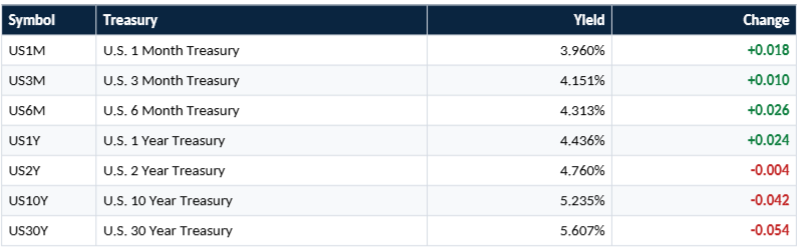
Treasury yields ease from 24-year highs after a decent 30-year auction. The Treasury sold $22 billion of 30-year bonds at a high yield of 5.618%, up 31 basis points from the 5.308% September result, with indirect bidders taking 72.3% against a 10-auction average of 68% and direct bidders 20.9% against 22%. One strategist called the sale decent but weaker than Wednesday's 10-year auction, saying demand is concentrated at the front and belly of the curve while the long end is where investors demand the most compensation. The 10-year yield fell to about 5.23% and the 30-year to about 5.6% after both hit their highest levels since 2002 this week, helped by Trump's pledge not to attack Iran before the midterms.
PepsiCo tops third-quarter estimates and leads a rally in consumer staples. The company reported adjusted earnings of $2.34 per share on revenue of $25.27 billion, against analyst expectations of $2.29 and $24.96 billion, and its shares rose 3.7%. PepsiCo also trimmed its profit growth outlook on weakness in North America, but the staples sector still gained 2.12%, second only to energy, as investors rotated into defensive names and Coca-Cola, Walmart, and Procter & Gamble all rose.
US suspends Microsoft and Adobe from its green card labor program in a crackdown on foreign hiring. Labor Secretary Keith Sonderling said the department will no longer accept or process new applications under the Permanent Labor Certification program from a list of companies including Cognizant, Infosys, Capgemini, Tata, Wipro, and HCL, and that Microsoft and Adobe were also suspended "due to multiple active federal investigations." Vice President JD Vance criticized Microsoft, pointing to its 6,000 layoffs in 2025, while Microsoft said most of its US employees are Americans and that 80% of the roughly 6,000 H-1B applications it filed last fiscal year were to extend or change the status of existing staff. The announcement came at the same summit where Trump was set to award the National Medal of Science to Microsoft's Satya Nadella and the chiefs of Nvidia, SpaceX, and AMD.
Amazon replaces its budget Fire tablets with a pricier Alexa lineup, from $230 to $550. The new 8-inch, 11-inch, and 12-inch tablets run Google's Android rather than Amazon's custom Fire OS, are available for preorder, and ship October 14, with the top model costing more than double the $155 Fire HD 10. Amazon said it will keep supporting Fire devices for four years after the final shipment, and it denied that a historic surge in memory prices drove the higher pricing.
Also today: Initial jobless claims edged down to 197,000 in the week ended October 3, just below the 200,000 estimate, while continuing claims rose 17,000 to 1.72 million; the Treasury sanctioned 17 more vessels tied to Iran's "shadow fleet" under "Operation Economic Outcast," with a Treasury official saying Iran has stopped loading and offloading oil because of the US blockade and Kpler data showing no crude loaded for export since August 25; and the national average gasoline price reached $4.36 a gallon, up about 40% from a year ago and from $2.98 just before the war began, according to AAA.
TOP STORIES: GLOBAL
Trump says the US will not attack Iran before the midterms, as oil jumps 4% on tanker attacks and a Gulf hurricane. In a post, Trump said the US "will not be attacking Iran at any time prior to the Midterm Elections" while having "productive discussions" with Tehran, reversing his stance from late Wednesday when he said he did not want a deal and reportedly weighed pre-election strikes, though the naval blockade stays in place. Brent settled 4.07% higher at $104.28 and WTI 3.64% higher at $91.49, both off their highs after the pledge, as nine tankers came under attack in and around the Strait of Hormuz over the past week and Houthi militants fired ballistic missiles at Riyadh and Khamis Mushait. Oil companies also shut in about 500,000 barrels per day, or 25% of Gulf of Mexico output, ahead of Hurricane Isaias, while about 9.5 million barrels per day of crude exited Hormuz in the week ended Tuesday, roughly 30% below prewar levels.
ECB policymakers saw upside inflation risks but refused to signal further rate moves. Accounts of the September meeting, released Thursday, showed officials viewed risks to inflation as skewed to the upside when they delivered the bank's first rate hike since 2023, but stressed avoiding guidance on the future path given uncertainty from the fighting between the US and Iran and Russia's war in Ukraine. They said the policy response should remain proportionate and noted that the 2.50% deposit rate remains within staff estimates of the neutral range.
German exports fall for a second month as shipments to the US slump 6.3%. Exports dropped 0.8% from the previous month to €137.6 billion in August, missing expectations for a 0.8% gain, after a downwardly revised 0.5% decline in July. Shipments to EU members fell 0.6% and to third countries 1.1% to €60.0 billion, with the US decline offsetting gains of 4.7% to China and 16.7% to the UK, though exports were still 6.2% higher than a year earlier.
Asian markets close lower, led by a 2.6% drop in South Korea's Kospi. Japan's Nikkei 225 fell 1.42% to 69,042.11 and the broader Topix dropped 1.51% to 4,091.46, while the Kospi lost 2.62% to 6,625.93 and the Kosdaq slipped 0.69% to 892.27. Australia's S&P/ASX 200 fell 0.77% to 8,660.90, Hong Kong's Hang Seng was down 1.43% in its last hour of trade, and mainland China's CSI 300 closed 1.09% lower at 4,310.28.
MANAGEMENT & FED SPEAK
Christopher Waller, Governor, Federal Reserve Board, on further rate hikes:
Speaking in Turkey, Waller said that if the data keep coming in as expected he anticipates additional hikes to bring inflation back to 2% in a timelier way, adding that "The hikes do not need to come at consecutive meetings," and defended forward guidance as an effective signaling tool.
Alberto Musalem, President, Federal Reserve Bank of St. Louis, on policy firming:
Musalem said it is important to contain any broadening of inflation pressures or second-round effects from supply shocks and persistent demand, and that "more monetary policy firming will be required." He did not specify the size of any hikes but envisions about 18 months for bringing inflation back to the 2% target.
Scott Bessent, Secretary, US Treasury, on Iran sanctions:
Bessent said the Treasury is starving Tehran of the money it uses to wage war in the region and that no enabler of Iranian sanctions evasion is safe from the department's full authorities, as it designated 17 more vessels.
Keith Sonderling, Secretary, US Department of Labor, on foreign worker programs:
Sonderling said the suspended companies alone have requested almost 3 million foreign workers since 2009 and received over 230,000 H-1B approvals and over 100,000 permanent labor certifications, which he described as hundreds of thousands of jobs taken from American workers.
Panos Panay, Head of Devices, Amazon, on memory costs and tablet pricing:
Panay acknowledged that the memory shortage made it "quite tricky" to build a premium tablet at a reasonable price, but said the team "did a good job designing without making that trade."
CORPORATE ACTIONS & EARNINGS CALENDAR
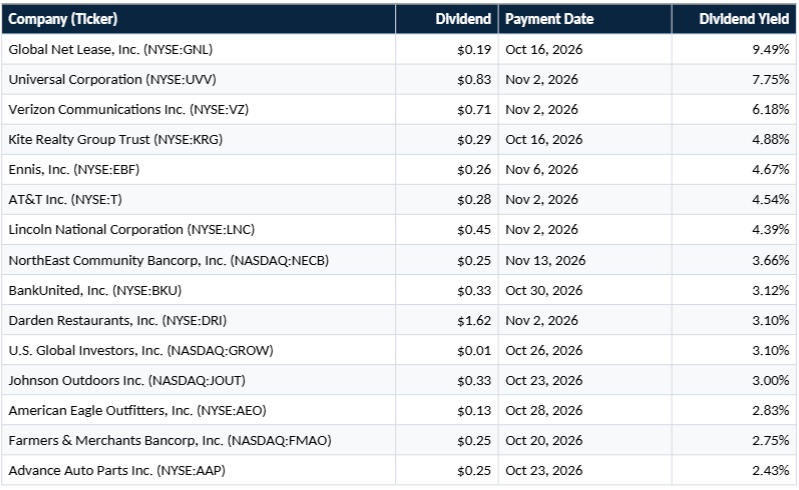
Top Ex-Dividend Companies for Friday, October 9:
Earnings Reported After the Close (Thursday, October 8):

Upcoming Earnings (Friday, October 9):

Economic Calendar (Friday, October 9):

That's the wrap for today! Attention turns to Delta Air Lines' results before the open, the preliminary University of Michigan consumer survey, and a speech from Kansas City Fed President Jeffrey Schmid, as investors test whether oil above $104 a barrel and a wobbling AI trade can coexist with Treasury yields hovering near 24-year highs.
Related post