The Wall Street Wrap: September 8, 2026
Stocks fell Tuesday as oil extended its longest rally since March and Middle East tensions escalated further, with the Dow posting back-to-back losses ahead of this week's inflation data. Semiconductors bucked the trend as Amgen sank on an FTC antitrust brief, while Canada's retaliatory tariffs and a widening Yemen-Saudi conflict added to the day's list of flashpoints.

Welcome to Wall Street Wrap, your quick end-of-day rundown of what moved US markets today, plus what's shaping global sentiment overnight.
Markets Today
Stocks dropped Tuesday to start a holiday-shortened trading week, with investors watching escalating tensions in the Middle East ahead of key inflation data due later this week. The Dow fell for a second straight session, extending Friday's decline, while the S&P 500 and Nasdaq 100 also closed lower. US markets were closed Monday for Labor Day. Oil prices climbed for a sixth consecutive day, their longest streak since March, after the US and Iran exchanged strikes over the weekend, while semiconductor stocks bucked the broader selloff and helped offset some of the pressure from higher energy prices.
Close Levels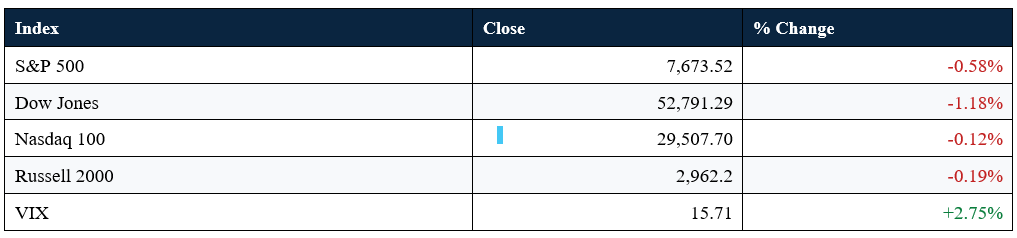
Analytical View
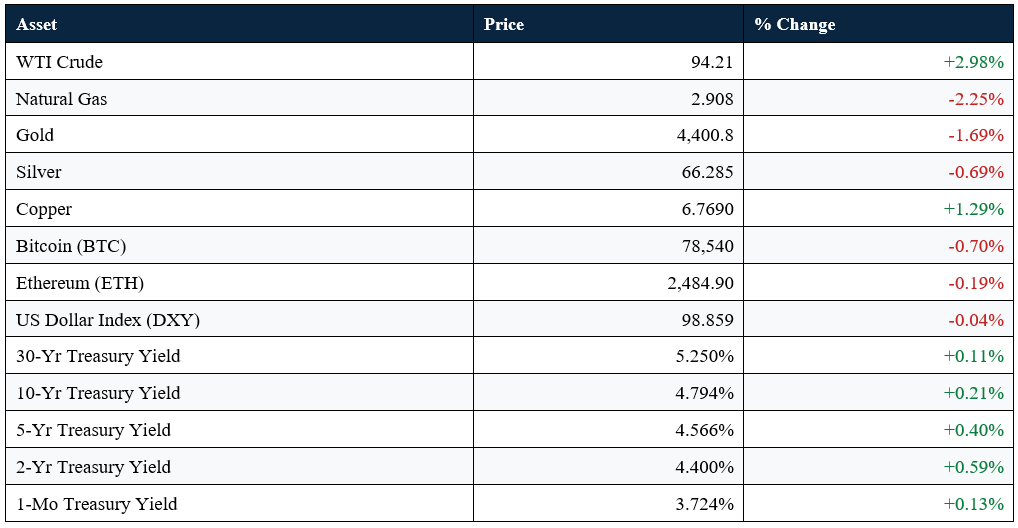
Today's selloff had a clear driver: oil. West Texas Intermediate crude climbed for a sixth straight session, its longest winning streak since March, as the weekend's exchange of strikes between the US and Iran kept a bid under energy prices. Brent crude traded above $98 a barrel. The rise in oil sharpens the focus on this week's inflation data, since higher energy costs feed directly into both the producer and consumer price indexes due out Thursday and Friday. Fed funds futures were last pricing a 59% chance of a quarter-point rate hike at the September 15-16 meeting. One market strategist framed the stakes bluntly: an upside surprise in the CPI print would make it very difficult for the Fed to avoid hiking, and that is squarely what investors are focused on right now.
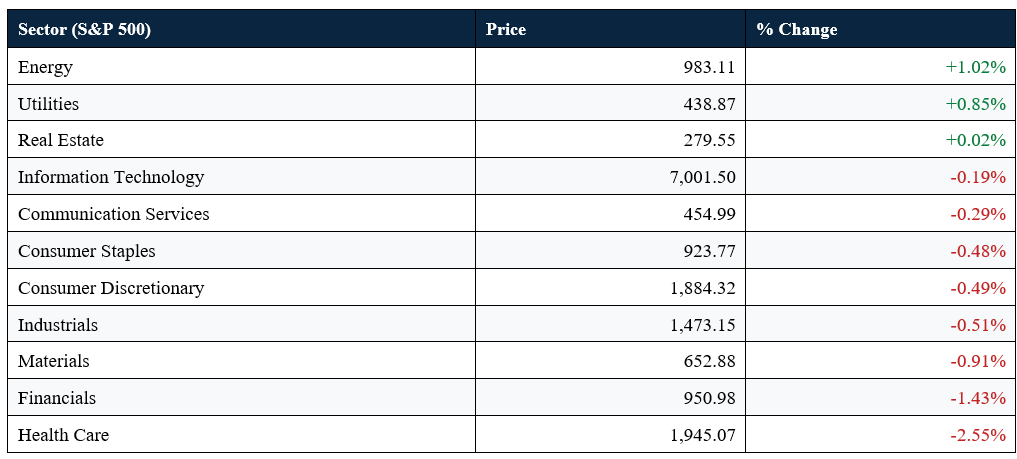
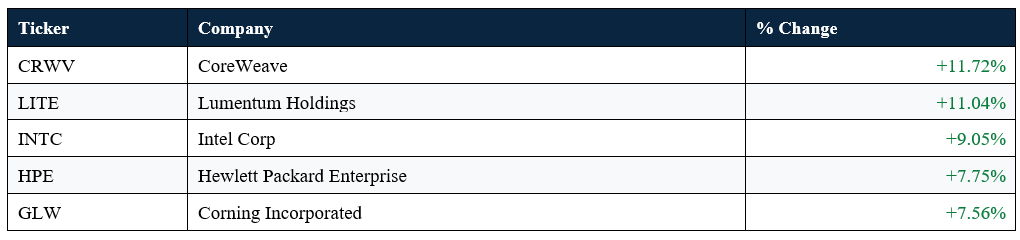
Not every part of the market moved the same way. Semiconductors held up well even as broader indices fell, with Intel (NASDAQ:INTC) and Advanced Micro Devices (NASDAQ:AMD) posting strong gains and Broadcom (NASDAQ:AVGO) also higher, a sign that chip demand remains a distinct story from the macro backdrop weighing on the rest of the tape. Treasury yields also moved higher alongside oil, with the 10-year note last week reaching its highest level since November 2023 and the 2-year yield touching a January 2025 high. Adding to the list of cross-currents, Canada's retaliatory tariffs on roughly $20 billion of US goods took effect Tuesday, and President Trump said Canadian planemaker Bombardier would be barred from selling in the US unless it begins manufacturing domestically.
What could change the picture: Thursday's Producer Price Index and Friday's Consumer Price Index are the next major tests, both of which will shape how much room the Fed has ahead of its meeting next week. Any further escalation between the US and Iran, or in the newly widened Yemen-Saudi Arabia conflict, would also keep upward pressure on oil and, by extension, on inflation expectations.
Sector Performance
 Winners & Losers
Top 5 Gainers (across S&P, Nasdaq, Dow)
Top 5 Decliners
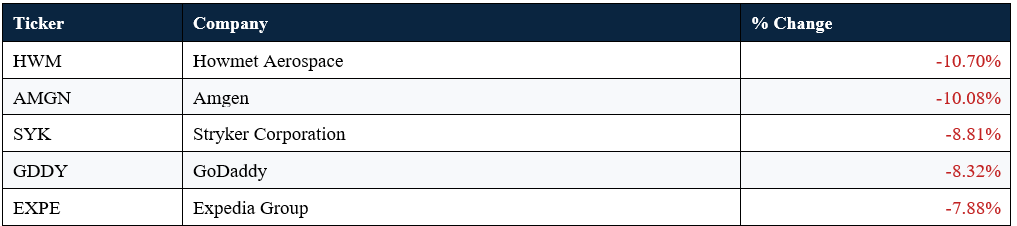
Note: Semiconductor and hardware names led the day's gainers even as the broader market fell, while Amgen weighed heavily on health care after news of a federal antitrust filing.
Commodities & Rates
Top Stories: US
- Oil's six-day rally deepens ahead of key inflation data. West Texas Intermediate crude rose for a sixth straight session, its longest streak since March, after the US and Iran exchanged strikes over the weekend, pushing Brent crude above $98 a barrel. The move sharpens attention on this week's producer and consumer price data, both of which will help shape expectations for the Federal Reserve's meeting next week.
- Global energy stocks hit a record high. The iShares Global Energy ETF, which tracks the sector worldwide, closed up 1.47% and touched its highest level since its inception in November 2001. A separate ETF focused on US exploration and production companies reached its highest point since June 2015.
- Canada's retaliatory tariffs take effect, deepening trade rift with the US. Canada's new duties, ranging from 15% to 50% on a wide array of US goods worth about CA$27.6 billion, took effect Tuesday in response to US tariffs imposed on Canadian goods in August. Steel, aluminum, and iron products face a doubled 50% rate. President Trump separately said Canadian planemaker Bombardier would be barred from selling aircraft in the US unless it begins manufacturing domestically, adding another point of friction to the dispute.
- Qualcomm (NASDAQ:QCOM) partners with Amazon Web Services on AI infrastructure. Qualcomm announced a collaboration with AWS, a division of Amazon (NASDAQ:AMZN), aimed at supporting the buildout of Amazon's AI infrastructure, combining AWS's compute and storage capabilities with Qualcomm's power-efficient processing and chip design expertise as demand for AI workloads continues to grow.
- Meta (NASDAQ:META) launches paid AI personal assistant app. Meta introduced a new AI agent app, internally code-named Hatch, that can handle tasks like booking appointments and filling out forms. The app will be offered through a free tier or paid subscription plans of $20 or $100 a month depending on usage, arriving as the company and the broader AI industry face growing public scrutiny.
- GE Aerospace (NYSE:GE) to acquire Consolidated Precision Products for $11.75 billion. GE Aerospace announced it will acquire CPP, a major manufacturer of engineered castings for the commercial aerospace and defense markets, from private investment firms Warburg Pincus and Berkshire Partners. The deal is expected to be financed with $7 billion in cash and the remainder in new debt, and is expected to be accretive to adjusted earnings per share and free cash flow in its first year. The transaction is expected to close in the second half of 2027, pending regulatory approval.
- Trump administration presses Ford (NYSE:F) over its ties to Chinese companies. Transportation Secretary Sean Duffy sent a letter to Ford CEO Jim Farley raising concerns about the automaker's relationships with Chinese firms, including battery supplier CATL, and a proposed framework to allow Chinese joint ventures on US soil. Ford pushed back, calling the letter a "wrongheaded attempt to capture headlines" and disputing specific factual claims in it, while noting it employs more hourly US autoworkers than any other automaker.
Top Stories: Global
- Yemen's Houthis strike deep into Saudi Arabia in war's biggest expansion yet. Houthi forces attacked four Saudi cities with drones and missiles, hitting an airbase and state oil company assets and wounding more than 70 people, marking one of the largest attacks on Saudi Arabia since the US and Israel began their war against Iran in February. Explosions were also reported near Iran's Kharg Island oil hub, suggesting a possible resumption of US strikes after a two-day pause.
- US says seized underwater drone in Strait of Hormuz was defective. The US military said an unmanned submersible that Iran claimed to have captured near the Strait of Hormuz had malfunctioned and carried no sensitive data or classified equipment. Iran's Revolutionary Guard had earlier claimed to have captured one of the US military's most advanced underwater drones.
- Government bond yields hit multi-decade highs across Europe. The yield on France's 30-year government bond reached its highest level since April 2008, while Germany's 10-year bund yield hit its highest since early 2011, as rising oil prices and inflation fears pushed borrowing costs higher across major economies.
- UK presses ahead with West Bank settlement sanctions despite US warnings. The UK announced it will ban imports from Israeli settlements in the occupied West Bank, with the measures expected to take six to nine months to take effect. Israel responded by announcing it would close the British consulate in Jerusalem, while US officials warned of potential economic consequences for British businesses, including a Florida lawmaker's threat to bar British firms from state and local government contracts.
- Technical failure disrupts hundreds of UK flights. A flight-processing system issue at air traffic control provider NATS caused widespread cancellations and delays at major British airports including Heathrow, Gatwick, Manchester, and Stansted, with roughly 100 cancellations and hundreds of delays reported at Heathrow alone.
Management & Fed Speak
Cristiano Amon, President and CEO, Qualcomm (NASDAQ:QCOM), on the AWS collaboration:
Amon said data center infrastructure will need advances in both computing and connectivity to keep pace with AI demand while becoming more efficient. He said Qualcomm is pleased to work with AWS on customized silicon and connectivity solutions, drawing on its experience in advanced processing and power-efficient compute to help deliver the next generation of AI infrastructure.
- Lawrence Culp, Jr., Chairman and CEO, GE Aerospace (NYSE:GE), on the CPP acquisition:
Culp said investing in mission-critical casting capacity is necessary to support strong, simultaneous demand across commercial engines, aftermarket, and defense. He said combining GE Aerospace's technology and manufacturing methodology with CPP's manufacturing experience is expected to expand capacity, improve performance, and speed up new engine technologies for both current and next-generation aircraft.
Corporate Actions & Earnings Calendar
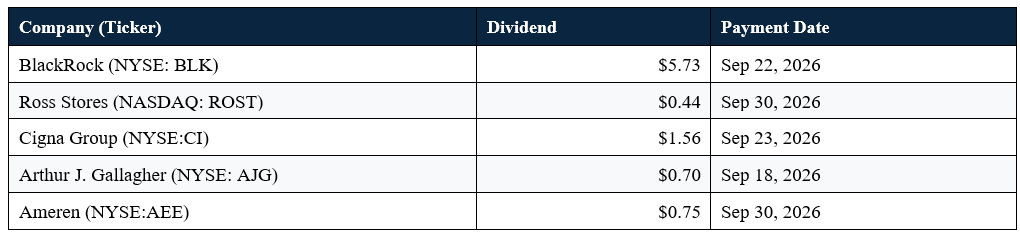
Top 5 Ex-Dividend Companies Today by Market Cap (Sept 8)
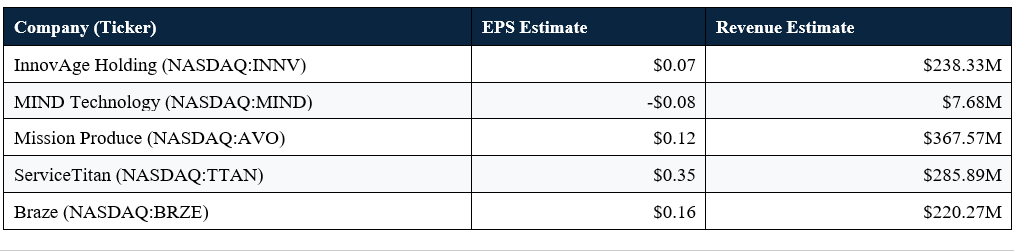
 Upcoming Earnings (Wednesday, Sept 9)
That's the wrap for today. Thursday's Producer Price Index and Friday's Consumer Price Index are next up, the real test for whether the Fed has room to hold steady at its September 15-16 meeting.