Wall Street Wrap: Pre-Market, October 12, 2026
U.S. stock futures are mixed on Monday as oil climbs on Houthi attacks on Riyadh's airport and a Gulf Coast hurricane, with Brent near $107. The dollar holds near an 18-month high ahead of Wednesday's consumer price report, while Iren, Salesforce, Biogen and First Solar lead pre-market movers. Bank earnings start Tuesday, and TSMC reports Thursday.


Oil climbs on Saudi airport attacks and a Gulf Coast hurricane as the dollar nears an 18-month high ahead of CPI, while Iren and Salesforce lead the movers
Wall Street looks set for a mixed open on Monday as oil rises on Middle East attacks and a Gulf Coast hurricane, and traders brace for a week of inflation data and bank earnings.
Futures Snapshot
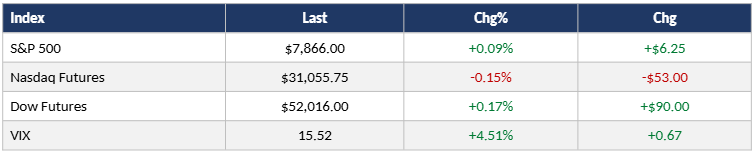
Futures were mixed early Monday, with the Nasdaq lower and the VIX higher as oil and the dollar firmed.
What's Driving the Open
Stocks come off a strong Friday. The Dow rose 423.31 points, or 0.83%, to 51,654.95, the S&P 500 gained 0.59% to 7,811.54 and the Nasdaq Composite added 0.64% to 27,366.17. Indexes hit their highs after President Trump said Russian President Vladimir Putin had agreed to supply diesel to the US and global markets. Software led the way, with Palo Alto Networks (NASDAQ:PANW) up 5%, CrowdStrike (NASDAQ:CRWD) up 4% and Palantir Technologies (NASDAQ:PLTR) up 5%, while Microsoft (NASDAQ:MSFT) gained 2% and Amazon (NASDAQ:AMZN) added 3%. All three major averages finished the week higher, with the S&P 500 up about 1.2%, the Dow up 0.9% and the Nasdaq up 0.6%, even as long-dated Treasury yields hit new 24-year highs.
Oil is rising again. Brent is up 2.05% at $106.865 and WTI is up 2.09% at $93.774. Houthi attacks on Riyadh's King Khalid International Airport killed 12 people and injured 309 on Saturday, and another projectile hit the terminal on Sunday. Two tankers were also attacked over the weekend. Hurricane Isaias has strengthened to a Category 3 storm with 120 mph winds as it nears the US Gulf Coast, forcing producers to curtail offshore output, UOB said. Prices had dipped earlier after Trump announced an "energy ceasefire" between Russia and Ukraine, but they reversed as Ukraine's president said Moscow must also halt its strikes.
The dollar is firm and rate-hike bets have cooled. The dollar index is at 102.418, up 0.18% and just below last week's 18-month high, while the euro is down 0.21% at $1.1178 after a fifth straight weekly loss. The 10-year Treasury yield is at 5.242%. CME FedWatch shows an 81% chance that the Fed holds this month, up from 51% a month earlier, though traders still see an 85% chance of a hike by December. Wednesday's consumer price report is one of the last big releases before the Fed's meeting this month. "It's a very high bar for the Fed to raise rates in October," said Chris Weston of Pepperstone.
What could change the picture: A hot consumer price reading on Wednesday could revive hike bets and push yields and the dollar higher, further attacks on Saudi infrastructure or a hurricane-driven outage in the Gulf would lift oil, and a lasting energy ceasefire would take some heat out of prices.
Overnight Markets
South Korea's Kospi fell 3.65%, while the small-cap Kosdaq dropped 4.83%. Mainland China's CSI 300 closed 0.68% lower, and Australia's S&P/ASX 200 gained 0.76%. Markets in Japan were closed for a holiday.
In Europe, the Stoxx 600 was 0.4% higher. Britain's FTSE 100 added 0.6%, Italy's FTSE MIB gained 0.7%, Germany's DAX rose 0.7% and France's CAC 40 moved 0.2% higher.
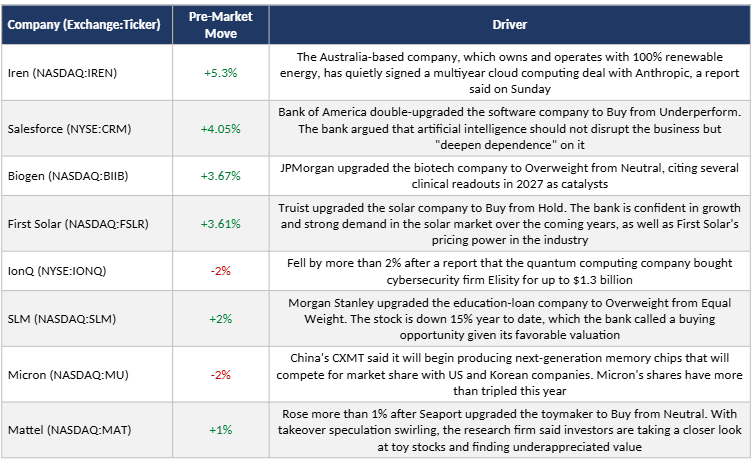
Pre-Market Movers
Rates, FX & Crypto
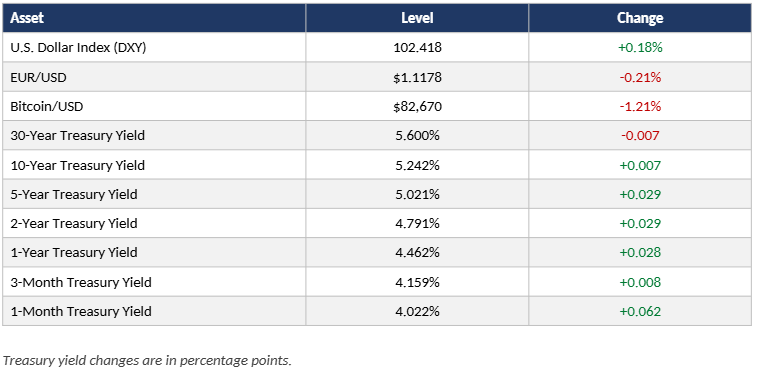
The dollar is holding near its strongest level in 18 months, helped by Middle East tensions and caution before the inflation data. Weekly data from the US markets regulator shows investors lifted their bullish dollar positions to around $36 billion in the week to October 7, from $8.4 billion three weeks earlier, largely at the expense of the euro. MUFG's Lee Hardman says troubles overseas have boosted the dollar even as Fed hike expectations eased. The euro is also weighed down by worries over France's finances, with the gap between French and German 10-year yields at 140 basis points after nearing 160 basis points last week, the most since 2012. Bitcoin is down 1.21%.
Commodities
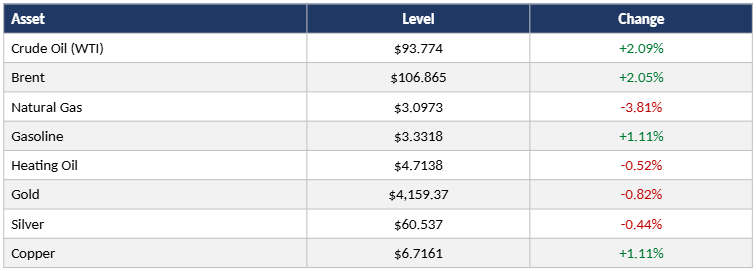
Crude and gasoline rose on the Riyadh attacks and the Gulf Coast hurricane, while natural gas fell almost 4%. Gold slipped as the firm dollar weighed, with investors waiting for the inflation data that could shape the Fed's next move.
Key Levels & Catalysts Today
Economic data
- This week's data is the focus: Wednesday's consumer price report, with producer price and retail sales figures also due this week.
- The IMF-World Bank annual meetings this week will give central bankers a stage for signals on policy.
Corporate
- Bank earnings start this week. Johnson & Johnson (NYSE:JNJ), UnitedHealth (NYSE:UNH), Wells Fargo (NYSE:WFC) and Citigroup (NYSE:C) report on Tuesday.
- Citigroup is seeking to resolve long-running regulatory demands quickly so it can focus on growth, according to two people familiar with the matter. The demands date to 2020 and have led to costly fines. CEO Jane Fraser has said the bank is about 90% done with the work required under the consent orders, and lifting them would need sign-off from the Fed and the Office of the Comptroller of the Currency. Citi spent $3.3 billion on "transformation" work last year.
- Taiwan Semiconductor Manufacturing (NYSE:TSM) is expected to report on Thursday a 65% jump in third-quarter net profit to T$746.3 billion ($23.4 billion), according to an LSEG SmartEstimate, which would be a record. The earnings call is at 2 a.m. ET. Analysts expect questions about a possible Texas expansion after the company's $265 billion Arizona investment.
- Volkswagen said global deliveries fell 14.3% in the third quarter to 1.89 million vehicles, its sharpest drop in more than four years. Deliveries in China tumbled 38.5%, and fell 5.8% in North America and 2.8% in Western Europe. Porsche and Mercedes-Benz also posted weaker deliveries last week.
Top Stories
The S&P 500's rally masks weakness beneath the surface. The index is up 14% this year to record highs, but more than 4 in 10 of its stocks are lower in 2026. Sandisk (NASDAQ:SNDK) and Micron have more than tripled, while the median stock has gained barely 4%, and over 200 companies have fallen, a quarter of them by 11% or more. Technology is up 32% and accounts for more than 10 percentage points of the index's gain, while energy is up 42% but contributes less than 1 point. Ross Mayfield of Baird said, "The Fed has killed a lot of bull markets in the past."
Houthi missiles hit Riyadh's main airport a second time. Saturday's attack killed 12 people and injured 309, according to Saudi Arabia's civil aviation authority, and a projectile struck again on Sunday, killing one and injuring 11. The Houthis renewed their warning to airlines against using Saudi airports, except those in Mecca and Medina. President Trump said he is considering joining Saudi retaliation. "We may. We're going to look at it," he said. Two Saudi officials said the kingdom has asked the US for urgent defense support. The heads of several Western oil majors pulled out of an industry event in Riyadh, though the energy ministry says the conference will go ahead.
Trump announces an energy ceasefire between Russia and Ukraine. The president said on Sunday that "Effective immediately, there is an ENERGY CEASEFIRE." Ukraine's president, Volodymyr Zelensky, said strikes on Russia would continue unless the Kremlin accepts, adding that Putin "doesn't read Truth Social." Russia kept hitting Ukraine's grid. Trump wants Ukraine to stop striking Russian refineries to lower fuel prices before the midterms. On Friday he said Moscow will supply more than 300,000 tons of diesel immediately, 500,000 tons in November and 1 million tons after that, with another 3 million tons depending on the state of Russia's refineries.
Asia's energy crunch intensifies. Thermal coal prices in China hit 1,004 yuan ($150) a tonne, a three-year high, after a mine collapse cut domestic output and shipments from Indonesia fell. Prices have risen by around a fifth since mid-July. In India, an unusually weak monsoon has curbed hydropower and drained coal stocks, causing blackouts of up to 12 hours a day for some factories.
The economics Nobel goes to Robert Hall and Michael Woodford. The American professors, of Stanford and Columbia, won for work on the "microeconomic foundations of macroeconomic stabilisation" that underpins the models central banks and governments use to smooth booms and busts. The prize is worth 12 million Swedish kronor ($1.2 million), to be split between them.
Eyes on Wednesday's consumer price report, Tuesday's bank earnings and Saudi Arabia's response to the Riyadh attacks for the next read on oil and rate-hike bets.
Related post