What Is RLUSD? Inside Ripple's Stablecoin and the Big Week That Just Validated It
Ripple’s dollar stablecoin explained for beginners, covering how it works and its growth. It also covers the week’s Robinhood, Moody’s A2 rating, and Coinbase developments that gave it new credibility.

Key Highlights
- RLUSD is a USD backed stablecoin issued by a Ripple subsidiary, live since December 2024
- Its market capitalization has grown from roughly USD 1.3 billion to more than USD 2.6 billion through 2026
- Robinhood agreed to expand RLUSD across trading, treasury, and institutional settlement
- Moody's gave RLUSD an A2 rating, reportedly the first investment grade rating given to any stablecoin
In under 48 hours, a dollar backed token most casual crypto watchers had never heard of landed a brokerage partnership with 28 million customers behind it, a credit rating usually reserved for banks and governments, and a spot on one of the world's largest crypto exchanges. The token is called RLUSD, and it belongs to Ripple, the company better known for XRP.
What Is RLUSD
RLUSD, short for Ripple USD, is a stablecoin issued by Standard Custody & Trust Company, a subsidiary of Ripple Labs, the company behind the XRP Ledger. A stablecoin is a type of digital token designed to hold a steady value, typically one unit equal to one US dollar, rather than fluctuating like Bitcoin or XRP do.
RLUSD launched on mainnet in December 2024 after receiving approval from the New York Department of Financial Services (NYDFS), capping months of closed beta testing on both the XRP Ledger and Ethereum. It is meant to be a separate asset from XRP. XRP is Ripple's original cryptocurrency, used for network fees and as a bridge asset in cross border transactions, while RLUSD is designed purely to track the US dollar for payments, trading, and settlement. The two tokens are often mentioned together because they share an issuer, but they serve different jobs inside Ripple's broader payments business.
The timing of the launch mattered too. It arrived not long after Ripple's long running legal dispute with the US Securities and Exchange Commission began to wind down, a backdrop that had kept some institutions cautious about touching anything connected to Ripple. A regulated, dollar pegged token gave the company a product that banks and payment firms could evaluate on its own terms, separate from the regulatory questions that had surrounded XRP.
How It Works and Where It Lives
RLUSD is collateralized on a roughly 1:1 basis by cash and cash equivalents, including short dated US Treasuries, much of which is reportedly held at BNY. The token currently runs across three blockchain networks: the XRP Ledger, Ethereum, and Base, with broader multichain access reportedly enabled through Wormhole's token transfer standard.
This multichain design is part of what separates RLUSD from older, more retail focused stablecoins. Ripple has positioned it primarily as an institutional tool, aimed at banks, exchanges, and payment companies that need a compliant, auditable dollar token for settlement rather than everyday retail spending.
Redemptions work on a straightforward principle. Institutional customers submit an RLUSD transaction on chain to a Ripple redemption wallet, and the corresponding blockchain updates Ripple's holdings to reflect what has been redeemed, with dollars moving back out through traditional banking rails. Ripple has also said the reserves sit under third party audit, a detail that matters to institutions comparing RLUSD against stablecoins with less transparent reserve reporting.
The Growth Story So Far
RLUSD's supply has climbed steadily since launch. It reportedly started 2026 around USD 1.3 billion in market capitalization and has since grown to more than USD 2.6 billion, a gain of well over 80 percent in a single year. Supply is split across its two main issuance chains, with Ethereum reportedly holding a larger share than the XRP Ledger for most of the year, though on chain checks in late October suggested the gap between the two had narrowed considerably.
Growth has come in bursts tied to specific milestones rather than a smooth curve, including exchange listings, new banking partnerships, and expanded access across additional blockchain networks. For context, the entire global stablecoin market is estimated at more than USD 300 billion, which means RLUSD still represents a modest slice of less than one percent of total supply, even after this growth. Tether's USDT and Circle's USDC continue to hold the overwhelming majority of that market between them.
The Big Week: Recent Developments
What pushed RLUSD into broader conversation was a cluster of announcements around Ripple's Swell 2026 conference in New York.
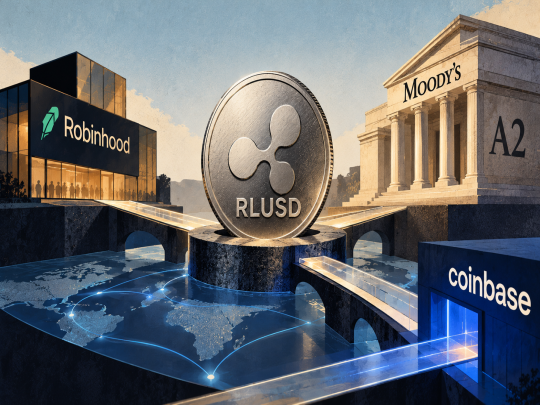
Robinhood partnership (October 27): Ripple and Robinhood announced an expanded relationship that could bring RLUSD to Robinhood's institutional settlement operations, treasury management, and potentially its main retail app before the end of 2026, a platform that reported more than 28 million funded customers in August. RLUSD is already reportedly live on Robinhood Chain and Bitstamp, the exchange Robinhood acquired last year.
Moody's A2 rating (October 27 to 28): Moody's assigned RLUSD a long term A2 and short term P-1 rating, which Ripple's team described as the first investment grade rating ever given to a stablecoin. The agency reportedly pointed to reserve coverage, liquidity, and redemption arrangements as supporting factors. It is worth noting that a credit rating is not deposit insurance, and RLUSD remains a crypto asset rather than a bank deposit.
Coinbase listing (October 28): Ripple launched RLUSD on Coinbase Prime, Coinbase Exchange, and the retail Coinbase app, adding support across the XRP Ledger, Ethereum, and Base networks for both retail and institutional users.
Each of these three developments addresses a different kind of gatekeeper. Robinhood brings retail and brokerage distribution, Moody's brings the kind of credit assessment institutional risk teams rely on, and Coinbase brings liquidity and trading access across a platform widely used by both individuals and funds. Seeing all three line up in the same week is unusual even by crypto's fast moving standards.
Why It Matters
A credit rating from a major agency, distribution through a large retail brokerage, and a listing on a top tier exchange are not the kind of endorsements niche tokens usually collect in one week. For institutions that stayed on the sidelines of newer stablecoins, this is closer to the paperwork they tend to wait for.
At the same time, RLUSD still trails far behind market leaders like Tether's USDT and Circle's USDC, and competition in the stablecoin space continues to intensify, with rivals such as PayPal's PYUSD growing alongside it. Whether this week's developments translate into sustained market share gains may depend on how quickly the Robinhood retail rollout happens and how institutions respond to the new rating.
There is also an irony worth noting. Robinhood has separately backed a rival stablecoin called USDG through an industry consortium, which makes its decision to also integrate RLUSD a sign of how fragmented, rather than settled, the stablecoin landscape remains. Large platforms appear willing to support more than one dollar token at once rather than commit to a single winner this early.
Where Things Stand
A year ago, RLUSD was a footnote next to XRP, the kind of product crypto reporters mentioned once and moved on from. This week it sat in the same sentence as Moody's, Robinhood, and Coinbase, three names that do not lend their credibility cheaply. That shift says less about RLUSD's size, which is still modest, and more about where Ripple is trying to compete next. Stablecoins are becoming the quiet infrastructure of institutional finance, and the companies racing to supply them are no longer just crypto exchanges. They are brokerages with tens of millions of customers and rating agencies that grade sovereign debt.
The real test is not this week's headlines but whether RLUSD still shows up in the same conversations a year from now, when a rating has been reviewed, a rollout has either happened or stalled, and the stablecoin market has moved on to its next USD 300 billion milestone.

.png)