Pre-Market Biotech Movers: Data, Deals and Listing Risk Set the Tone
Pre-market trading on 1 October 2026 rewarded biotech and pharma companies with measured evidence or contracted certainty—biomarker data, signed payments, resolved compliance issues—while projections and modelled risk drew muted responses. Six names moved on verifiable milestones, revealing how investors price conviction in early-stage science and pipeline strategy.


Key Highlights
- Monte Rosa leads pre-market movers with an 11.15% gain after early-stage data showed sharp falls in inflammatory markers.
- Sanofi's $1 billion upfront payment to Regeneron, with litigation settled, adds contracted certainty to a pipeline rebuild.
- Eli Lilly's modelled risk reductions drew almost no reaction, a reminder that projections price differently from results.
- Tevogen's listing reprieve and CollPlant's strategic pivot show how micro-cap risk is tested.
- United Therapeutics extends Wednesday's gain as investors await the court's remedy against Liquidia.
Introduction
Pre-market quotes are early and thinly traded, so they often shift once the main session begins. Even so, the pattern is informative. Across six biotech and pharmaceutical names, the market rewarded evidence it could measure or contract: biomarker data from a human trial, a signed payment, a resolved listing issue. It gave far less credit to evidence that is modelled or projected. Closing prices cited are from the previous session.
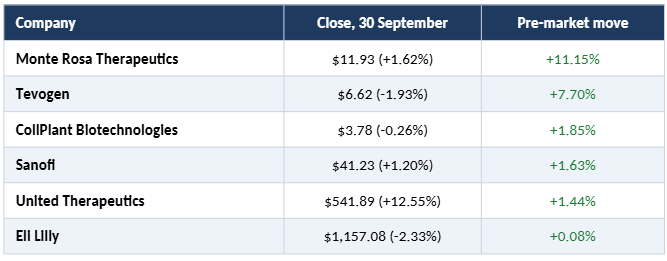
Pre-Market Snapshot
1. Monte Rosa Therapeutics (NASDAQ: GLUE): Measured Biomarkers Draw a Double-Digit Bid
Monte Rosa, a Boston-based clinical-stage company, develops molecular glue degraders, small molecules designed to remove disease-driving proteins. It closed at $11.93 on Wednesday and is trading at $13.26 in pre-market, up 11.15%. Its market capitalisation was about $1.01 billion at the close, and the pre-market price is still roughly half the 52-week high of $25.77.
The catalyst is Phase 1 data on MRT-8102, which degrades NEK7, a protein involved in NLRP3-driven inflammation. The study enrolled 108 obese adults at elevated cardiovascular risk, who took one of three doses or placebo for four weeks, followed by four weeks of safety follow-up. The company reports median reductions of 85% in hsCRP, 54% in IL-6 and 24% in lipoprotein(a). Adverse events occurred in 33% of treated participants and 30% of those on placebo, with no serious events.
The data are pharmacodynamic, not clinical outcomes, and the reductions are medians reported by the company. The trial was short, and biomarker changes do not guarantee fewer heart attacks. Phase 2 studies in coronary artery disease, gout and hidradenitis suppurativa are planned from late 2026 into 2027, and the coronary study still depends on long-term toxicology work.
2. Sanofi (NASDAQ: SNY) and Regeneron (NASDAQ: REGN): Contracted Dollars Lift a Pipeline Rebuild
Sanofi, the French pharmaceutical group, co-developed Dupixent with Regeneron, a drug now used by more than 1.5 million patients. Its US-listed shares closed at $41.23 on Wednesday and are trading at $41.90 in pre-market, up 1.63%. The close sat only about 2% above the 52-week low of $40.40.
The two companies have expanded their alliance to cover four long-acting antibodies invented by Regeneron, targeting IL-13, IL-4, IL-4 receptor alpha and a combined IL-4 and IL-13 bispecific. Regeneron receives $1 billion upfront and is eligible for up to $7 billion in milestones. Costs and profits will be shared equally, the existing Dupixent split is unchanged, and prior litigation has been settled.
For Sanofi, the upfront payment is roughly 1% of its $99.0 billion market capitalisation, by our approximation, so the price effect rests on strategic value more than on the cheque itself. Only one of the four antibodies is in the clinic, in Phase 1 for atopic dermatitis; the others are expected to enter trials in 2027. Most of the $7 billion depends on milestones that early assets may never reach.
3. United Therapeutics (NASDAQ: UTHR): Follow-Through Before the Remedy
United Therapeutics, based in Silver Spring, Maryland, markets Tyvaso and Tyvaso DPI, inhaled treprostinil therapies for pulmonary hypertension. It closed at $541.89 on Wednesday, up 12.55%, after a Delaware court found that Liquidia infringed two claims of its patent. It is trading at $549.70 in pre-market, up a further 1.44%. Its market capitalisation is about $23.0 billion.
The next step is procedural. The court gave the parties a week from Wednesday to propose a final judgment. United Therapeutics has said it will seek an order directing the Food and Drug Administration to withdraw approval of Liquidia's Yutrepia application, plus damages for past infringement. Liquidia, which fell 57.19% on Wednesday, says it will appeal.
The modest pre-market gain suggests most of the ruling was priced on Wednesday. The unresolved variable is the breadth of the remedy, which could be narrow or broad, and an appeal could shift the outcome in either direction.
4. Eli Lilly (NYSE: LLY): Modelled Risk Fails to Move the Shares
Eli Lilly, based in Indianapolis, makes Zepbound and Foundayo (orforglipron), an approved once-daily oral obesity treatment. Its shares fell 2.33% on Wednesday to $1,157.08 and are flat in pre-market at $1,158.00, up 0.08%. The market capitalisation is about $1.09 trillion, and the close was roughly 10% below the 52-week high of $1,292.65.
New post-hoc analyses of the 3,127-participant ATTAIN-1 trial estimate that, at 72 weeks, Foundayo cut predicted 10-year type 2 diabetes risk by 45%, 50% and 57% versus placebo across its three doses. The highest dose also cut predicted cardiovascular risk by 18%.
The word that matters is predicted. These figures come from risk engines applied to trial data, not from observed diabetes or heart events, and post-hoc analyses are not prespecified. The muted reaction suggests investors treated the work as supportive context for a franchise whose valuation, at 26 times forward earnings, rests on other drivers.
5. Tevogen (NASDAQ: TVGN): A Listing Reprieve on Thin Volume
Tevogen, based in Warren, New Jersey, describes itself as a healthcare enterprise combining biotechnology, artificial intelligence and healthcare services, with a biotech arm developing off-the-shelf T cell therapies. It closed at $6.62 on Wednesday, down 1.93%, and is trading at $7.13 in pre-market, up 7.70%.
The company said Nasdaq confirmed on 29 September that it had regained compliance with the $50 million minimum market value of listed securities requirement for the Global Market. On 9 September it regained compliance with a separate requirement on publicly held shares. Both matters are now closed.
Removing delisting risk is a binary event, and it can matter a great deal to a small company. It is not, however, a business milestone. Pre-market volume was very thin, so the move may not hold into the open. Listing standards are tested continuously, so compliance is not permanent.
6. CollPlant Biotechnologies (NASDAQ: CLGN): A Penny Stock Pivots to Photonic Computing
CollPlant, based in Rehovot, Israel, develops plant-derived recombinant human collagen for 3D bioprinting and medical aesthetics. In September it completed the acquisition of LightSolver, a laser-based photonic computing company. The stock, a penny stock, closed at $3.78 on Wednesday, down 0.26%, and is trading at $3.85 in pre-market, up 1.85%.
Second-quarter results, which exclude LightSolver, showed revenue of $108,000 against $179,000 a year earlier and a net loss of $2.7 million. Cash stood at $2.6 million on 30 June. After the quarter closed, the company received $1.94 million from a private placement and about $5.2 million from warrant exercises, roughly $7.1 million combined by our sum. A one-for-ten reverse split took effect on 4 September.
The muted response is understandable. LightSolver's cited speed-ups of 40 times to more than 80,000 times against GPU algorithms are projected time-to-solution figures from joint research, not commercial results. Integration, funding and continued Nasdaq compliance remain open risks.
What the Pre-Market Tells Us
Three kinds of evidence earned a reaction. Measured data lifted Monte Rosa, a contracted payment supported Sanofi, and a resolved listing issue moved Tevogen. Two kinds did not. Lilly's modelled risk reductions and CollPlant's projected computing gains drew little response. The ranking is clearest in the two largest moves, where evidence the market could verify mattered more than evidence it had to assume.
The caution runs both ways. Pre-market volumes are thin, small-cap quotes can reverse at the open, and a strong first reaction to Phase 1 biomarker data is no guide to later-stage results. Monte Rosa and Sanofi with Regeneron each host investor calls this morning, and the proposed judgment in the Liquidia case is due within a week.
Risks and Uncertainties
Several of these stories carry risks that headline moves do not capture. Pre-market quotes are indicative and can look quite different once the main session opens. Early-stage results do not always carry over to larger or longer studies, legal remedies can shift on appeal, and payments tied to milestones are never certain. Smaller listed companies also face ongoing compliance and financing demands. Estimates derived from reported figures are approximate.
Related post