Why Are Corteva (NYSE:CTVA), Roze AI (NASDAQ:RZAI) and OpenWorld (NASDAQ:OPNW) Moving Pre-Market?
Pre-market movers on October 1, 2026 were driven less by earnings than by corporate mechanics, from the Corteva seed spin-off and a Roze AI direct listing to a wave of reverse splits and dilutive share sales across small caps. Here is what moved and why it matters.

Key Highlights
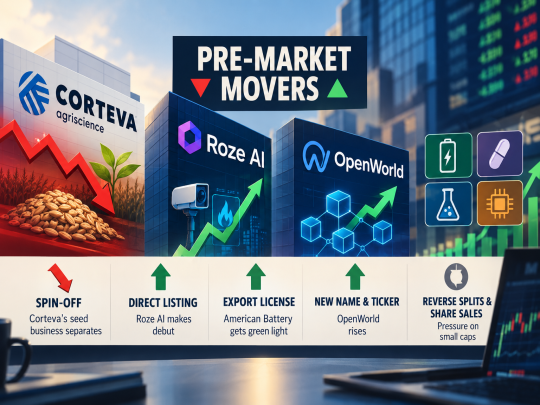
- Corteva (NYSE:CTVA) is indicated down roughly three-quarters, reflecting the distribution of its seed business, not a collapse in value
- Roze AI (NASDAQ:RZAI) indicated a gain of roughly 90 to 110 percent against a reference price near 22 dollars after its direct listing
- American Battery Technology (NASDAQ:ABAT) gained about 22 percent after winning an export license covering up to 100 million dollars of recycled black mass
- OpenWorld (NASDAQ:OPNW), formerly VerifyMe, rose by more than a third on its first morning under a new name and ticker
- Reverse splits and discounted share sales weighed on six small caps
Pre-market screens tend to reward readers who hunt for earnings surprises. On Thursday the more useful skill was reading corporate mechanics. Few of the largest moves before the opening bell reflected a change in how much money a company makes. Instead they traced to a spin-off, a new listing, a name change, an export license and a clutch of share sales and reverse splits. The distinction matters, because a price that moves for structural reasons says something different from one that moves on news about demand.
A Fall That Is Mostly Arithmetic
Corteva, Inc. (NYSE:CTVA) posted the steepest decline on the board, with shares indicated lower by roughly three-quarters. The explanation is arithmetic rather than distress. The company completed the separation of its seed business into a standalone company, Vylor Inc. (NYSE:VYLR), and shareholders of record received the new shares through a pro rata distribution. What remains is a crop-protection company that is smaller than before, and its share price has adjusted accordingly.
A person who held Corteva yesterday now holds two stocks rather than one, and has not lost three-quarters of their wealth by that fact alone. Screens that fail to adjust for the distribution can make the drop look alarming. The more sensible measure is the combined value of both holdings, which should move with the fortunes of each business in the usual way once trading settles.
New Names and Fresh Listings
Roze AI Inc. (NASDAQ:RZAI), a South Korean maker of fire detection and disaster prevention systems, drew the most attention among new arrivals. Indicated prices were roughly 90 to 110 percent above a reference level near 22 dollars, although reports differ on exactly when trading began. The company combines wireless sensors, data analytics and digital twin technology to assess and monitor fire risk, and it markets a forecasting product that produces a fire risk index.
The structure of the listing helps explain the volatility. Roze AI went public by direct listing, so there was no underwriter, no new capital raised and no book-building exercise to set an opening price. Existing shareholders registered about 18.1 million shares for sale. Separately, the company agreed to sell about 10 million dollars of convertible preferred stock to accredited investors at 8 dollars a share, a price that implied a valuation near 933 million dollars, with the conversion price potentially lower. A gap between 8 dollars and the mid-40s is a reminder that early prices in a direct listing are found by a thin market rather than negotiated in advance. The company has no connection with a similarly named, SoftBank-backed business that is reportedly exploring an offering of its own.
OpenWorld, Inc. (NASDAQ:OPNW), formerly VerifyMe, rose by roughly 36 to 45 percent on its first morning under a new name and ticker. The merger with a blockchain and real-world asset tokenization business closed on Wednesday. A one-for-ten reverse split took effect on September 29, and a special cash dividend of 1.50 dollars a share, adjusted for the split, is payable on Friday to holders of record on that date. Former owners of the acquired business received about 11.6 million shares, or roughly 85 percent of the fully diluted equity, and transfer restrictions cover about three-quarters of the post-merger shares, with scheduled releases. A small tradable float combined with a change of identity can produce sharp swings in either direction.
Catalysts With Some Substance
Not every gain was cosmetic. American Battery Technology Company (NASDAQ:ABAT) rose about 22 percent after receiving approval from the U.S. Commerce Department's Bureau of Industry and Security to sell up to 100 million dollars of recycled black mass abroad. The license follows newly enacted federal export controls on critical battery materials, and it reduces one source of uncertainty for the Nevada recycler. The company reported revenue growth of more than 400 percent in its latest fiscal year and is building a second recycling facility backed by 150 million dollars of federal grants. Its own risk disclosures make less comfortable reading, however, flagging the need to maintain the license and the company's ability to continue as a going concern.
DataMeds AI, Inc. (NASDAQ:MEDS) climbed about 27 percent after saying preliminary, unaudited September revenue at its Corexa Pharmacy division topped one million dollars, more than 66 percent above July. The growth followed a rebranding and the launch of dietary supplements and medical foods distributed under a wholesale arrangement with Tollo Health. One detail deserves attention: the interim co-chief executive of DataMeds also leads Tollo Health, so the supplier relationship is one between connected parties. The figures are small in absolute terms and have not been audited.
Monte Rosa Therapeutics, Inc. (NASDAQ:GLUE) rose about 10 percent, to roughly 13 dollars, ahead of an early-morning webcast on Phase 1 data for MRT-8102, an experimental molecular glue degrader aimed at cardiovascular risk. The shares have drifted lower over most timeframes and sit well below a 52-week high near 26 dollars. Early clinical readouts are close to binary events in practice. Safety and activity across dose levels will either support the case for the company's platform beyond oncology and immunology or raise fresh questions, and pre-event run-ups can unwind if the details disappoint.
The Dilution Desk
The weakest part of the board was the familiar cluster of small caps that issued shares or reshaped them. NFT Limited (NYSE American:MI) fell after agreeing to sell 80 million Class A shares at 45 cents each, raising about 36 million dollars for its platform and a planned robotics project. Its first-half revenue had already fallen by roughly two-thirds. NewGenIvf Group Limited (NASDAQ:NIVF) slipped as traders took profits after a sharp rebound, having priced an offering of about 17.9 million shares and pre-funded warrants at 7 cents each to raise 1.25 million dollars. Neo-Concept International Group Holdings (NASDAQ:NCI) declined after pricing a 2 million dollar registered direct offering at 1 dollar a share, following a spike and a crash.
Reverse splits formed the second cluster. Vivakor, Inc. (NASDAQ:VIVK) announced a one-for-15 consolidation due at the open on October 5, and Scienture Holdings, Inc. (NASDAQ:SCNX) a one-for-25 split effective the same day, which would shrink its share count from about 41 million to about 1.6 million. SHF Holdings, Inc. (NASDAQ:SHFS) has implemented a one-for-12 split. Each aims to lift a low share price and support compliance with exchange listing rules.
A reverse split changes the number of slices, not the size of the pizza. In theory it leaves a company's value untouched. In practice the companies that need one often share a record of dilution and thin liquidity, and the market tends to read the move as a sign of earlier trouble. Selling is a common first reaction, though by no means a certain one.
Two further decliners lacked a single clear trigger. Baiya International Group Inc. (NASDAQ:BIYA) lost ground after first-half results showed continued net losses despite some revenue growth, and Grande Group Limited (NASDAQ:GRAN) fell with no company-specific news, a pattern typical of thinly traded names where modest volume produces large percentage swings.
Reading the Tape
Taken together, the morning offers a small lesson in sorting signal from noise. Corporate actions such as spin-offs, splits and listings alter the price without altering the underlying economics, while genuine news, such as a license or a trial readout, alters expectations about future cash. Pre-market trading adds its own distortions in the form of thin volume, wide spreads and quotes that can reverse once the regular session opens. Several of these moves may fade, and some may extend. A useful question to ask of each is what changed, and for whom.
Related post