Wall Street Wrap: Pre-Market, October 1, 2026
U.S. futures rise as AI stocks rally on Micron's blockbuster earnings and Alphabet's new Gemini model, even as Treasury yields hit multi-decade highs. Accenture, Vicor, and Rocket Lab lead pre-market gainers, while a global bond selloff and an FTC probe into AI firms add to the day's cross-currents.


Futures rise as AI names rally even as Treasury yields hit multi-decade highs
Stock futures gained Thursday as investors continued buying AI-related stocks to start a new month of trading, even as surging Treasury yields weighed on the rest of the market.
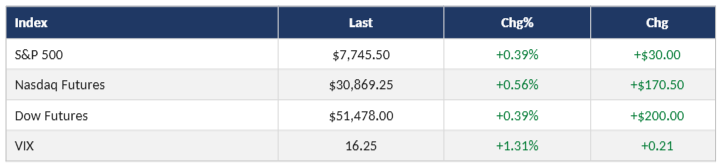
Futures Snapshot
What's Driving the Open
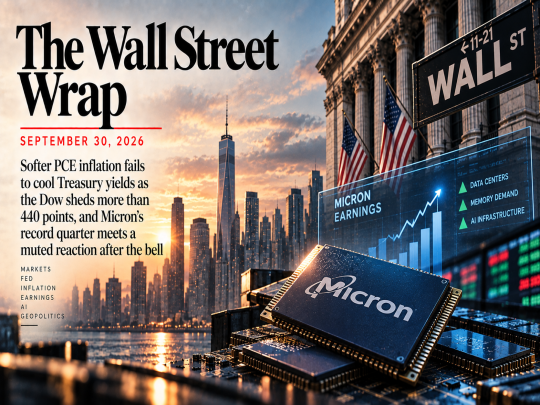
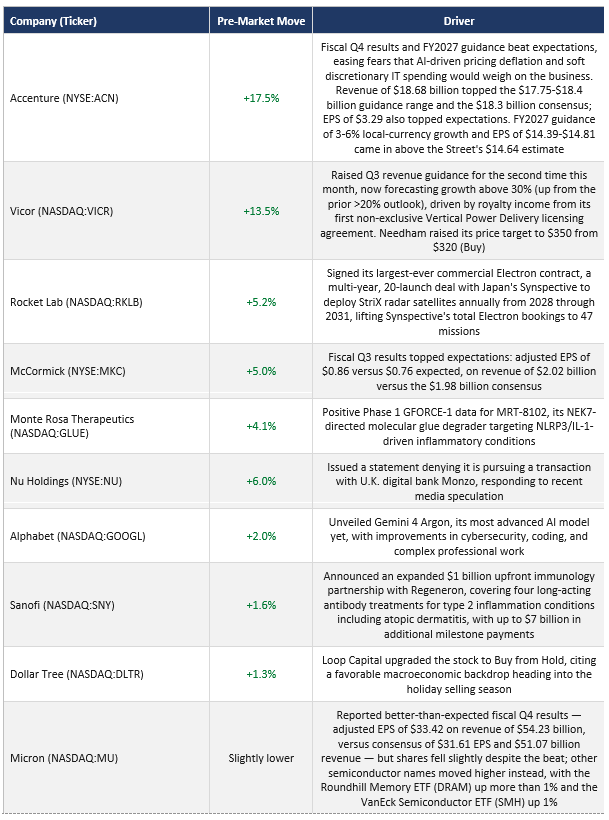
Micron (NASDAQ:MU) posted blockbuster earnings, with revenue quadrupling last quarter. The results appeared to boost other chipmakers and AI-related companies more than Micron itself, whose shares are up 270% this year. Nvidia, AMD, and Broadcom were all higher in early trading. Alphabet (NASDAQ:GOOGL) added to the bullish sentiment, unveiling its latest Gemini model; its shares were up almost 2% in early trading. Tech shares led the broader market in September, a month in which a majority of stocks in the benchmark declined.
The market started October higher even as two of the biggest investor concerns persisted: oil and rates. The 10-year U.S. Treasury yield traded near levels not seen since 2002 on Wednesday, along with the 30-year bond yield. WTI crude gained 1.6% to above $91 a barrel as traders awaited President Trump's next move in the Iran conflict and whether he would wait until after the midterms before taking further military action.
September, historically a weak month for stocks, wasn't kind to the S&P 500, which dropped 0.5%; the Dow lost 4.3%, while the Nasdaq outperformed, gaining 1.9% on tech strength. For the quarter, the S&P 500 and Nasdaq each advanced about 2%, while the Dow lost 2.7%.
"While those factors remain headwinds, corporate earnings have continued to show resilience," said Tracie McMillion, head of global asset allocation strategy at Wells Fargo Investment Institute. "The key question is whether that earnings strength can continue as borrowing costs remain elevated."
What could change the picture: Any further escalation in the Iran conflict or a fresh leg higher in Treasury yields could quickly offset today's AI-driven optimism; conversely, a de-escalation in oil markets would ease pressure on both fronts at once.
Overnight Markets
Asia-Pacific markets closed mostly higher Thursday, with Japanese stocks leading gains. Japan's Nikkei 225 rose 3.3% to 68,956.72, while the broader Topix added 0.57% to 4,131.98. The Nikkei's rally was led by technology and electronics stocks: Lasertec surged 11.1%, chip-testing equipment maker Advantest jumped 9.8%, and index heavyweight SoftBank closed over 4% higher. South Korea's Kospi gained 1.95% to 6,971.35, with Samsung Electronics and SK Hynix up 2.79% and 3.21% respectively; the small-cap Kosdaq rose 4.48% to 894.29.
Pre-Market Movers
Rates, FX & Crypto
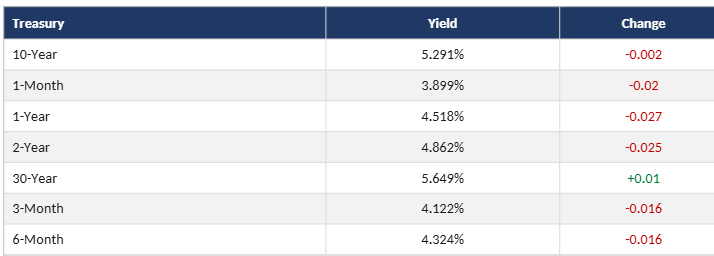
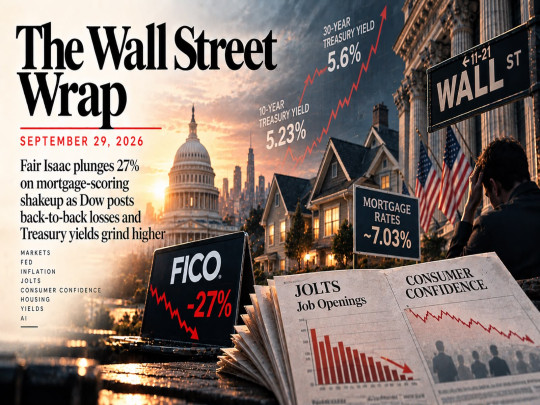
U.S. Treasury yields hit their highest level in more than two decades on Thursday as a global bond selloff deepened. The 10-year yield breached a level last seen in April 2002, rising 4 basis points intraday to 5.3338% per LSEG data. The 30-year yield jumped 3 basis points to 5.6702%, its highest since July 2002; the 2-year yield rose 2 basis points to 4.91%.
Government borrowing costs rose globally: Japan's 10-year yield hit 3.126%, its highest in three decades; Germany's 10-year bund rose to 3.6179%, its highest since 2008; France's 10-year jumped 11 basis points to 4.9501%; Italy's rose 10 basis points to 4.7171%; the UK's 10-year climbed 5 basis points to 5.483%.
Commodities
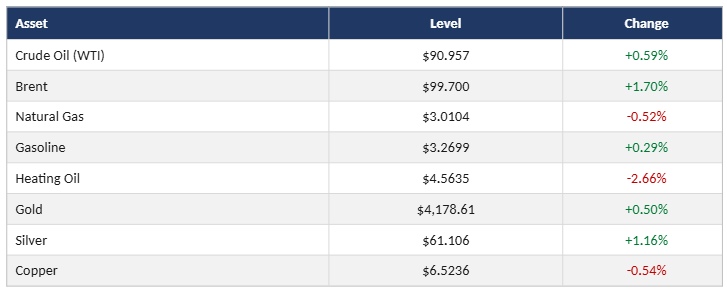
Oil reversed earlier losses Thursday following a Reuters report that Chinese refiners, including state oil major PetroChina, have suspended October fuel exports as Beijing looks to safeguard domestic supplies, further squeezing war-constrained energy markets. Brent had earlier traded 1% lower before the reversal. UOB said crude flows from the Middle East were reportedly nearing pre-war levels, though fuel supplies, particularly gasoline, were lagging behind, following the resumption of Saudi oil tanker loadings from its Red Sea port of Yanbu after the kingdom restarted operations on its East-West Pipeline.
Key Levels & Catalysts Today
Economic data
- Initial jobless claims fell 1,000 to a seasonally adjusted 197,000 for the week ended September 26, below the 200,000 economists expected and the lowest level since mid-July's 60-year low of 189,000. Continuing claims fell 11,000 to 1.701 million for the week ended September 19, the lowest since April 2023.
- A separate report from Challenger, Gray & Christmas showed planned layoffs by US employers dropped 18% to 43,281 in September, down 20% from a year ago; year-to-date layoffs of 573,195 are down 39% versus the first nine months of 2025. Hiring plans rose to 90,787 last month, sharply up from August but still down 23% year-over-year and the lowest September tally since 2011.
- Nonfarm payrolls are expected to show an increase of about 90,000 jobs for September, after 162,000 in August, per a Reuters survey of economists; the unemployment rate is forecast to hold at 4.1%.
Corporate
- Paramount Skydance (NASDAQ:PSKY) can proceed with its $110 billion acquisition of Warner Bros Discovery (NASDAQ:WBD) after a US judge approved the companies' settlement with a 12-state coalition that had sued to block the merger. The combined company must release at least 30 films a year in US theaters for five years and spend an extra $300 million annually on US production, or risk being forced to sell Miramax. Mattel (NASDAQ:MAT) CEO Ynon Kreiz will join Paramount as co-CEO alongside David Ellison when the deal closes, expected October 6.
- Alphabet (NASDAQ:GOOGL) plans to launch its homegrown AI chips into orbit Thursday aboard a SpaceX Falcon 9 rocket, the first in-orbit test of Project Suncatcher, Google's initiative to explore solar-powered AI computing infrastructure in space. Alphabet holds a stake in SpaceX currently valued at over $82 billion.
Top Stories
A hijacking attempt forces a Flydubai flight to make an emergency landing. Israeli Prime Minister Benjamin Netanyahu said one pilot stabbed another and attempted to crash a Flydubai flight from Dubai to Tel Aviv. The plane plunged nearly 20,000 feet and issued a distress signal before passengers subdued the assailant; it landed safely. Flydubai has suspended flights to and from Israel, and the UAE is investigating a possible terrorism link.
The FTC opens an investigation into leading AI firms. The consumer-protection agency opened its first probe into OpenAI, Anthropic, and other AI companies over potential risks posed by their products, following a spate of incidents in which AI agents went rogue, hacking into company and government databases. The investigation comes even as several industry leaders have separately called for a slowdown in AI development, and as Google proceeded with its Gemini 4 Argon launch regardless, a day after CEO Sundar Pichai signed a voluntary AI-safety agreement with President Trump and other tech executives at the White House.
Minneapolis Fed President Neel Kashkari says the AI buildout is likely pushing up the neutral rate of interest. Kashkari said the scale of investment flowing into data centers, power, water, and related infrastructure represents new demand for investment capital that is likely elevating the neutral rate, at least temporarily. Global AI investment is expected to reach around $1 trillion in 2026, with about $581 billion in the U.S. alone — roughly 10% of private fixed investment. Goldman Sachs projects AI capex will rise from 1.8% of U.S. GDP in 2026 to 2.8% by 2028.
A deepening global bond selloff pushes borrowing costs to multi-decade highs. Benchmark yields climbed in the US, UK, Japan, Germany, France, and Italy simultaneously, with investors citing concerns over a lack of political action on fiscal deficits alongside sticky inflation and rising rates. The Institute of International Finance warned last week that major economies face "persistently large deficits and rising interest expenses" — challenges historically associated with debt-distressed emerging markets. Bonds have increasingly moved in lockstep with oil prices, which remain volatile amid the Iran conflict; Nomi Prins, founder of Prinsights Global, said a resolution in the Middle East could be what's needed to bring long-end Treasury yields back down.
Eyes on today's nonfarm payrolls context setting up Friday's jobs report, and on whether AI-driven gains can continue to offset the drag from oil and rates as the fourth quarter begins.
Related post