Two Prediction-Market Giants, Two Very Different Ways of Deciding Who's Right
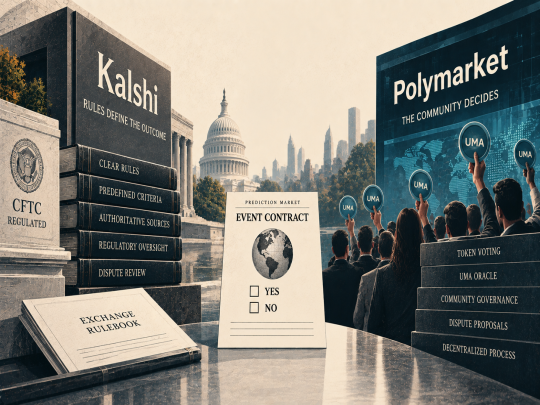
Kalshi settles disputes with a rulebook. Polymarket settles them with a vote. Both have already been tested by real money, and both have already failed, in very different, very expensive ways. What happens when the same instrument has two completely different ideas of who's right.

Key Highlights
- Kalshi resolves contested markets through an internal team that writes and enforces detailed rulebooks, while Polymarket outsources disputed outcomes to holders of a token called UMA.
- An analysis found that nine wallets, out of more than 6,400 accounts that have ever voted, control nearly half of all UMA voting power and almost always land on the winning side.
- A disputed settlement tied to Iran's supreme leader's death triggered a class-action lawsuit against Kalshi after the platform paid out less than traders expected.
- A single UMA whale forced a premature, incorrect resolution on a 2025 Polymarket market, an incident serious enough that it led UMA to overhaul how disputes get proposed.
- As institutional capital scales, dispute resolution credibility, not trading volume, may end up mattering more for which platform proves durable.
Two Companies, One Instrument, Opposite Philosophies
Kalshi and Polymarket start from the same simple idea. What happens next is where they split. Both list binary event contracts. Both let traders buy yes or no positions on a defined outcome. Both turn that trading activity into a continuously updated probability. Beyond that, the resemblance is mostly surface-level, and the market has priced both companies as if the resemblance runs deeper: Kalshi last confirmed at $22 billion, Polymarket at $15 billion, with both reportedly already in talks for higher rounds still.
The meaningful difference sits somewhere less visible to a casual trader: what happens when an outcome is disputed. Every prediction market eventually lists a contract where the real-world result isn't immediately clear, where the contract's language is ambiguous, or where events unfold in a way nobody anticipated when the market was created. How a platform resolves that ambiguity, and who gets to decide, may be a more consequential differentiator than trading volume or user growth.
Kalshi was built from inception as a CFTC-regulated Designated Contract Market, placing it in the same regulatory category as established exchanges and requiring it to submit its rules and procedures to federal oversight. Polymarket was built as a crypto-native exchange, structured to operate largely outside that perimeter, though it has since launched a separate, dollar-denominated, regulated version for the US market. That foundational choice, compliance-first versus decentralization-first, shapes almost everything about how each platform handles disputes.
How Kalshi Decides What Happened
Kalshi settles contested markets through an internal process built on precision in advance. A dedicated team writes the specific rules governing each contract before it lists, defining exactly what triggers a yes or no settlement, which source counts as authoritative, and how edge cases get handled. Drafted rules are reviewed internally before being submitted as part of the exchange's CFTC filings, and no one involved in writing or reviewing a market's rules is allowed to trade on it.
That approach has produced a track record of strict, sometimes unpopular, adherence to stated rules even when the outcome feels counterintuitive. A market on Oscars television viewership was once settled using the first publicly reported audience estimate, even after that estimate was later revised upward. A market tied to whether a specific company would advertise during a major sports broadcast settled as no despite the company running an ad, because the ad didn't meet the exact definition written into the contract. Traders on both sides of these disputes have called the outcomes technically correct but practically unsatisfying.
The trade-off is deliberate. Rule adherence gives Kalshi's settlements a defensible, auditable basis that can withstand regulatory scrutiny and legal challenge. The cost is a lack of flexibility when a contract's original language fails to anticipate how an event actually unfolds, a cost that turned out to be far more expensive than a disputed Oscars number.
How Polymarket Decides What Happened
Polymarket takes a structurally different approach. Its contracts are typically written with shorter, more general resolution language, often relying on a standard described as a consensus of credible reporting rather than a precisely defined rulebook. When an outcome is disputed, resolution goes to a decentralized oracle system built around a cryptocurrency called UMA. Holders of UMA tokens vote on how a disputed market should resolve, choosing among a small set of standard outcomes, with voting weight proportional to tokens held, meaning larger holders carry disproportionately more influence than smaller ones.
Independent analysis has found that influence is concentrated to a striking degree. A Bloomberg review of roughly three years of Polymarket disputes found that just nine wallets, out of more than 6,400 accounts that have ever participated in a vote, control nearly half of all UMA voting power, and that these nine wallets have consistently voted together and landed on the winning side almost every time. Bloomberg's own example of the dynamic in action involved a market on whether the US and Israel had struck Iranian facilities, where prices swung as traders tried to guess which way the concentrated voting bloc would land, rather than what had actually happened.
A single incident forced a real change to how Polymarket's process works: a March 2025 market that resolved incorrectly after one large token holder dominated the vote. The platform maintains that the overwhelming majority of markets resolve without any dispute at all, and that large token holders have little incentive to vote dishonestly, since a false resolution only pays off if enough of the broader token base votes the same way.
When the Rules Break Down
Both governance models have produced real disputes with real financial consequences, proof that neither approach has fully solved the settlement problem.
Kalshi's most consequential dispute involved a market titled "Ali Khamenei out as Supreme Leader?", asking whether Iran's supreme leader would leave office by a set deadline. The contract's rules included a specific clause, a so-called death carveout, stating that if the leader left office solely because he had died, the market would settle at the last traded price rather than pay out in full to yes positions. On February 28, 2026, Khamenei was killed in a joint US-Israeli strike on Tehran. Traders holding yes positions expected a full payout, since his departure had technically occurred before the deadline. Kalshi instead enforced the death carveout. Trading volume on the market had exceeded $54 million.
Kalshi refunded all trading fees and covered net losses on the disputed positions, saying no trader had suffered financial harm. Traders disagreed and filed a class action, Risch v. KalshiEX LLC, in the US District Court for the Central District of California, alleging the carveout was inadequately disclosed and that the platform's conduct amounted to an unfair business practice. Kalshi co-founder Tarek Mansour defended the provision publicly, arguing it keeps settlement rules simple and avoids creating a financial incentive tied to a public figure's death. The case remains unresolved.
Polymarket's most notable governance failure predates the Khamenei dispute by almost a year and involves a different mechanism entirely. In March 2025, a roughly $7 million market asked whether the United States and Ukraine would agree to a critical-minerals deal before the end of that month. Odds moved from around 9 percent to effectively 100 percent within a day, even though no deal had been signed. The resolution was later traced to a single holder controlling roughly five million UMA tokens spread across three wallets, about a quarter of active voting power at the time, who forced through a premature yes. Polymarket called the episode unprecedented and said in a public statement that "because this wasn't a market failure, we are not able to issue refunds," leaving traders on the losing side of the vote with nothing. The incident was serious enough that UMA overhauled its process afterward, restricting who can propose a market's resolution to a vetted whitelist rather than leaving it open to anyone willing to post a bond.
Read together, the two cases share a common thread. Ambiguity written into a contract at the time of listing becomes a genuine financial liability once real-world events unfold in a way the original rule didn't anticipate, whether a platform resolves disputes through an internal team or a distributed vote.
Why This Matters More as Institutional Money Arrives
The governance question gets more consequential, not less, as institutional capital scales into prediction markets. A retail trader placing a modest wager on a sports outcome can shrug off an unexpected or disputed settlement as a cost of doing business. A hedge fund using an event contract to hedge real commodity exposure, or an asset manager citing event contract pricing as a research input, needs confidence that a multimillion-dollar position will settle in a predictable, defensible way.
This is where each platform's foundational choice carries forward into its institutional pitch. Kalshi's CFTC oversight, its internal rule-writing team, and its prohibition on market-makers trading contracts they help define are exactly the features that make it legible to regulated institutions used to operating within clear rules and audit trails. Polymarket's flexibility and decentralized resolution reflect a different set of values, faster market creation, resistance to any single point of control, and a process that in principle can't be unilaterally overridden by the exchange itself. Whether institutional capital ultimately prefers predictability or decentralization may do more to shape each platform's long-term trajectory than either company's current trading volume.
Neither Referee Has Fully Solved the Problem
Neither governance model has solved the underlying problem prediction markets face as they scale into more ambiguous subject matter. Kalshi's rigidity produces defensible outcomes that still generate real controversy when a rule fails to anticipate an edge case. Polymarket's flexibility produces a resolution process vulnerable to concentrated influence among its largest participants, and, as the Ukraine minerals case showed, occasionally to a single well-positioned holder. Both approaches have now been tested by real disputes carrying real financial stakes, and both have had to change course afterward, Kalshi through litigation it's still fighting, Polymarket through a structural rebuild of how disputes get proposed in the first place.
These are, at bottom, internal governance failures, disagreements about how a platform interprets and enforces its own rules. A separate and larger set of questions sits above both companies entirely: how federal and state regulators define the legal boundaries within which either governance model is even allowed to operate, a fight that's already further along, and far messier, than either company's own rulebook.