ASX Post-Market Wrap: 15 September 2026
The ASX 200 fell to an 11-week low as miners and financials dragged the index down, with the US 10-year Treasury yield breaking above 5% for the first time since 2007 and markets pricing a 77% chance of an RBA hike this month. Health Care and Consumer Staples bucked the trend as defensive flows took hold.

Welcome to ASX Post-Market Wrap, your quick end-of-session rundown of what moved the Australian market today, plus what's shaping global sentiment into tonight's Wall Street open.
Markets Today
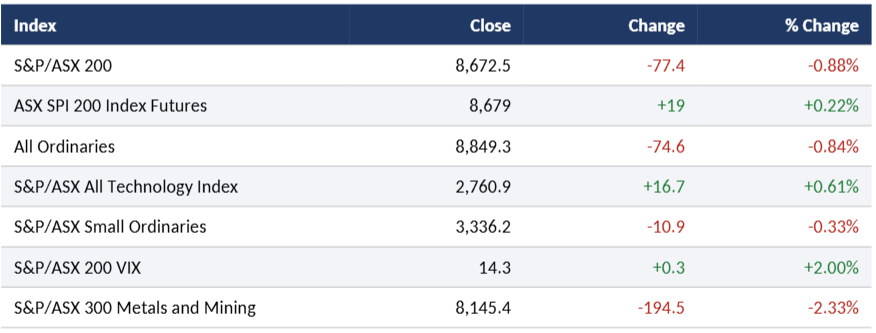
The ASX 200 fell for a second straight session on Tuesday, dropping 77.4 points, or 0.88%, to 8,672.5, a fresh 11-week low and its worst level in three months. The All Ordinaries followed it down, off 74.6 points, or 0.84%, to 8,849.3. It was a broad retreat rather than a narrow one: decliners outnumbered advancers 664 to 403 on the ASX, with 393 stocks unchanged, and the volatility index jumped 2.00% to 14.33. Miners and financials did the damage, while Health Care and Consumer Staples were the session's standouts as investors rotated into defensive earnings streams. The index has now lost 2.78% over the past five sessions, though it remains virtually flat for the year.
Analytical View
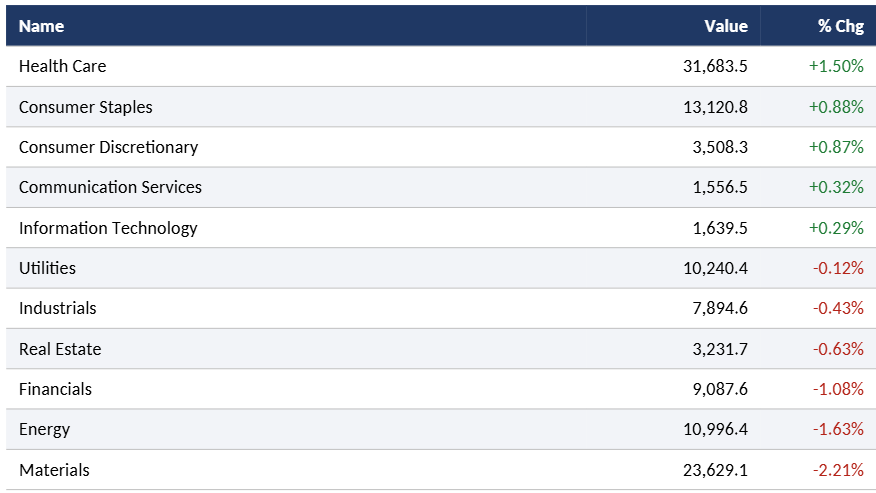
Miners and financials led today's losses. Materials fell 2.21% as copper came under pressure from calls for AI safety guardrails, which dented hopes that AI's infrastructure boom would keep driving metals demand, while gold stocks fell even harder as rising bond yields increased the opportunity cost of holding bullion and surging crude lifted diesel costs for miners on the other side of the ledger. Financials fell 1.08% as bets narrowed on a September RBA hike, even as Macquarie argued the central bank's own language has grown steadily more hawkish since its August hold. Health Care bucked the trend, jumping 1.5% as money rotated into defensive earnings, led by 4DMedical, Telix Pharmaceuticals and Healius, with ResMed, Sonic Healthcare and CSL also firmer. Consumer Staples added 0.9% on the same logic, led by A2 Milk. EQ Resources jumped 11.7% on a binding deal for a 10% stake in a Nevada tungsten processing joint venture, while NEXTDC fell 4.0% after shareholder notices flagged securities-lending activity that could include short selling.
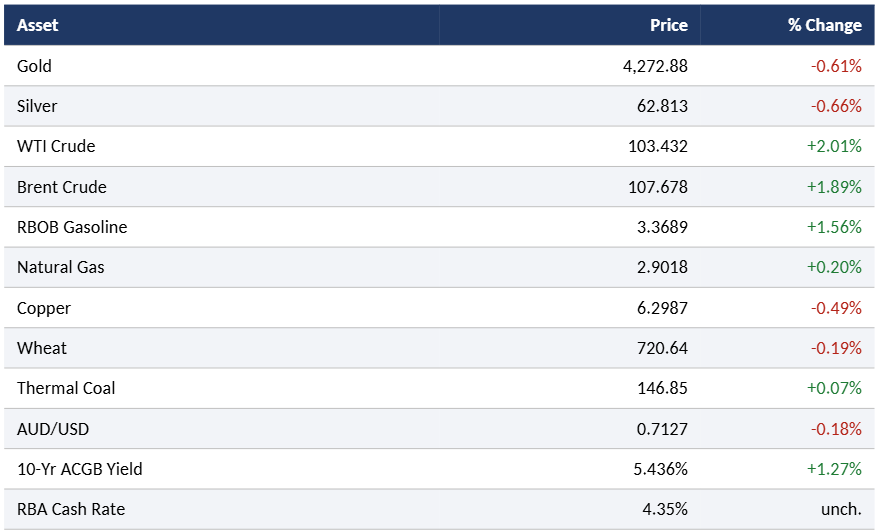
The bigger picture is a global bond repricing. The US 10-year Treasury yield broke above 5% for the first time since 2007, trading around 5.02% as energy-driven inflation fears met heavy government debt issuance, with traders pricing a 92.3% chance of a Fed hike Wednesday, its first since 2023. Australia's own 10-year followed suit to 5.436%, its highest since May 2011, with markets pricing a 77% chance of an RBA hike on 29 September and a second fully priced by March. Oil remained the accelerant, with Brent around US$107-108 a barrel after Gulf state talks on Strait of Hormuz shipping collapsed. Wall Street futures pointed lower into Tuesday after weekend warnings from AI industry figures weighed on the sector's infrastructure trade, Asian markets were mixed, and Europe opened lower as the same yield and Fed-hike repricing hit financials there too.
What could change the picture: the Fed's rate decision on Wednesday, and the RBA's own call on 28-29 September.
Sector Performance
Winners & Losers
Top 5 Gainers:
- EQR (EQ Resources Ltd): +11.69% to $0.43
- EIQ (Echoiq Ltd): +11.34% to $0.54
- 4DX (4DMedical Ltd): +8.72% to $3.74
- TLX (TELIX Pharmaceuticals Ltd): +8.63% to $17.75
- APX (Appen Ltd): +8.38% to $1.035
Top 5 Decliners:
- VYS (Vysarn Ltd): -9.09% to $0.75
- CXO (Core Lithium Ltd): -8.97% to $0.355
- CRN (Coronado Global Resources Inc): -8.16% to $0.225
- SMI (Santana Minerals Ltd): -8.04% to $0.515
- HCH (Hot Chili Ltd): -7.72% to $1.435
Volume Outliers
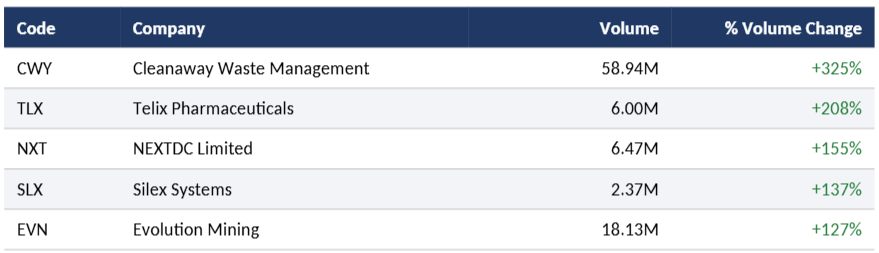
Stocks trading furthest above their 90-day average volume:
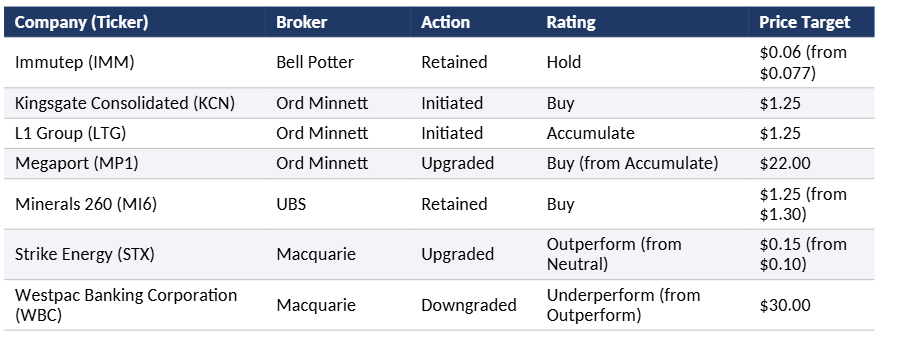
Broker Moves
52-Week Highs & Lows
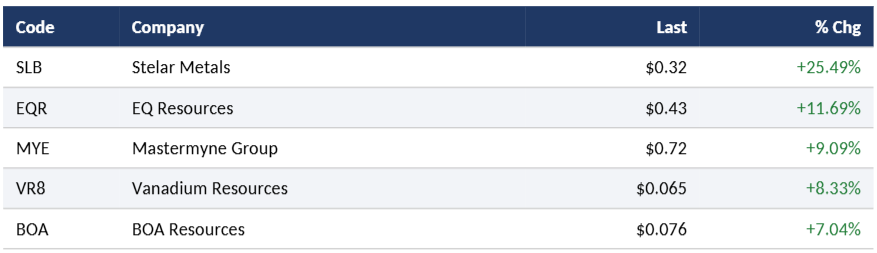
Highs:
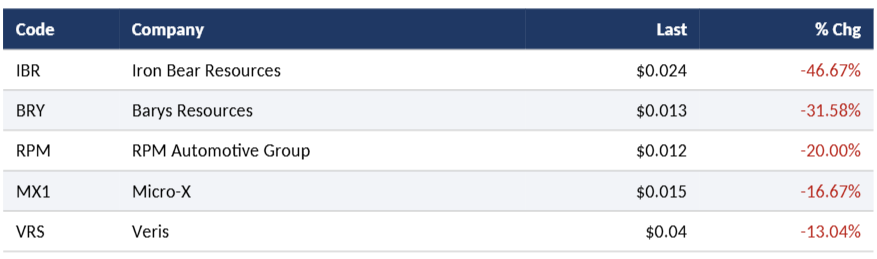
Lows:
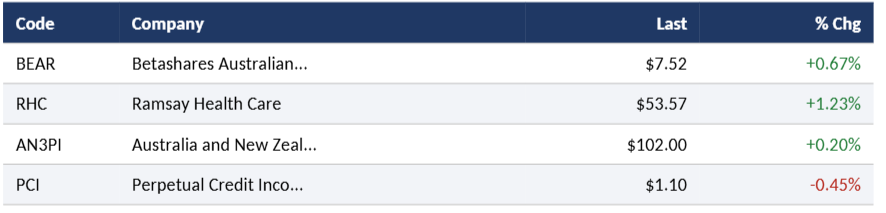
Near Highs
Commodities & Rates
Top Stories: Australia
New Hope shares jump to a three-and-a-half-year high despite a sharply lower annual profit. New Hope declared a fully franked final dividend of 30.0 cents, well ahead of the 14-16 cents expected, taking FY26 dividends to 40 cents versus roughly 24-34 cents expected, even as underlying EBITDA fell 32.8% to $514.3 million and statutory NPAT dropped 63.4% to $161.0 million on higher overburden costs and depreciation from the Bengalla growth project and New Acland ramp-up. Coal sales rose 11.8% to 11.8 million tonnes against guidance of 10.2-11.5 million tonnes, and available cash rose 10.1% to $778.5 million, comfortably covering the payout despite free cash flow of $371 million missing expectations.
EQ Resources takes a 10% stake in a Nevada tungsten processing restart. EQ Resources signed a binding agreement with The Elmet Group and Blue Moon Metals to restart the Springer ammonium paratungstate plant in Nevada, backed by US Department of War funding. Elmet operates the joint venture with 70%, and EQ Resources' 10% stake comes with an eight-year offtake covering 4,000 tonnes of contained tungsten trioxide and access to a quarter of the plant's initial capacity. Managing director Craig Bradshaw called the deal transformational for the company's Australian and Spanish production.
Netwealth pays $20 million for AI advice automation platform Paradino. Netwealth will pay $20 million upfront, split between cash and escrowed shares, for Paradino, used by more than 500 financial advisers to automate file notes, Records of Advice and client profiling, with churn below 1%. A further $10 million will be invested over two years, though Paradino isn't yet at break-even and is expected to post an FY27 EBITDA loss of around $3 million. Netwealth's guidance is unchanged, with completion expected by end-October.
Nickel Industries pauses ramp-up as Sulawesi drought bites. Nickel Industries will run its Excelsior Nickel Cobalt facility at 30% of nameplate capacity after an El Niño-driven water shortage hit the Indonesian nickel hub, with just under 4mm of rain falling at the nearby Hengjaya mine last month against a historical average of 222mm. The broader IMIP park, where most of the group's operations sit, has flagged output cuts of 30-40% if new water sources aren't found, a risk with read-through well beyond one company given Indonesia's roughly 60% share of global nickel supply.
Cue Clothing collapses into voluntary administration. The Sydney-based fashion label, which also owns Veronika Maine, entered voluntary administration on Tuesday after more than six decades in business, with FTI Consulting appointed receivers across its 51 stores in Australia and New Zealand. The receivers said rising sales hadn't offset overhead costs, and a sale process seeking buyers as a going concern begins immediately.
Global Stories
China's factory strength masks weakening consumer demand. Industrial output rose 5.2% in August, ahead of expectations and accelerating from July's 4.5%, on double-digit export growth tied to global AI electronics demand, but retail sales grew just 0.4% against forecasts for 0.8%, dragged down by an 18.5% slump in auto sales. Fixed-asset investment fell 7.2% over the first eight months, worse than expected as property investment slumped almost 20%, and the urban jobless rate ticked up to 5.3%. New bank lending badly missed forecasts too, expanding by just 60 billion yuan against a roughly 400 billion yuan forecast, and Beijing's own statisticians described an "acute" imbalance between strong supply and weak domestic demand, even as officials have so far resisted more aggressive stimulus.
The US 10-year Treasury yield broke through 5% for the first time since 2007. The yield climbed as high as 5.025%, with the 30-year at 5.384% and the 2-year at 4.68%, extending a seventh straight monthly rise, the longest run since 2011, and leaving Treasuries on course for their first annual loss since 2022. Standard Chartered's Jonathan Liang said the tight link between inflation expectations and long-end yields is likely to persist while inflation stays above the Fed's 2% target, with traders assigning a 92.3% probability to a Wednesday hike, the Fed's first since 2023. A US$6 billion Treasury buyback of longer-dated debt has done little to ease the pressure, with BMO noting it doesn't address the underlying drivers.
Australia's cyber intelligence chief calls for an AI "early warning system." Speaking at ASPI's Sydney Dialogue AI Masterclass, Australian Signals Directorate director-general Abigail Bradshaw said Australia lacks a formal mechanism to share early warnings about AI-related risks the way it already does in cybersecurity, with these risks extending beyond cyber into areas like biotechnology. She said government access to leading AI companies' models, including Anthropic's Mythos and OpenAI's cyber-specific models, had let her agency complete in hours work that would otherwise take weeks, while urging organisations not to let AI use replace basic security discipline.
Management & RBA Speak
Sarah Hunter, Assistant Governor (Economic), Reserve Bank of Australia, on the inflation risks facing the economy:
Speaking at a Regional Australia Institute summit in Canberra on Monday, Hunter said the RBA sees inflation risks skewed to the upside, pointing first to the Middle East conflict and its flow-through to local fuel prices, noting that "prices have tracked up just recently" and that the development is "certainly concerning" for both households and the inflation outlook. She also flagged a second, subtler channel: surging global demand for AI chips has pushed up the price of consumer electronics, a small but real contributor to inflationary pressure, while weak productivity growth means the economy can grow less before generating price pressures than it could in the past.
Macquarie strategists, on the case for a September RBA hike:
Macquarie's analysis of RBA officials' recent language found growing hawkishness since the Board's August hold, telling clients the central bank "has repeatedly pushed back on cuts they didn't want to endorse, but not on hawkish pricing that is consistent with its inflation objective." The strategists questioned how a surprise hold would help return inflation to target, and said the RBA has acknowledged current rates are slowing the economy without yet indicating that's enough on its own.
Abigail Bradshaw, Director-General, Australian Signals Directorate, on the need for an AI early warning system:
Bradshaw said Australia has the equivalent of an early warning system for cyber threats but not yet for AI-specific risks, and that bringing together reports of individual incidents would help identify wider patterns. She added that AI access had let her agency complete in hours work that previously took cybersecurity experts weeks, while cautioning organisations to keep basic security measures in place rather than relying on AI alone.
Closing Line
That's the wrap for today's session. Wall Street's own verdict on this yield surge lands with the Fed's rate decision on Wednesday, and the RBA's own call is now just under two weeks away on 28-29 September.