ASX Pre-Market: Thursday, 17 September 2026
ASX SPI 200 futures point to a sharply weaker open, down 63 points, or 0.72%, to 8,681, after Wall Street sold off overnight as the Federal Reserve delivered its first interest rate hike since 2023 and Chair Kevin Warsh struck a hawkish tone on inflation.

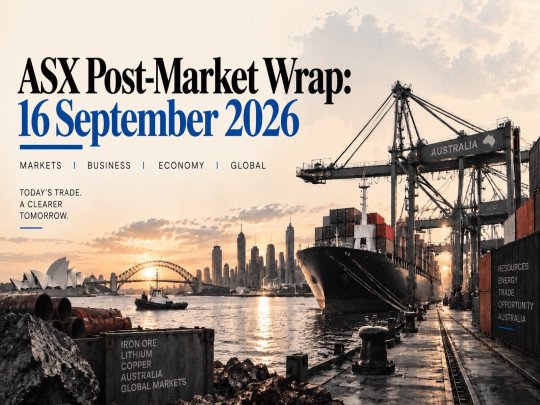
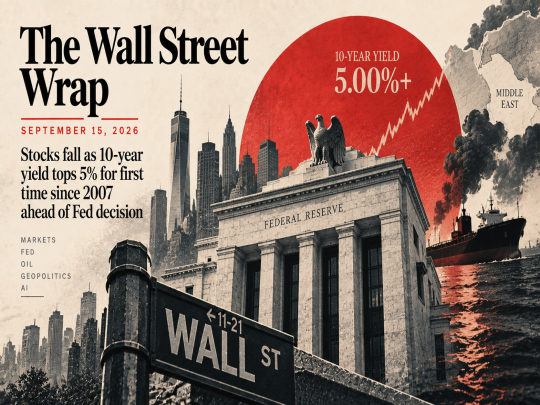
Welcome to your morning briefing on overnight Wall Street action and what's set to move the ASX 200 at the open. (See yesterday's ASX Post-Market Wrap: 16 September 2026 & The Wall Street Wrap: September 16, 2026 for the full session recap.)
ASX Futures
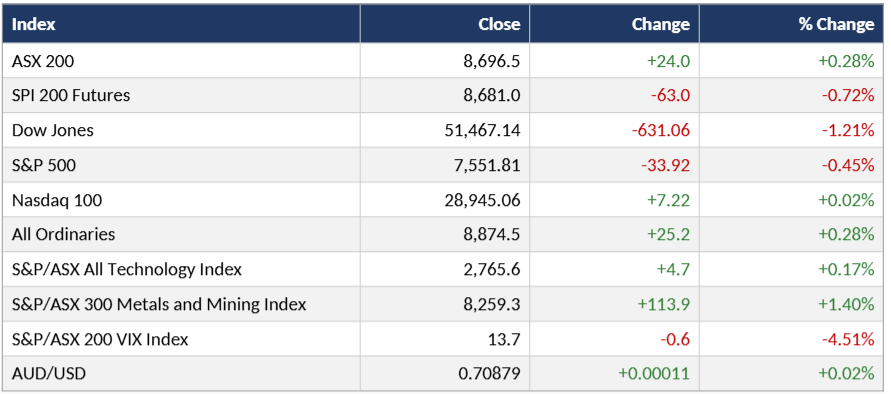
SPI 200 futures were down 63 points, or 0.72%, to 8,681, pointing to a sharply weaker open after Wednesday's local session snapped a four-day losing streak. The reversal follows Wednesday's close, where the ASX 200 rose 24.0 points, or 0.28%, to 8,696.5, and comes as Wall Street fell overnight after the Federal Reserve raised its benchmark interest rate for the first time since 2023 and signalled more hikes may follow.
Overnight Leads + This Morning
Wednesday's local session snapped a four-day losing streak, with the ASX 200 rising 24.0 points, or 0.28%, to 8,696.5, and the All Ordinaries adding 25.2 points, or 0.28%, to 8,874.5. It was a narrow but broad-based advance, with advancers edging out decliners 154 to 122 on the S&P/ASX 300 and seven of eleven sectors finishing higher. Energy led the charge as refiners and producers treated Monday's crude spike as durable, while miners snapped their own four-day losing streak as a softer US dollar helped copper and gold rebound. Consumer Staples and Real Estate lagged as money rotated back out of the defensive names that had led Tuesday's session. Reliance Worldwide jumped as much as 4.3% after agreeing to a US$2.8 billion buyout from Brookfield Asset Management.
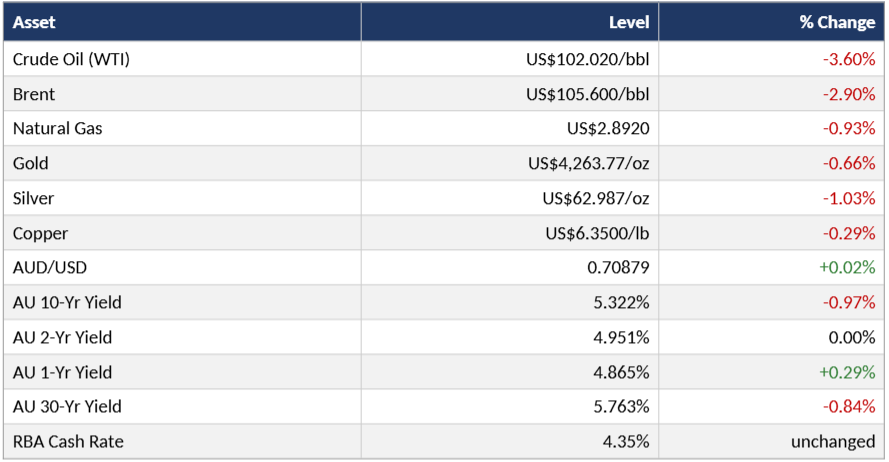
Overnight, Wall Street fell as the Federal Reserve delivered its first interest rate hike since 2023, lifting the federal funds rate a quarter point to a target range of 3.75% to 4.00% in a unanimous 12-0 decision. The Dow Jones Industrial Average dropped 631.06 points, or 1.21%, to 51,467.14, the S&P 500 fell 33.92 points, or 0.45%, to 7,551.81, while the Nasdaq 100 edged up 7.22 points, or 0.02%, to 28,945.06. Stocks had been higher earlier in the session before turning lower during Fed Chair Kevin Warsh's press conference, where he repeatedly stressed that inflation remains too high. The two-year Treasury yield, most sensitive to Fed policy expectations, jumped to as high as 4.74%, its highest level since July 2024, while the ten-year yield ticked up only modestly to around 5.01%. Bank stocks led the market lower on concerns that further tightening could slow lending growth, with Goldman Sachs, Bank of America and Wells Fargo among the sharpest decliners. Oil fell as Saudi Arabia moved to ease supply fears by offering additional crude cargoes to Asian refiners via Oman, with Brent down 2.7% to $105.83 a barrel and WTI down 3.2% to $102.43. August retail sales rose 1.2% for the month, beating expectations and reversing a July decline, a sign consumer spending remains resilient even as the inflation picture stays unresolved.
Close Levels
Analytical View
Wednesday's local session was a genuine reversal after four straight losing sessions, with energy and miners doing the heavy lifting. Energy's rally reflected refiners and producers treating Monday's crude spike as durable rather than a one-off, while miners benefited from a softer US dollar taking pressure off copper and gold after weeks of being squeezed by surging bond yields. The narrow 0.28% headline gain masks a genuinely broad-based advance, with seven of eleven sectors finishing green and Consumer Staples and Real Estate the only notable laggards as money rotated back out of Tuesday's defensive trade.
Overnight, Wall Street's session was dominated entirely by the Federal Reserve. The central bank's first hike since 2023 was itself widely expected, with markets having priced in a roughly 92% probability heading into the decision, but the sell-off came from Chair Warsh's press conference rather than the decision itself, as his repeated emphasis that inflation "is too high and has been for too long" left investors bracing for further tightening. The unanimous 12-0 vote was a notable surprise given the range of views policymakers had expressed in recent weeks. For the ASX 200, that combination, a hawkish Fed alongside a domestic market that had just found its footing after a brutal five-session stretch, sets up a genuinely difficult open, even as the underlying commodity trade that lifted Wednesday's local session remains broadly intact.
What could change the picture: RBA Governor Michele Bullock's testimony before Parliament on Friday is the next domestic test, alongside the Bank of Japan's own rate decision the same day, ahead of the RBA's own call on 29 September.
Federal Reserve: 25 Basis Point Hike
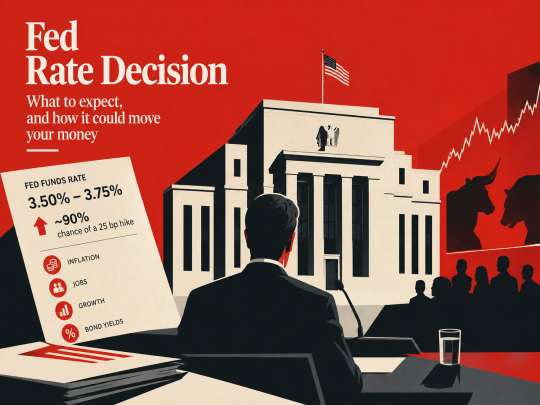
The Federal Reserve raised its benchmark interest rate by a quarter point to a target range of 3.75% to 4.00% on Wednesday, its first hike since 2023, in a unanimous 12-0 vote by the Federal Open Market Committee. The central bank's updated dot plot showed 16 of 18 policymakers expect at least one more quarter-point hike before the end of the year, with the median official projecting the federal funds rate at 4.1% by year-end, up from 3.75% projected in June, and eight officials pencilling in a higher 4.4%. The median policymaker projected core inflation at 3.4% by the end of 2026, a touch above the 3.3% forecast in June, alongside GDP growth of 2.3%, up from a prior 2.2% projection. Futures markets moved quickly to reprice the path ahead, with the probability of a further hike at the Fed's late-October meeting rising to 56.5% from 54% before Wednesday's decision, according to CME Group's FedWatch Tool, while some measures put the odds of the funds rate reaching 4.25% to 4.50% by year-end as high as 38%. Major US banks including JPMorgan Chase, Bank of America, Citigroup, Wells Fargo and Truist Financial raised their prime lending rate to 7% from 6.75%, effective Thursday, a move that will lift borrowing costs on credit cards and personal loans tied to the benchmark.
(For Further Reading: Fed Raises Rates to 4% as Growth Outlook Firms, Inflation Risk Persists)
Commodities & Rates
Home & Away
Names with a foot in both camps today, ASX movers with direct overseas read-through, and overseas news with a local echo.
Goldman Sachs (NYSE:GS), Bank of America (NYSE:BAC) and Wells Fargo (NYSE:WFC): led US bank stocks lower overnight, down roughly 4%, 2.7% and 3% respectively, after the Fed's hike raised concerns that further tightening could slow lending growth just as major US lenders lifted their prime rate to 7% from 6.75%. The read-through for the ASX's own major banks is direct: Wednesday's local session already showed Financials giving back some of Tuesday's gains ahead of the decision, and a genuinely hawkish Fed raises the same higher-for-longer questions for Australian lenders that are weighing on their US counterparts.
Boeing (NYSE:BA): fell more than 5% after CEO Kelly Ortberg told investors that stabilising 737 Max production is taking "a little bit longer" than expected, with wing production at the company's Renton, Washington factory now a constraint. Boeing is producing about 47 of the aircraft a month, and Ortberg said certification of the larger Max 10 model is expected "very soon."
Generac (NYSE:GNRC): surged more than 40% after Amazon (NASDAQ:AMZN) was granted warrants to purchase up to $340 million worth of the backup-power provider's stock as part of a deal to supply generators for Amazon's data centres, with initial deliveries worth a combined $2.4 billion expected across 2027 and 2028. The move extends Amazon's recent run of data-centre infrastructure deals, following a similar arrangement with Qualcomm last week.
Local Catalysts
Australian fuel distributors squeezed as Middle East conflict tightens spot-market supply. Independent fuel distributors in Sydney, Brisbane and Newcastle have reported reduced spot-market allocations from major suppliers over the past week, even as overall inventories remain stable. United Petroleum confirmed petrol supplies have become temporarily tighter in New South Wales due to planned maintenance at a Port Botany terminal, expected back online by Friday evening, while other distributors said they were sourcing fuel from Queensland to cover shortfalls normally drawn from Newcastle. The national average price of regular unleaded reached $2.16 a litre, up 39% since July, while diesel rose to $2.65 a litre, up 48% over the same period, as global oil prices climbed on the back of the wider Middle East conflict.
Home Affairs Minister unveils migration crackdown via regulation. The federal government will pursue tighter rules on temporary visas to bring net overseas migration down from around 300,000 to a target of 225,000 by 2028, after compromise talks with the Coalition on stronger legislation broke down. The overhaul, to be pursued through regulatory changes to visa conditions rather than new laws, is expected to include an effective ban on international students bringing family members to Australia; 45,991 of the 337,427 student visas granted last financial year were secondary applicants classed as dependents. The announcement lands as hospitality and tourism job ads rose 3.6% in August and construction job ads climbed 10.7% over the year, with industry groups pointing to a working-holiday-maker visa freeze introduced in July as a factor tightening the labour market ahead of the summer season.
Global News
Federal Reserve delivers first hike since 2023 as Wall Street sells off. The Dow fell 631.06 points, or 1.21%, the S&P 500 dropped 0.45% and the Nasdaq 100 edged up 0.02% as Fed Chair Kevin Warsh's hawkish press conference commentary overshadowed a widely expected quarter-point rate rise. The two-year Treasury yield jumped to its highest level since July 2024 as traders repriced the odds of further tightening.
EU offers Canada associate membership as Trump trade war intensifies. European Commission President Ursula von der Leyen said in her State of the Union address that the bloc wants to open the door for Canada to become its first associate member, a significant deepening of ties as Ottawa pursues a closer relationship with Europe amid its own trade dispute with Washington. The proposal would move the relationship beyond the existing EU-Canada free trade agreement toward what von der Leyen called "an alliance for the future."
Oil falls as Saudi Arabia eases supply fears via Oman. Brent crude fell 2.7% to $105.83 a barrel and WTI dropped 3.2% to $102.43 after reports that Saudi Arabia is offering additional crude cargoes to Asian refiners through ship-to-ship transfers off Oman's Sohar port, blunting some of the impact from the East-West pipeline's continued closure. A smaller-than-expected draw in US crude inventories added further downward pressure on prices.
AI safety debate continues as Anthropic's policy chief weighs in. Anthropic's head of public policy, Sarah Heck, said artificial intelligence companies cannot be expected to manage oversight and safety concerns on an "honor code," adding that the industry cannot be "checking our own homework." Her comments follow days of industry debate sparked by Anthropic CEO Dario Amodei's call for a coordinated slowdown in frontier AI development, a position Meta's Mark Zuckerberg and Nvidia's Jensen Huang have both pushed back against, arguing existing product-liability law and market-driven trust considerations make new regulation unnecessary.
Management & Fed / RBA Speak
Kevin Warsh, Chair, US Federal Reserve, on the decision to raise rates:
Warsh told reporters that price stability "is foundational to economic growth," framing Wednesday's hike as an important step toward that goal by withdrawing part of the Fed's prior policy accommodation. He also declined to signal the central bank's future path, saying he is "not in the forward guidance business" and describing the decision as one the Fed had been preparing for carefully during his time as chair.
Donald Trump, President of the United States, on the Fed's decision:
Posted on Truth Social shortly after the hike was announced, writing: "LOWER THE INTEREST RATES FOR THE UNITED STATES OF AMERICA, AND FAST!" Trump has repeatedly pressed the Fed to cut rates well below their current level, and the White House separately said the hike lacked a compelling economic justification, arguing that current inflation is driven by energy costs from the Middle East conflict rather than factors interest rates can address.
Corporate Actions & Earnings Calendar
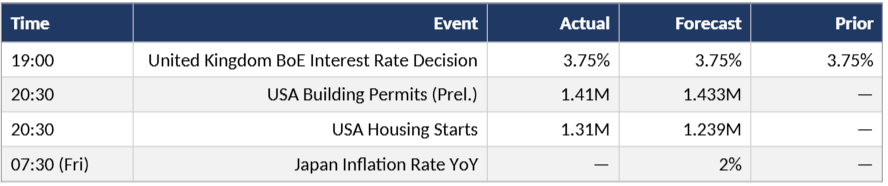
Economic Calendar (Thursday, 17 September):
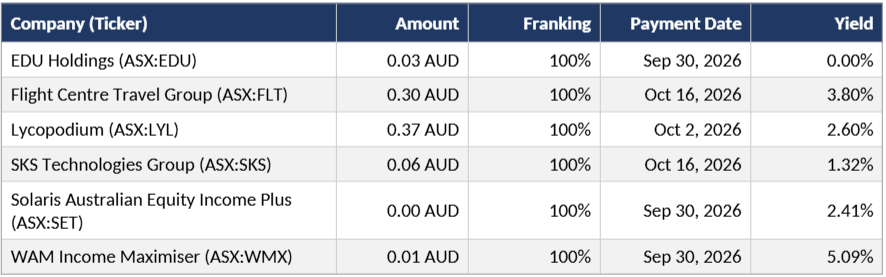
Ex-Dividend Today (Thursday, 17 September 2026):
Closing Line
That's the pre-market wrap for today. The ASX looks set for a sharply weaker open after the Federal Reserve's first rate hike since 2023 and a hawkish press conference from Chair Warsh unsettled Wall Street, even as Wednesday's local session had just snapped a four-day losing streak on the back of firmer energy and mining stocks. RBA Governor Bullock's testimony before Parliament on Friday, alongside the Bank of Japan's own decision the same day, is the next test ahead of the RBA's own call on 29 September.