FDA Calendar September 2026: PDUFA Dates, First-in-Class Drugs & Biotech Stocks to Watch
September could be a decisive month for biotech investors. The FDA faces a crowded calendar of PDUFA decisions, first-in-class therapies and a landmark advisory-panel review. From gene therapy and rare diseases to oncology and diagnostics, the outcomes could reshape valuations across a group of closely watched biotech stocks.

Key Highlights
- September 2026 concentrates an unusually high number of FDA decisions with direct implications for biotech stock valuation and regulatory risk pricing.
- At least four pending rulings could deliver either first-in-disease treatments or first-in-class or first-in-modality therapies, creating an unusual concentration of potentially important regulatory catalysts.
- Manufacturing and facility inspection issues, not just clinical data, are shaping the approval odds for several closely watched applications.
- One advisory panel review on the calendar is not a decision at all, a distinction that matters for how investors should read regulatory risk this month.
- Three candidates once expected to headline late-Q3 regulatory decisions were already resolved in August, underlining how quickly FDA calendars can go stale.
A Regulatory Calendar With Structural Weight
Most months carry a handful of Prescription Drug User Fee Act, or PDUFA, target action dates. September 2026 is denser than most. Within a thirty-day window, the US Food and Drug Administration faces action dates spanning rare neurological disease, oncology, dermatology and hematology, alongside a first-of-its-kind advisory committee review for a diagnostic technology.
The clustering matters beyond scheduling. For institutional investors tracking regulatory environment as a component of valuation, a month this concentrated compresses risk that would otherwise be spread across a calendar year. It also means that whatever the FDA decides, the outcomes will be read collectively, not in isolation, by a market already sensitive to approval and rejection cycles across small and mid-cap biotech names.
Four of the pending decisions carry a distinction worth separating from the rest of the calendar. If cleared, each would represent either the first approved therapy for a condition that currently has none, or the first treatment of its specific mechanistic class or modality for that disease. That is a materially different risk and reward profile than a label expansion for an already-approved drug, where clinical and commercial precedent already exists.
The Four Candidates Without Precedent
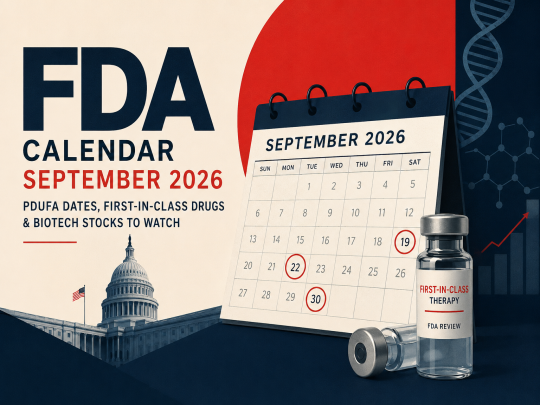
Ultragenyx Pharmaceutical Inc. (NASDAQ:RARE) and UX111. The FDA is due to rule on a resubmitted Biologics License Application for UX111, an AAV9 gene therapy for Sanfilippo syndrome Type A, by September 19. This is the second FDA review of the candidate. The agency issued a rejection in July 2025, citing chemistry, manufacturing and controls concerns. Ultragenyx addressed those issues and resubmitted in January 2026. Sanfilippo syndrome Type A is a rare lysosomal storage disorder with a median life expectancy of approximately fifteen years and an estimated patient population of three thousand to five thousand in commercially accessible regions. No approved therapy currently exists. The product originated at Abeona Therapeutics before being transferred to Ultragenyx for late-stage development, a detail relevant to how development risk and commercial upside are now allocated between the two companies.
Ionis Pharmaceuticals Inc. (NASDAQ:IONS) and zilganersen. Under priority review, with a decision due September 22, zilganersen is an RNA-targeted medicine for Alexander disease, a progressive neurological disorder marked by motor and cognitive decline. There are no approved disease-modifying treatments for this condition today. Approval would make zilganersen the first and only treatment option, a status that carries meaningful implications for both patient access and the commercial exclusivity period Ionis could expect to hold.
Scholar Rock Holding Corp. (NASDAQ:SRRK) and apitegromab. The PDUFA date for apitegromab, proposed for spinal muscular atrophy in children and adults, falls on September 30. This is a second attempt after an FDA rejection last September tied to inspection findings at Catalent Indiana, a fill-finish facility now part of Novo Nordisk A/S (NYSE:NVO). Scholar Rock resubmitted with two fill-finish facilities included in the filing. The FDA subsequently classified an April 2026 inspection of Catalent Indiana as Official Action Indicated, prompting the company to remove that facility from the application entirely and proceed with an alternate site. Scholar Rock has stated it is prepared for immediate commercial launch if approval is granted. If cleared, apitegromab would be the first muscle-targeted therapeutic in spinal muscular atrophy to demonstrate statistically significant benefit in a pivotal trial, a distinct mechanism from existing gene therapy and splicing-modifier treatments already on the market. The manufacturing history here is a relevant risk factor independent of the clinical data package.
Biofrontera Inc. (NASDAQ:BFRI) and Ameluz photodynamic therapy. A decision on expanding the label of Ameluz to include superficial basal cell carcinoma is due September 28. Basal cell carcinoma is the most common cancer diagnosis in the United States, with approximately 3.6 million cases annually, of which published estimates suggest ten to twenty five percent are of the superficial subtype. In a pivotal trial, composite clinical and histologic clearance at twelve weeks reached 65.5 percent with active treatment against 4.8 percent with vehicle. If approved, Ameluz would become the first and only photodynamic therapy photosensitizer indicated specifically for superficial basal cell carcinoma in the United States, expanding beyond its existing approval for actinic keratosis.
What the Calendar Also Contains, and Why the Distinction Matters
Not every event on September's regulatory calendar is a yes-or-no approval decision, and conflating the two carries analytical risk.
GRAIL Inc. (NASDAQ:GRAL). Galleri, its multi-cancer early detection test, faces an FDA advisory committee meeting on September 23, not a PDUFA action date. This is the first time an FDA panel has convened specifically to evaluate a premarket approval application for a multi-cancer early detection test. The panel's vote is non-binding and a separate approval decision would follow later. Treating this date as equivalent to a drug approval ruling overstates the immediacy of the regulatory outcome, even though the panel's reception of the clinical data, drawn from more than 25,000 participants in the PATHFINDER 2 study and over 70,000 in the NHS-Galleri trial, will likely move sentiment regardless of its non-binding status.
Merck & Co. Inc. (NYSE:MRK). Its application to expand the Winrevair label for pulmonary arterial hypertension carries a September 21 target date. The submission rests on the Phase 3 HYPERION study, which reported a 76 percent reduction in the risk of clinical worsening events against placebo, with a hazard ratio of 0.24. This is a label expansion for an already-commercialised product with an established revenue base, a fundamentally lower-variance event than a first-in-class approval decision, since the underlying safety and efficacy profile of the drug is already known to regulators and prescribers.
Bristol Myers Squibb Co. (NYSE:BMY). Its application to extend Camzyos to adolescents aged 12 to under 18 with symptomatic obstructive hypertrophic cardiomyopathy carries a September 30 target date, under Priority Review. Camzyos is currently approved only for adults and has been prescribed by more than 4,500 healthcare providers to almost 25,000 patients in the United States. The drug generated $416 million in second-quarter 2026 revenue, up 59 percent on a currency-adjusted basis. If approved for adolescents, Camzyos would be the first cardiac myosin inhibitor available for this age group, another lower-variance label expansion rather than a first-in-disease decision.
A Calendar Already Overtaken by Events
Not every name once tied to the September window is still awaiting a decision, and not every date has held. Rusfertide (Protagonist Therapeutics Inc., NASDAQ:PTGX; Takeda Pharmaceutical Co. Ltd., NYSE:TAK), a first-in-class hepcidin mimetic for polycythemia vera, was approved on August 28, 2026 as Mimrylo. Brepocitinib (Roivant Sciences Ltd., NASDAQ:ROIV, through subsidiary Priovant Therapeutics), the first targeted therapy for dermatomyositis, was approved on August 27, 2026 as LISRAYA. Takeda's oveporexton for narcolepsy type 1 was approved on August 5, 2026 as Orzeyful. All three had been disclosed by their sponsors only as third-quarter or August targets rather than fixed September dates, and all three cleared review before the month began. Novo Nordisk A/S (NYSE:NVO), by contrast, still has denecimig for hemophilia A under review, with no specific PDUFA date disclosed in public filings as of this writing.
The calendar has also moved in the other direction. Praxis Precision Medicines Inc. (NASDAQ:PRAX) originally carried a September 27 PDUFA date for relutrigine, its candidate for SCN2A and SCN8A developmental and epileptic encephalopathies. In June 2026, the FDA extended the review by three months to December 27, classifying additional sensitivity analyses submitted by the company as a major amendment. No new clinical studies were requested and no safety or manufacturing concerns were cited. Taken together, the two patterns illustrate the same underlying fact: a PDUFA date is a target action date rather than a fixed regulatory deadline. Decisions can arrive early, as with rusfertide, brepocitinib and oveporexton, or later than planned, as with relutrigine, without either outcome implying anything in particular about the eventual result. Most of the dates discussed above are disclosed by the sponsor company rather than confirmed by the FDA itself, GRAIL's advisory committee meeting being the notable exception.
Several other names sit on the September calendar without a first-in-class distinction attached.
Telix Pharmaceuticals Ltd. (NASDAQ:TLX). Telix awaits a September 11 decision on TLX101-Px, a PET imaging agent for glioma, following an earlier rejection in April 2025 over confirmatory clinical evidence requirements.
Mirum Pharmaceuticals Inc. (NASDAQ:MIRM). Mirum faces a September 26 decision on zilurgisertib for fibrodysplasia ossificans progressiva, a candidate it licensed from Incyte Corp. (NASDAQ:INCY). If approved, it would become only the third approved therapy for the condition, following Sohonos in 2023 and Pasatru in August 2026.
What the Month Actually Tests
September 2026 sits at the intersection of two separate questions, and conflating them is the main risk for anyone tracking these names. The first is clinical and regulatory: whether UX111, zilganersen, apitegromab and Ameluz clear the bar for a first-in-disease, first-in-class or first-in-modality approval, each on its own evidence and, in Scholar Rock's case, its own manufacturing record. The second is definitional: whether a given date on the calendar is actually a binary approval decision, a label expansion with an established safety record behind it, or a non-binding panel vote such as GRAIL's. A calendar that reduces both questions to a single list of dates will misstate the risk on offer in either direction, understating it for the four first-of-their-kind candidates and overstating it for the routine label expansions and already-resolved approvals sitting alongside them.
This article is for informational and analytical purposes only and does not constitute investment advice. It does not contain a recommendation to buy, sell or hold any security. Readers should conduct independent research and consult a qualified financial advisor before making investment decisions.